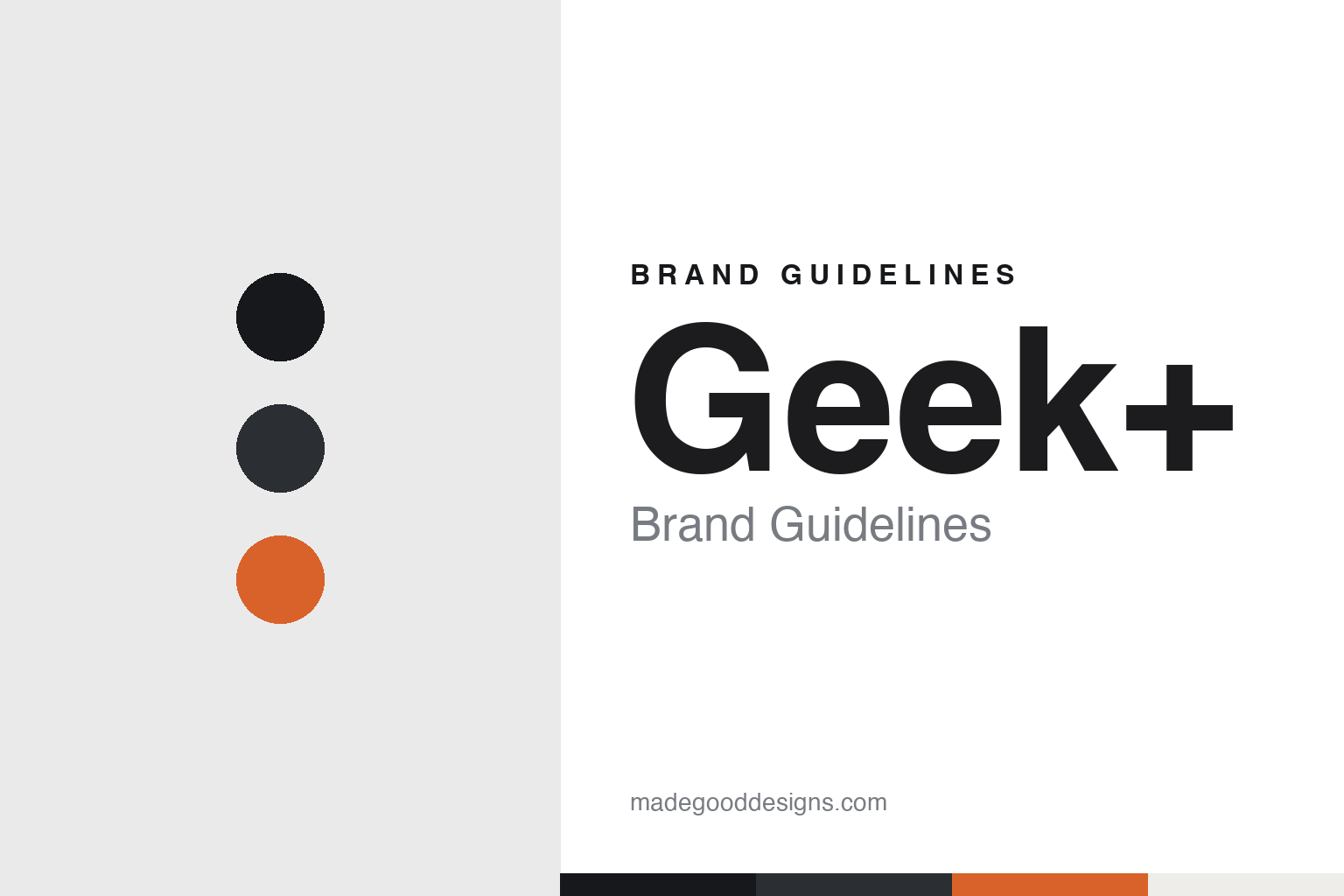
Geek+ Brand Guidelines
The Beijing warehouse-robot maker that listed in Hong Kong in 2025.
Aa
Two constants: a graphite and signal-orange palette and a geometric grotesque register. Abstract homage — not a Geek+ product or mark; no robot, logo or nameplate is reproduced.
A Tsinghua basement
Founded in Beijing in 2015.
Geek+ was founded in Beijing in February 2015 by Yong Zheng, English Wikipedia says; the company itself gives 2015 as its founding year. Its full name is Beijing Geekplus Technology, and it writes its name both as Geek+ and as Geekplus; English Wikipedia describes Geekplus as “branded as Geek+.”
The Asian tech publication KrASIA, writing in July 2025, traced the idea to 2014, when Zheng, then working at the investment firm New Horizon Capital, visited an Amazon warehouse and saw robots moving shelves in coordination. Finding no Chinese start-up doing similar work, he decided to build one. A Tsinghua University graduate, he had earlier worked at ABB and as a factory manager at a Saint-Gobain subsidiary. His co-founders, KrASIA reported, were Li Hongbo, a former Tsinghua professor who became chief technology officer, and, later, Liu Kai and Chen Xi; the company started in the basement of a building on the Tsinghua campus, and the founding team has stayed together since.
The first test came quickly. KrASIA reported that early investors asked the 20-person team to deliver a goods-to-person system in time for Singles’ Day, China’s big online shopping event, with fewer than three months and a single prototype, and that the first deployment, at a Tmall supermarket warehouse, served as a proof of concept. By 2016 it had signed contracts with several e-commerce platforms, and in 2017 it completed its first international project, in Japan, which KrASIA said made it one of China’s earliest exporters of AMRs. English Wikipedia, citing TechCrunch, says that by 2018 it had delivered more than 5,000 robots for around 100 warehouse projects in China and abroad.
Colour
Shelves, totes, pallets and sorting.
Geek+ makes autonomous mobile robots, or AMRs, for warehouses. Its first robots, English Wikipedia says, carried storage racks or goods to warehouse workers, a goods-to-person method. The range has since widened into shelf-to-person and tote-to-person systems, pallet handling, sorting and the movement of materials inside warehouses, Wikipedia says, citing the company’s 2025 listing prospectus. The company’s own timeline adds SkyCube and PopPick for high-density picking, robot arms for workstations and, most recently, a general-purpose humanoid robot called Gino 1.
Software is a large part of the offer. The company describes warehouse software that covers system design, fleet control and day-to-day execution, with links to customers’ ERP and WMS systems, and it says its scheduling software can coordinate thousands of robots in a single building.
Its customers are spread across e-commerce, retail, manufacturing and logistics. English Wikipedia, citing TechCrunch, lists Walmart, Nike, Dell and Decathlon among companies it has supplied. KrASIA reported that UPS had deployed more than 1,000 of its robots across both US coasts and that the US apparel distributor S&S Activewear had upgraded five fulfilment centres with Geek+ systems over three years. In 2020 Geek+ partnered with the warehouse integrator Conveyco to distribute its technology in North America, TechCrunch reported, according to Wikipedia.
Market rankings appear often in its material. China Insights Consultancy, cited in the listing documents, ranked Geek+ first among providers of warehouse-fulfilment AMR solutions for the sixth year in a row in 2024, English Wikipedia says; the company’s website cites the research firm Interact Analysis for a seventh consecutive year at the top of AMR market share.
Typography
How warehouse automation presents itself.
Warehouse automation is an industry that mostly sells to other businesses, and its companies present themselves through the machines they install. The images are familiar across the sector: a dense block of stacked storage bins with robots running across the top, a swarm of small mobile robots moving under or up tall racks, or long shuttle aisles feeding a line of conveyors and sorters inside a distribution centre.
Those images do a job that a product catalogue cannot. A storage grid or a robot fleet is usually built to fit one building, so the companies show finished sites, walk-through videos and case studies named after their customers. Many also describe themselves as software companies as much as machine builders, and show control-room screens and dashboards that track robots, orders and stock in real time.
Trade fairs are where the sector meets its buyers. LogiMAT in Germany, ProMat in the United States and CeMAT are among the logistics shows where makers build working demonstration systems on their stands, and where new robots and workstations are often launched. Many of the companies also sell through partners and system integrators, so the same system can appear under more than one name on a show floor.
This guide sets out what can be checked about each company — who founded it, who owns it, where it says its equipment is made, and what has happened to it — and marks clearly what rests only on the company’s own word. The palettes and typefaces shown are our own interpretation, not the companies’ official colours or logos.
Aa
A geometric grotesque for a robot maker. (Specimen set in Space Grotesk, a sans STAND-IN; NOT the Geek+ logo.)
Geek+
A Hong Kong listing in 2025.
The company went abroad early. KrASIA reported that it entered Germany and the United States in 2019, building local teams there. Its website now lists offices in the United States, Germany, the United Kingdom, Japan, South Korea, mainland China, Hong Kong and Singapore, says it has more than 1,000 employees, and says it works with partners including Microsoft and Intel. It crossed 10,000 robots sold in 2020, and by the end of 2024 had delivered 56,000, KrASIA reported; in June 2020 TechCrunch headlined a story on the company “the Amazon Kiva of China,” after the Kiva robots that, KrASIA notes, Amazon rebranded as Amazon Robotics in 2014.
On 9 July 2025 Geek+ listed on the Main Board of the Hong Kong Stock Exchange, under the stock code 2590. Hong Kong Science and Technology Parks (HKSTP), which counts Geek+ as a partner company, said that day that the offering was the largest H-share listing by a robotics company to date; Geek+ describes itself as the first publicly listed company in the AMR warehouse-robotics market. Zheng attended the listing ceremony as founder, chairman and chief executive, and told guests the listing gave the company “the twin engines of capital and technology,” according to the company’s release. HKSTP’s chief executive, Albert Wong, presented the listing as an example of a mainland company using Hong Kong as a base for going global. In February 2026, English Wikipedia says, citing the official China Xiong’an news site, Geek+ formally established its headquarters in the Xiong’an New Area in Hebei.
For a design guide, Geek+ shows how a technology company can grow from one goods-to-person robot into a family of named products, from PopPick and SkyCube to Gino 1, under one short name written both as Geek+ and as Geekplus. Compare HAI ROBOTICS, another Chinese warehouse-robot maker, and Locus Robotics, an American maker of autonomous mobile robots for warehouses. For this guide we use graphite, slate and a signal orange with a sans, an unofficial interpretation; no product or logo is reproduced.
Explore & save
Keep Geek+’s identity on hand — save it to a board in the Made Good inspiration library.
Geek+ identity set
Pin the Geek+ graphite and signal-orange palette and the geometric grotesque register to your own board.