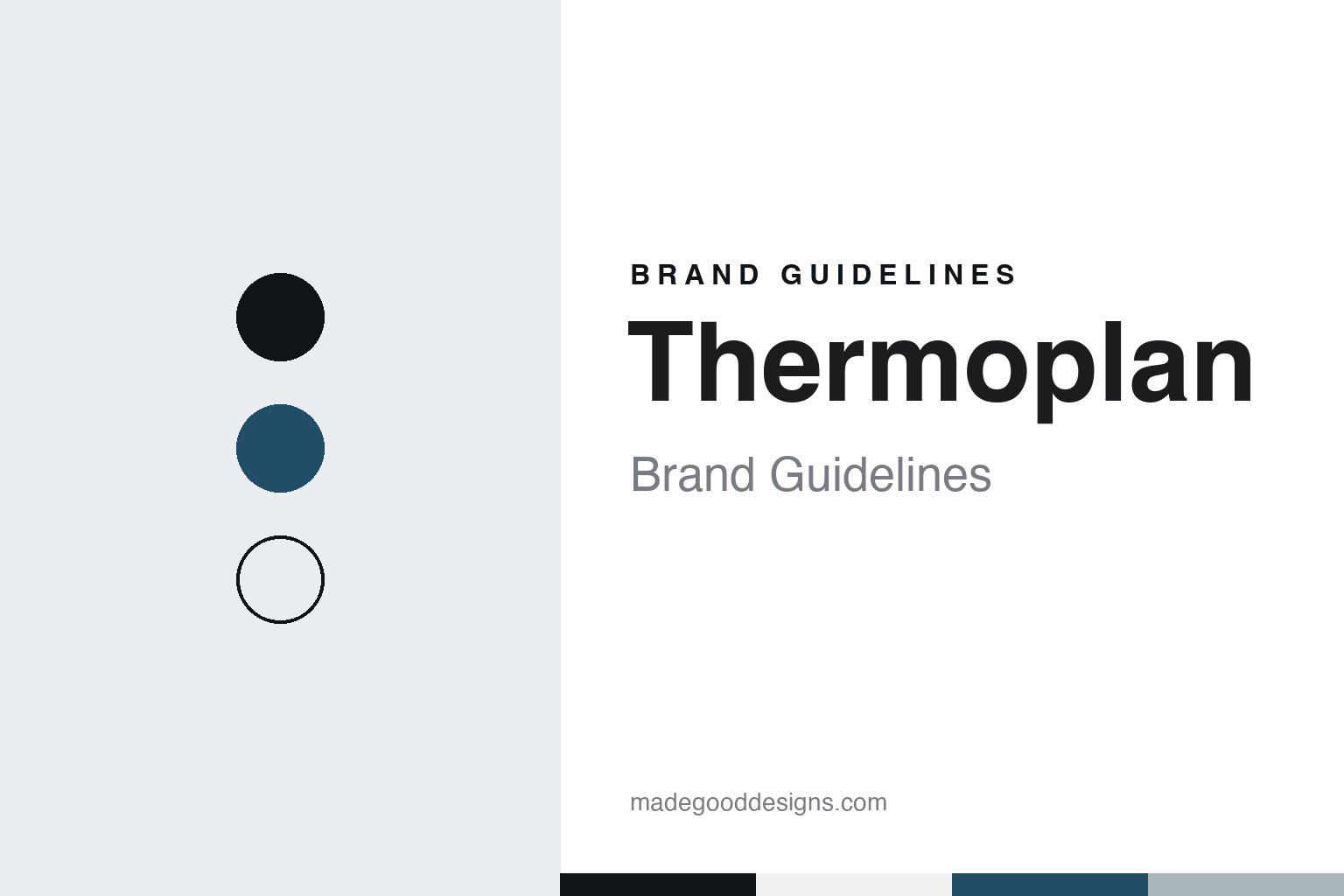
Thermoplan Brand Guidelines
The Weggis family firm behind Starbucks’s espresso machines.
Aa
Two constants: a black, white and lake blue palette and a geometric grotesque register. Abstract homage — not a Thermoplan product or mark; no machine, logo or nameplate is reproduced.
From cream to coffee
A couple, a cream whipper and a milk-foam machine.
Thermoplan was founded in 1974 by Domenic Steiner, and SWI swissinfo.ch described it in 2002 as the creation of Domenic and Esther Steiner, a couple who ran it as a 50-50 partnership. Sources give different first products. The 2002 SWI swissinfo.ch profile says Steiner set it up to make ventilation equipment for the restaurant trade; a 2024 SWI swissinfo.ch history says the company made automatic whipping-cream machines and milk frothers. Both agree on where it went next.
According to the 2002 profile, the turning point came in 1983, when the Steiners decided to focus on developing, making and selling specialty equipment for the food and beverage trade. The first product was a cream whipper, followed by a machine for milk foam, built so that restaurants could make the same cappuccino every time. Importers then asked for a coffee machine that would be just as easy to use and to maintain. Steiner had no experience of coffee machines, the profile says, and brought in Jean-Paul In-Albon, an engineer from the canton of Valais who had.
The result was a professional machine called the Black and White, which went into production in 1996, SWI swissinfo.ch reported in 2002; its 2024 history dates the company’s entry into coffee machines to 1995. In a 2014 Bloomberg report carried by SWI swissinfo.ch, the company was described as family-owned, based among the pastures of Weggis, a village of about 4,400 people near Lucerne. English Wikipedia says the headquarters are in Weggis, in the canton of Lucerne.
Colour
Starbucks, the Verismo and the Mastrena.
Thermoplan’s most widely reported customer is Starbucks. SWI swissinfo.ch reported in 2002 that the coffee-shop chain decided in 1998 to make its coffee with fully automatic machines, set up a team to look at manufacturers around the world, and, after a three-day visit to Weggis and a six-month trial of ten Thermoplan machines in Vancouver, chose Thermoplan from three finalists. Domenic Steiner pointed to the machine’s build from four modular components, which can be swapped quickly if one fails. The contract began in 1999, when, Bloomberg reported, Thermoplan had just 20 employees.
Starbucks, Bloomberg reported, was replacing traditional espresso machines, which need baristas to prepare the grounds and steam the milk, with automatic ones. English Wikipedia describes the Verismo 801 as a machine made only for Starbucks until 2008, later sold commercially as the Black and White CTS2. Its successor, the Mastrena, which Thermoplan makes only for Starbucks, was introduced in 2008, Bloomberg reported; a Starbucks spokeswoman said its reduced height encouraged baristas to connect with customers. SWI swissinfo.ch said in 2024 that Thermoplan had developed and produced two generations, Mastrena I and II, at its Weggis headquarters, and quoted chief executive Adrian Steiner saying the partnership had played a major part in the company’s success.
Starbucks is not the only customer. Bloomberg named Nestlé, Google and Costa Coffee among other clients in 2014, and English Wikipedia says McDonald’s and IKEA began using Thermoplan equipment in 2004. Under its own name the company sells the Black&White line, which now includes the Black&White4; English Wikipedia also describes a lower-volume model, the Tiger, distributed in the United States by Bunn. English Wikipedia, citing the company’s timeline, says Thermoplan received an innovation award from the Central Swiss Chamber of Commerce in 2004.
Typography
Machines for counters, buffets and offices.
Commercial coffee machine makers sell mainly to businesses rather than to homes. Their customers are hotel groups, coffee-shop chains, office caterers and restaurants, and their products sit on hotel breakfast buffets, office counters, convenience-store shelves and behind café bars. Some build fully automatic machines that grind, dose, brew and froth milk at the touch of a screen; others build large batch brewers that fill urns and airpots for a busy service.
Much of the trade grew from a practical problem. SWI swissinfo.ch reported in 2024 that Swiss restaurants in the 1970s faced higher wage costs and fewer staff behind the buffet, and the historian Jonathan Morris told the publication that Swiss automatic machines set out to make coffee and milk drinks simpler for staff without barista training. Switzerland remains a centre of that business, with makers in Weggis, Zuchwil and elsewhere.
The machines now present themselves through screens and options as much as through steel. In 2025 TOP HOTEL Projects described one fully automatic model offered with touchscreens of two sizes, modes for staff service, self-service and office use, and interchangeable panels in a customer’s chosen colour. Milk systems, cleaning routines and service networks also feature in how these makers describe what they offer.
Launches tend to happen at trade fairs rather than in shops. HOST Milano, the hospitality fair held in Milan, is one such stage; specialty-coffee events such as World of Coffee are another. This guide sets out what can be checked about each maker — who founded it, who owns it, and what it says about where its machines are made — and marks clearly what rests only on the company’s own word.
Aa
A geometric grotesque for a machine maker on Lake Lucerne. (Specimen set in Space Grotesk, a sans STAND-IN; NOT the Thermoplan logo.)
Thermoplan
Made in Weggis, sold almost entirely abroad.
Independence has been part of the story from the start. In 2002 Domenic Steiner told SWI swissinfo.ch that he had founded the company on three principles: take no outside money so as to stay independent, treat staff and customers as part of the family, and do not grow so big that he could not know every employee by name. It then had 85 employees. In 2014 Bloomberg reported that a stock-market listing was not planned, though Adrian Steiner did not rule one out, and quoted him calling fully automatic machines “something very German and Swiss.”
Thermoplan has kept its production at home. Bloomberg reported in 2014 that it built its machines in four halls a short walk from Lake Lucerne, that assembling one, mostly by hand, took six to eight hours, and that every machine had to brew 100 cups before leaving the factory. Adrian Steiner, an electrical engineer, was chief executive; the company then had 230 employees, 40 of them in research and development and 140 in production.
The site has grown since. On 22 June 2024 Thermoplan opened a new production and office building at its Weggis headquarters after nearly 960 days of construction, the Lucerne business-promotion agency reported; Adrian Steiner cut the ribbon with the founding couple, and about 5,000 visitors came to the open day. The agency said more than 500 people work at the headquarters. The company says all of its fully automatic machines are made in Weggis and that about 80 percent of their components are also made in Switzerland. In its 50th-anniversary year, SWI swissinfo.ch reported, Thermoplan exported 98 percent of its machines to more than 80 countries.
For a design guide, Thermoplan shows how a supplier can shape a famous chain’s counter while its own name stays mostly behind the scenes. Compare Schaerer, another Swiss maker of fully automatic machines, and Eversys. For this guide we use black, white and a lake blue with a sans, an unofficial interpretation; no product or logo is reproduced.
Explore & save
Keep Thermoplan’s identity on hand — save it to a board in the Made Good inspiration library.
Thermoplan identity set
Pin the Thermoplan black, white and lake blue palette and the geometric grotesque register to your own board.