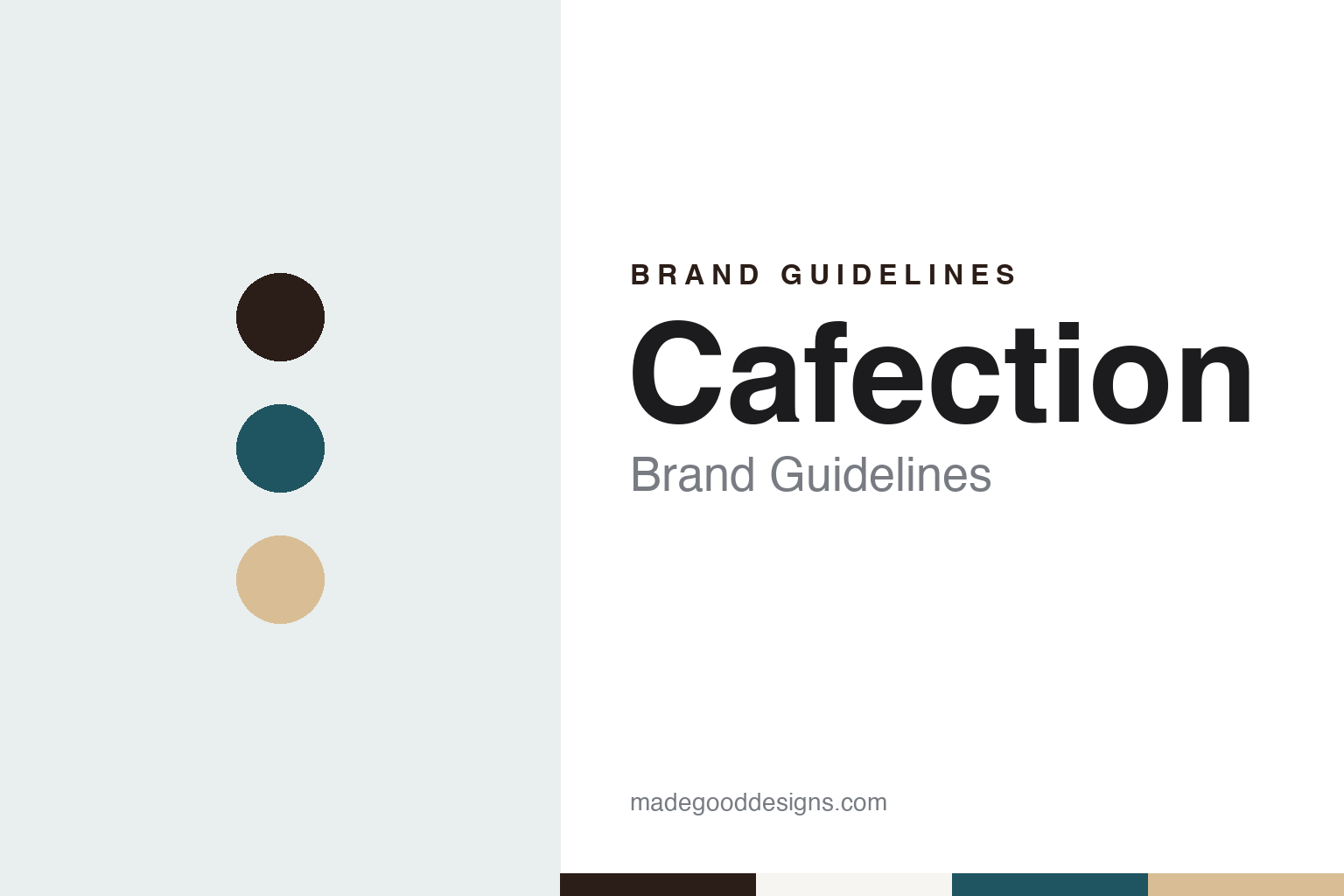
Cafection Brand Guidelines
Quebec City’s bean-to-cup brewer, now part of Evoca.
Aa
Two constants: a Cafection roast, teal and crema palette and a friendly geometric sans register. Abstract homage — not a Cafection product or mark; no brewer, logo or screen is reproduced.
Quebec City, 1996
A coffee-service family that built its own brewer.
Cafection began in Quebec City in 1996. English Wikipedia, citing the Journal de Montréal in 2012, says that Yves Baron and his wife, after decades in the coffee business, started making their own bean-to-cup coffee brewers that year, and that in 2011 they sold the company to their son. Evoca North America, the business Cafection later became part of, describes the start the same way: a small family business created in 1996.
Bean-to-cup means the machine grinds whole beans and brews each cup to order, rather than holding a pot. Cafection built these machines mainly for the office coffee service trade, in which operators place and maintain brewers in workplaces. A 2018 company announcement called Cafection “North America’s largest bean-to-cup brewer manufacturer” and the leading maker of such machines for that market; those are the company’s own descriptions. English Wikipedia adds that in February 2013 the Quebec City Chamber of Commerce named Cafection business of the year at its Fidéides awards.
Trade reports in 2018 call the business Cafection Enterprises, and by 2022 its corporate name was Cafection Ventures Inc. Its headquarters stayed in Quebec City: Evoca North America, as the company is now called, gives Quebec City as its head office and describes itself as a manufacturer and distributor of professional coffee machines. It says its brewers are made for settings from break rooms and convenience stores to restaurants, micro-markets, hotels and bakeries.
Colour
Touchscreens, French press and a web dashboard.
Evoca North America says Cafection’s machines use a French press technology to brew freshly ground coffee for each cup, with a choice of up to three coffee blends and three soluble powders; among the drinks it names are cappuccino, café latte and mokaccino.
The brand has leaned on screens and software. Evoca North America says Cafection introduced the Total 1 in 2011 and calls it the world’s first machine equipped with a touchscreen; in 2012, it says, came a connected machine that could be managed remotely through an online platform called Sophia. Those “firsts” are the company’s claims. A March 2018 announcement, reported by Vending Times, described Sophia as a web application that lets operators set up and monitor machines remotely and customise the videos and coffee labels shown on screen, and introduced a renewed Encore 29 alongside the Innovation Series brewers. In 2020, the company says, it added touchless ordering by smartphone.
The current range, as Evoca North America lists it, includes the Total 1, the Symbol, the Emblem and several Encore models. It describes the Symbol as a modular brewer with a separate burr grinder for each bean hopper, and the Emblem as a 30-inch-high machine with an 18.5-inch touchscreen whose interface and lights can be set in 30 colours. Its product pages list UL and CSA certification for these models and NSF/ANSI 4 certification for the Emblem.
Typography
The category.
Commercial coffee machine makers sell mainly to businesses rather than to homes. Their customers are hotel groups, coffee-shop chains, office caterers and restaurants, and their products sit on hotel breakfast buffets, office counters, convenience-store shelves and behind café bars. Some build fully automatic machines that grind, dose, brew and froth milk at the touch of a screen; others build large batch brewers that fill urns and airpots for a busy service.
Much of the trade grew from a practical problem. SWI swissinfo.ch reported in 2024 that Swiss restaurants in the 1970s faced higher wage costs and fewer staff behind the buffet, and the historian Jonathan Morris told the publication that Swiss automatic machines set out to make coffee and milk drinks simpler for staff without barista training. Switzerland remains a centre of that business, with makers in Weggis, Zuchwil and elsewhere.
The machines now present themselves through screens and options as much as through steel. In 2025 TOP HOTEL Projects described one fully automatic model offered with touchscreens of two sizes, modes for staff service, self-service and office use, and interchangeable panels in a customer’s chosen colour. Milk systems, cleaning routines and service networks also feature in how these makers describe what they offer.
Launches tend to happen at trade fairs rather than in shops. HOST Milano, the hospitality fair held in Milan, is one such stage; specialty-coffee events such as World of Coffee are another. This guide sets out what can be checked about each maker — who founded it, who owns it, and what it says about where its machines are made — and marks clearly what rests only on the company’s own word.
Aa
A friendly geometric sans for a touchscreen brewer. (Specimen set in DM Sans, a sans STAND-IN; NOT the Cafection logo.)
Cafection
From family firm to an Italian group’s North American arm.
Cafection did not stay independent. A March 2018 announcement, reported by Vending Times and VendingMarketWatch, said that in June 2017 Cafection and Evoca Group, the coffee-machine maker based in Valbrembo near Bergamo in Italy, had entered a joint venture to make and sell coffee machines for the North American office market. Evoca’s own group history lists the step as its acquisition of Cafection, while Evoca North America calls it a merger.
The link widened Cafection’s range. Through Evoca, the 2018 announcement said, Cafection became the official distributor and service provider for Saeco’s professional coffee machines in the United States, and showed Wittenborg and Saeco machines next to its own, among them the Krea Touch, a machine for both espresso and fresh-brewed coffee with a 7-inch screen. The same announcement said Evoca had just bought the assets of VE Global Solutions, its North American distributor in Cleveland, and set up a US affiliate, Evoca USA. Vending Times reported in November 2022 that Evoca’s North American business had added four brands since 2018: Gaggia Milano, Saeco, Necta and Wittenborg.
In November 2022 the company itself changed name. Vending Times and Comunicaffè reported that Cafection Ventures Inc. had become Evoca North America Venture Inc., to represent the Evoca Group in North America, and moved to a new website launched that October. Comunicaffè quoted Denis Belleau, chief executive of Evoca North America, on the sales and technical teams the company had built for both office coffee and foodservice customers. Cafection did not disappear as a name: in 2022 Evoca North America described a portfolio of five brands including Cafection, its website keeps a Cafection brand page, and Evoca Group lists Cafection among its brands alongside Gaggia, Necta, Saeco and Wittenborg.
For a design guide, Cafection shows how a machine brand can grow from a family firm into one name in a group’s portfolio, with touchscreens and remote-management software at the centre of how it describes its machines. Compare Wittenborg, a sister brand in the Evoca group, and Franke, another maker of automatic coffee machines. For this guide we use a dark roast brown, a teal and a crema beige with a sans, an unofficial interpretation; no product or logo is reproduced.
Explore & save
Keep Cafection’s identity on hand — save it to a board in the Made Good inspiration library.
Cafection identity set
Pin the Cafection roast, teal and crema palette and the friendly geometric sans register to your own board.