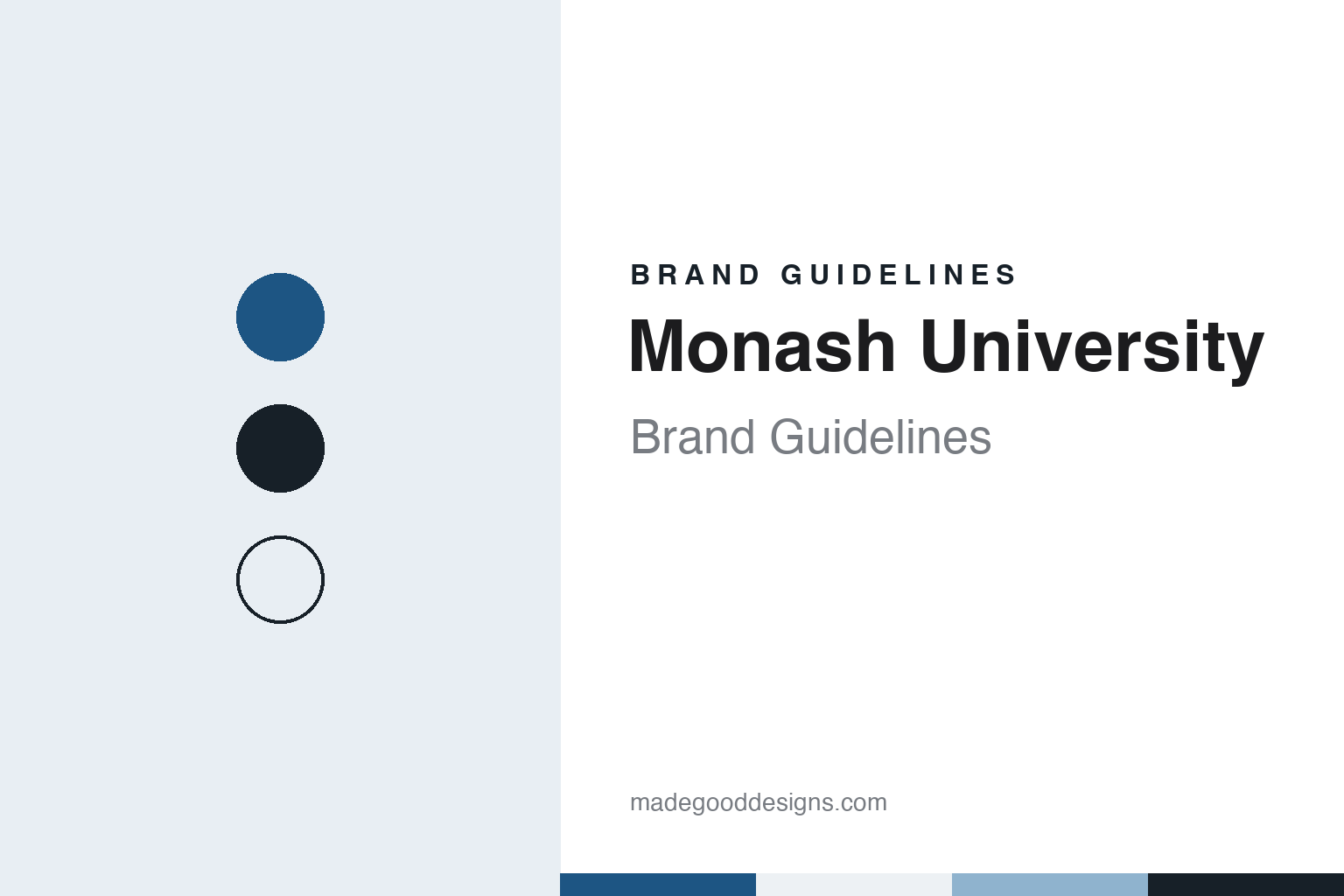
Monash University Brand Guidelines
A general’s name, a Michelangelo motto and a campus that became a network.
Aa
Two constants: a blue and near-black palette and a direct sans register. Abstract homage — not a Monash University mark; no crest, logo or shield is reproduced.
A university with a person’s name
Victoria’s second university.
Monash University was created by the parliament of Victoria through the Monash University Act 1958; English Wikipedia gives the date as 30 May 1958 and ties the decision to the Murray Report, commissioned in 1957 by Prime Minister Sir Robert Menzies. It was the state’s second university.
The name was unusual. Wikipedia says this was the first time an Australian university had been named after a person rather than a city or state. Sir John Monash is remembered as a First World War general, but his own degrees came from the University of Melbourne, where he was vice-chancellor from 1923 to 1931, and he ran Victoria’s State Electricity Commission from 1920 to 1931.
The motto is Ancora imparo, Italian for “I am still learning,” a saying attributed to Michelangelo. The university had no old traditions to draw on: Wikipedia says Monash’s youth let it adopt modern approaches without resistance, and that it set up Australia’s first research centres and scholarships devoted to Indigenous Australians.
The site was farmland at Clayton, in Melbourne’s south-east, granted at 100 or 115 hectares by different Wikipedia accounts; the campus is now put at about 110. The first chancellor was Sir Robert Blackwood, and the first vice-chancellor, Sir Louis Matheson, a British professor of engineering, served until 1976. The first students arrived in March 1961, numbered at 347 or 357 in the same two pages, and more than 21,000 had enrolled by 1967.
Its early public reputation came from protest. From the mid-1960s to the early 1970s Monash was the centre of student radicalism in Australia, Wikipedia says, with mass demonstrations over the Vietnam War and conscription; a meeting in May 1969 drew more than 6,000 people. The same account says many people first heard of Monash because of its protests.
Colour
One name across many sites.
Monash’s shape changed with the Dawkins reforms of the late 1980s. In 1988 it had one campus and about 15,000 students. Just over a decade later, Wikipedia says, it had eight campuses, including two overseas, a European centre and more than 50,000 students. Mergers began in 1990 with the Chisholm Institute of Technology and the Gippsland Institute of Advanced Education, and in 1991 the Victorian College of Pharmacy joined as a new faculty.
The name then went abroad. A campus opened at Bandar Sunway in Malaysia in 1998, and in 2001 a campus opened in Johannesburg while the university secured an 18th-century palace in Prato, Italy, for a research and teaching centre. Wikipedia calls the Malaysian and South African sites the first foreign universities in those countries. An academy with the Indian Institute of Technology Bombay opened in 2008, and an Indonesian campus at BSD City, Tangerang, opened in October 2021.
Some of that map has been redrawn. Gippsland passed to Federation University Australia from January 2014, the Berwick campus followed, and in 2019 the South African campus was sold to Advtech. Wikipedia now lists four Victorian campuses: Clayton, Caulfield, Peninsula and Parkville. It gives 86,558 students for 2023, and Times Higher Education called Monash Australia’s biggest university in April 2023.
Clayton carries the architectural record. The circular Religious Centre, designed by John Mockridge and completed in 1968, has stained glass by Les Kossatz and Leonard French and joined the Victorian Heritage Register in December 2008. Robert Blackwood Hall was designed by Sir Roy Grounds. The art collection began in 1961, when Matheson created a fund to buy work by living Australian artists; it became the Monash University Museum of Art, based at Caulfield since 2010 and alongside the university’s Faculty of Art, Design & Architecture.
Typography
Campus, broadcast and prospectus.
Universities founded after 1950 could not borrow a medieval past, so their identities had to come from somewhere else. In Britain the buildings came first. The writer Michael Beloff chose the word “plateglass” for the new universities of the 1960s, for their modern design and wide expanses of glass in steel or concrete frames, and he wrote of the “grey or biscuit concrete massiveness” of most of their buildings and “the black towers of Essex.” The term set them apart from the Victorian redbrick universities and the ancient ones.
The marks followed a similar line, keeping the idea of a crest while simplifying it. Grafik described the Open University’s 1969 logo as a U with a crest-like structure and a punched-out O, respectful of heraldry while looking ahead. In 2022, campaign material said the same shield had become the starting point for a design system built with accessibility in mind.
Some of these universities reached the public through broadcast before most people could see a campus. The BBC dates the first Open University programme to 3 January 1971, on BBC Two, with academics as presenters and an animated logo and fanfare at the start. That late-night teaching ended in 2006. Monash University’s early fame in Australia came by a different route: Wikipedia says many people first heard of it through its student protests.
This guide follows these universities onto the surfaces where they meet the public: prospectus covers, banners on open days, degree certificates and national campaigns. For each one, it sets out what can be checked about the founding, the name and the identity, and it says who is making each claim, including when the claim comes from the university itself.
Aa
A direct sans for a university that writes its slogans as instructions. (Specimen set in Archivo, a sans STAND-IN; NOT the Monash University logo.)
Monash University
Change It.
The public voice of the modern university is Change It, a brand platform developed with the agency now called VML. In February 2024 B&T and The Stable reported that Monash had reappointed VML after a competitive pitch, with the university’s marketing chief citing seven years of partnership, and had added paid media and social strategy to the account.
The work is written as a challenge. In May 2022 the campaign asked “Is the next generation endangered?”, fronted by babies born on 1 January 2020 and launched with a front-page wrap of The Age, B&T reported, around themes of health, habitat, inequality and trust. In July 2025 Mediaweek and Mumbrella reported the next phase, Momentum Now, made with VML and Wavemaker, which looked back to the 1958 founding. Wikipedia gives the university’s colours as blue and black.
That message has been tested by a long dispute over pay. In April 2023 Times Higher Education reported the National Tertiary Education Union’s claim that casual academics were being underpaid for student consultations, and Monash’s position that it wanted to resolve an ambiguity in its enterprise agreement. The Fair Work Commission refused the university’s attempt to vary that agreement in June 2023, and its full bench upheld the refusal, Times Higher Education reported that October. In July 2025 HR Leader reported a Federal Court finding that Monash had breached workplace law. In December 2025 Human Resources Director reported that Monash had entered an enforceable undertaking with the Fair Work Ombudsman and would repay 10,877 current and former employees for work between January 2014 and January 2025.
For a design guide, Monash University shows a name doing the work of a place: one general’s surname has travelled across campuses, countries and campaigns while the sites beneath it changed. Compare University of Melbourne, the older university in the same city, and Deakin University, another Victorian university. For this guide we use a mid blue and a near-black with a sans, an unofficial interpretation; no product or logo is reproduced.
Explore & save
Keep Monash University’s identity on hand — save it to a board in the Made Good inspiration library.
Monash University identity set
Pin the blue and near-black palette and the direct sans register to your own board.