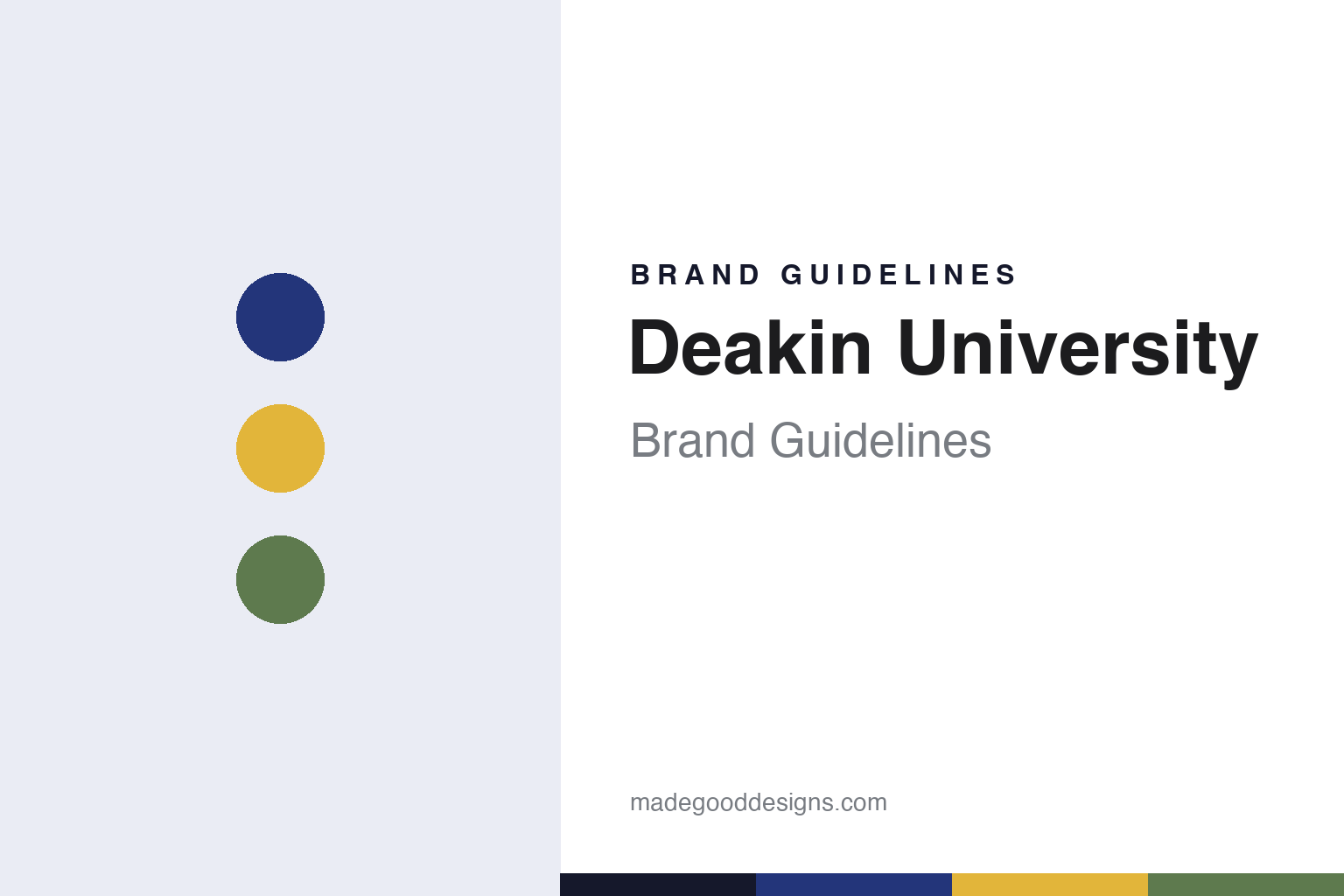
Deakin University Brand Guidelines
A university for Geelong that taught students off campus.
Aa
Two constants: a blue, gold and green palette and a bold grotesque register. Abstract homage — not a Deakin University mark; no shield, logo or crest is reproduced.
The fourth university
A Geelong campaign and a name from a shortlist.
Deakin University was a political project before it was a campus. Its own history site says that Victoria had added Monash in 1958 and La Trobe in 1964 to the University of Melbourne, and that a fourth university was debated through the 1960s and 1970s. A Geelong University Committee formed in 1957 and became the University for Geelong Committee in 1961; one member, the Geelong College principal Peter Thwaites, later became the first chancellor.
The state’s Ramsay Committee recommended in 1972 a site in Melbourne’s east. That ran against a mood for decentralisation in both state and federal governments, and the Whitlam government, elected that December, saw a fourth university as part of its own decentralisation policy. In February 1974 a federal cabinet committee chose Geelong. The education minister, Kim Beazley, announced that the university would absorb the Gordon, as the Gordon Institute of Technology was known, and the State College of Victoria at Geelong, and that the Gordon’s new campus at Waurn Ponds would be the site. Royal Assent to the university’s establishment followed on 10 December 1974.
The name came from a list. In mid-1974, the history site says, the interim council settled on historical figures with some link to the area and chose Alfred Deakin, a leader of the federation movement and Australia’s second Prime Minister, who served three terms between 1903 and 1910. The education minister, Lindsay Thompson, agreed, and the university was named in September 1974.
The roots are older than that. The history site lists antecedents reaching back to the Gordon Technical College of 1887, the Warrnambool Technical School of 1913 and Mercer House of 1921. Its archive says the higher-education courses of the Gordon and its Waurn Ponds site, together with the Geelong State College, merged to create Deakin on 1 April 1976. The vocational side of the Gordon, English Wikipedia says, carries on separately. The first students arrived in April 1977, at a campus set in farmland on the edge of Geelong, a 2019 post from Deakin’s archives says; a 1982 photograph it describes shows cattle drawn to the courtyard’s ornamental pool.
Deakin’s 50-year site acknowledges Wadawurrung, Eastern Maar and Wurundjeri Country as the lands of its campuses.
Colour
The Open University model, in Victoria.
Deakin’s reputation was built on students who were not there. Its history site says the first vice-chancellor, Fred Jevons, spent five months in Britain looking for ideas before taking up the post and found them at the Open University, whose vice-chancellor, Walter Perry, contributed to the planning of Deakin’s programmes. The first off-campus students came in 1978: 1,250 enrolments, about 300 of them from the Geelong region. A 2021 archive post says they were especially popular with country women, many of them mature-age, and that “the housewife from Wycheproof” was the archetype units were written for.
The model had a material culture of its own. Weekend schools brought isolated students together, “access centres” offered videos, cassettes and slides, and the library sent books to students within 48 hours of a request, the archive says, dispatching nearly 1,500 items in 1978. Deakin says it was the first Australian university to adopt an off-campus MBA and that the University of Strathclyde then did the same in Britain; in 1991, it says, off-campus students could attend virtual tutorials for the first time in Australia. The history site quotes the Good Universities Guide of 1994 calling Deakin “the most creative and adventurous distance education provider.”
The university’s visual history sits in the same archive, which holds logos for Deakin and for the colleges it absorbed. The earliest Deakin mark there, dated about 1978, is a dark blue shield with a yellow triangle edged in white. A version dated about 1990 keeps the blue shield and the triangle, now broken into diagonal black bars, with “DEAKIN” in heavy capitals above and “UNIVERSITY” curving around the base. The archive also holds a 40th-anniversary logo.
One closely documented piece of design came from a predecessor. In 1954 Max Dimmack, an art lecturer and foundation teacher at Burwood Teachers’ College, on the site of today’s Melbourne campus, designed the college emblem: an abstracted Tree of Knowledge, a sun for enlightenment, the founding date and the motto Animum Cultum Parabo, in tan, light green and lemon. His sketches survive in the archive, and a 2020 post says the design was agreed by the student body and appeared on badges and blazers.
Later brand work has come through campaigns. In May 2025 B&T reported a new campaign, “See the Wonderful Possible,” by SICKDOGWOLFMAN, for television, cinema, social, digital and outdoor. Campaign Brief reported that Deakin’s marketing team describes “Wonderful Possibility” as the university’s brand essence, and in December 2025 Mediaweek reported “Together,” a philanthropic platform by Three Scoops built on the same phrase.
Typography
How newer universities look.
Universities founded after 1950 could not borrow a medieval past, so their identities had to come from somewhere else. In Britain the buildings came first. The writer Michael Beloff chose the word “plateglass” for the new universities of the 1960s, for their modern design and wide expanses of glass in steel or concrete frames, and he wrote of the “grey or biscuit concrete massiveness” of most of their buildings and “the black towers of Essex.” The term set them apart from the Victorian redbrick universities and the ancient ones.
The marks followed a similar line, keeping the idea of a crest while simplifying it. Grafik described the Open University’s 1969 logo as a U with a crest-like structure and a punched-out O, respectful of heraldry while looking ahead. In 2022, campaign material said the same shield had become the starting point for a design system built with accessibility in mind.
Some of these universities reached the public through broadcast before most people could see a campus. The BBC dates the first Open University programme to 3 January 1971, on BBC Two, with academics as presenters and an animated logo and fanfare at the start. That late-night teaching ended in 2006. Monash University’s early fame in Australia came by a different route: Wikipedia says many people first heard of it through its student protests.
This guide follows these universities onto the surfaces where they meet the public: prospectus covers, banners on open days, degree certificates and national campaigns. For each one, it sets out what can be checked about the founding, the name and the identity, and it says who is making each claim, including when the claim comes from the university itself.
Aa
A heavy capital sans, as on the shield of about 1990. (Specimen set in Archivo, a sans STAND-IN; NOT the Deakin University logo.)
Deakin University
Mergers, woolstores and a difficult June.
The university that exists today was made by the mergers of the 1990s. In June 1989, Deakin’s archives say, more than 3,000 students and staff were reported to have gathered to oppose a plan for a state university joining Deakin with the colleges of Ballarat, Bendigo and Warrnambool. The plan fell away, but the federal Dawkins reforms required mergers. The Warrnambool Institute of Advanced Education joined in 1990 and became a campus.
The larger change was Victoria College, with its campuses at Rusden, Prahran, Toorak and Burwood. The merger was enacted on 31 December 1991, after a dispute the history site sets out in detail: Monash voiced its own interest, the state’s post-secondary commission opposed the merger, arguing that Deakin should keep a regional focus, and Prahran went to Swinburne. Deakin’s historians say the merger transformed the university in size, complexity, culture and geography and gave it a presence in Melbourne.
English Wikipedia describes the result. The largest campus is Burwood, on the site of the teachers’ college, followed by Waurn Ponds. In Geelong’s centre, the Waterfront campus occupies the Dalgety’s woolstores of 1893 on Corio Bay, and the Warrnambool campus stands on the Hopkins River. A School of Medicine opened at Waurn Ponds in 2008. Deakin’s 50-year site gives its alumni as about 350,000.
June 2026 was what the Geelong Times called a tumultuous fortnight for the university. On 9 June the vice-chancellor resigned with immediate effect, days after a proposed restructure. The Geelong Times reported that the National Tertiary Education Union put the possible job losses at 140 and that the chancellor’s statement gave no reason. On 18 June, the Geelong Times reported, staff were told the plan would not proceed, with an apology for the uncertainty and a warning that change would still be needed in time.
For a design guide, Deakin University shows how a university built on off-campus study can move its weight from a shield to a phrase carried across campaigns. Compare The Open University, whose model Deakin’s first vice-chancellor studied, and Monash University, the Victorian neighbour that came before it. For this guide we use blue, gold and green with a sans, an unofficial interpretation; no product or logo is reproduced.
Explore & save
Keep Deakin University’s identity on hand — save it to a board in the Made Good inspiration library.
Deakin University identity set
Pin the Deakin University blue, gold and green palette and the bold grotesque register to your own board.