Arrow Dynamics Brand Guidelines
The machine shop behind the tubular steel coaster, closed since 2002.
Aa
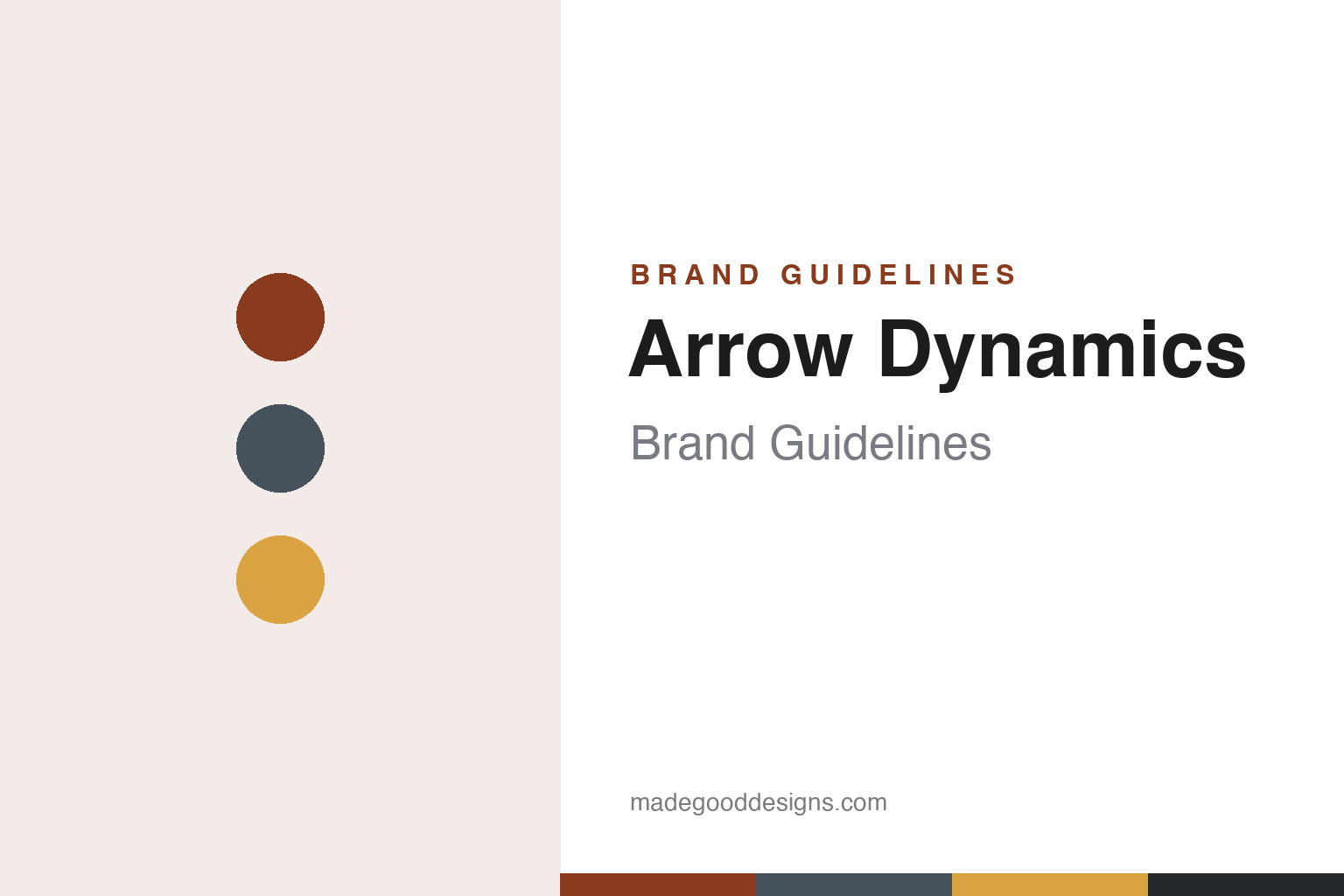
Two constants: a primer red and track steel palette and a condensed engineering sans register. Abstract homage — not an Arrow Dynamics product or mark; no ride, logo or nameplate is reproduced.
Arrow Development
A machine shop in Mountain View.
Arrow Dynamics no longer exists. The Utah company filed for Chapter 11 bankruptcy on 3 December 2001, and a court approved the sale of what remained to S&S Power in October 2002, the Deseret News reported. The name itself lasted only sixteen years, but the business behind it was older, and its story begins with a California machine shop.
That shop was Arrow Development, in Mountain View. The Mountain View Voice, in a local history piece of July 2002, said Ed Morgan and Karl Bacon formed it in 1946. English Wikipedia’s article on Arrow Development gives a fuller and slightly earlier account: incorporation in California on 16 November 1945, with four founders, Angus “Andy” Anderson, Karl Bacon, William Hardiman and Edgar Morgan. It says the four met at the Hendy Iron Works in Sunnyvale, which built torpedo launchers and marine engines under wartime US Navy contracts, and that a labour dispute there in 1943 gave Bacon and Morgan the idea of starting their own firm. By 1956 Hardiman and Anderson had sold their shares to Walter Schulze, the same article says.
The early work was general engineering. English Wikipedia says Arrow sold used machine tools, made replacement truck parts and built test furnaces for the US Navy before it became known locally for carousels and small rides.
Disney changed its scale. In 1953, the Voice reported, Walt Disney contacted the company about the park that became Disneyland, and Arrow helped design and build the ride systems for Mad Tea Party, the carousel, Mr. Toad’s Wild Ride and Snow White’s Adventures, then the Casey Jr. train, Dumbo and Autopia. The rides were tested in Mountain View and shipped to Anaheim for the opening.
The turning point was the Matterhorn Bobsleds at Disneyland in 1959, which the Voice called the first modern steel tube roller coaster. English Wikipedia says tubular track gave a smoother ride than the railroad-style rails used on earlier wooden coasters. Disney then bought a third of the company, in 1960 according to English Wikipedia, and Arrow moved to a larger plant in Mountain View. English Wikipedia lists the “bobsled amusement ride” patent, granted in December 1963 to Bacon and Morgan and assigned to Disney. Robert R. Reynolds’ book Roller Coasters, Flumes and Flying Saucers, cited by the Voice, covers those years.
Colour
Flumes, loops and corkscrews.
Arrow’s later work for Disney included vehicles and track for It’s a Small World, Pirates of the Caribbean and the Haunted Mansion, but it was already selling elsewhere. English Wikipedia credits it with the modern log flume, beginning with El Aserradero at Six Flags Over Texas in 1963, with more than 50 installed. Ron Toomer, an engineer hired in 1965, worked on the Run-A-Way Mine Train at the same park and later ran the company’s engineering; English Wikipedia credits him with 93 coasters.
In the 1970s, the Voice reported, Arrow brought the loop back to roller coasters. English Wikipedia’s milestones include the Corkscrew at Knott’s Berry Farm in 1975, as the first modern inverting coaster, and interlocking loops at Loch Ness Monster at Busch Gardens Williamsburg in 1978. Its 1979 catalogue, the same source says, listed more than 200 rides at nearly 100 locations, among them 43 flumes and 15 corkscrews.
Ownership moved often. Bacon, Morgan and Schulze sold Arrow to Rio Grande Industries, in 1971 or 1972 according to different English Wikipedia articles. Arrow opened a manufacturing plant at the Freeport Center in Clearfield, Utah, in 1977, and by 1980 had left Mountain View. In late 1981 the German firm Huss bought it, forming Arrow Huss. English Wikipedia links Arrow Huss’s financial trouble partly to investments in Darien Lake and the 1984 Louisiana World Exposition, and dates its bankruptcy to 1984 or 1985.
Thirteen of the company’s American officers, Toomer among them, negotiated a buyout, and the business became Arrow Dynamics in January 1986. By that time, English Wikipedia says, none of the original founders had a financial or managerial interest in the company. Toomer served as president until 1993.
The Dutch manufacturer Vekoma enters the story around this period: English Wikipedia says Arrow taught it to build tubular track in return for European distribution, and dates this to the late 1970s in one article and the mid-1980s in another.
The big rides kept coming. Magnum XL-200 opened at Cedar Point in 1989, which English Wikipedia lists as the first hypercoaster, and The Big One opened at Blackpool Pleasure Beach in 1994, listed by the same source as the world’s tallest coaster at the time.
Typography
Track, flumes and the trade floor.
Ride makers sell to parks rather than to the public. The park usually names and themes the ride, and the maker’s own identity sits further back, in the engineering. That shapes how these firms present themselves.
The factory floor is usually the first picture. Long curved lengths of steel track, jigs, welded supports and finished trains waiting for shipment do the work of a product shot, because a coaster cannot be photographed whole until it stands in a park. Alongside them come CAD renderings, which let a maker show a layout, a station or a new train to a buyer long before any steel is cut.
The trade stand is the second stage. IAAPA Expo, the industry’s large annual show, is where makers put full-size vehicles and scale models in front of park owners, announce new models and compete for the show’s product awards. Company websites tend to follow the same logic, leading with reference lists and record claims rather than with a founder’s story.
The third stage belongs to the ride itself. On-ride films, shot from the front seat and released by parks and makers, are a common way to show a layout to people who will never see the drawings, and a park’s opening day puts the finished work in public view. This guide sets out who founded each firm, who owns it and where its work is made, and it attributes every claim to its source. Colours and typefaces here are our own interpretation, not the companies’ standards.
Aa
A condensed engineering sans — the register of a drawing office. (Specimen set in Barlow Condensed, a sans STAND-IN; NOT the Arrow Dynamics logo.)
Arrow Dynamics
The end of the line, in 2001 and 2002.
Bookings fell in the late 1990s, according to English Wikipedia, which cites RollerCoaster! magazine, as other manufacturers took a larger share of the market.
The last big project was X at Six Flags Magic Mountain, a coaster with seats that rotate independently of the train, designed by Alan Schilke. It opened on 12 January 2002 and was Arrow’s final coaster installation, English Wikipedia says. Company president Fred Bolingbroke told the Deseret News in January 2002 that Arrow had lost money on the ride, and that he had realised in July 2001 the loss would run into the millions. The Las Vegas Sun, in April 2002, quoted his account to the Associated Press that Arrow had misjudged the cost of building X. Bolingbroke also said the September 2001 attacks had made the industry wary of investing in new rides.
One of the company’s last projects was not a ride. The Deseret News reported that Arrow spent about 18 months on the structural engineering of the caldron for the 2002 Winter Olympics in Salt Lake City, designed by Wet Design. Bolingbroke said the firm held off filing for bankruptcy until that work was finished, and that there was no connection between the two.
The end came in stages. The filing was made in the US Bankruptcy Court in Salt Lake City on 3 December 2001. By April 2002, the Las Vegas Sun reported, Arrow’s controller said the company no longer built its rides and would only design them, as part of its reorganisation. In late October 2002 a bankruptcy judge approved the sale to S&S Power of Logan, Utah, in a deal that also settled claims by Six Flags, the Deseret News reported. S&S chief executive Stan Checketts said he bought it out of nostalgia, and that he planned to keep most of the remaining 20 employees and would probably move manufacturing to Logan.
The name carried on for a time as S&S Arrow, a limited liability company set up to buy the assets. English Wikipedia says that it was not legally a successor to Arrow Dynamics, and that the remainder of the old company was dissolved. In November 2012 Sansei of Osaka acquired 77.3% of S&S; in 2018 it also acquired Vekoma, the firm Arrow had once taught to build track.
The visual record is thin. English Wikipedia shows an Arrow Huss logo dated 1981 to 1985 and an Arrow Dynamics logo dated 1986 to 2000. What survives best is the rides, and the tubular track they made common.
For a design guide, Arrow Dynamics shows how a name can stand for a technique more than a company: three firms and two bankruptcies sat behind one word and one kind of steel track. Compare Intamin, another steel coaster maker of the period, and Cedar Point, home of Magnum XL-200. For this guide we use a primer red and a track steel with a sans, an unofficial interpretation; no product or logo is reproduced.
Explore & save
Keep Arrow Dynamics’s identity on hand — save it to a board in the Made Good inspiration library.
Arrow Dynamics identity set
Pin the Arrow Dynamics primer red and track steel palette and the condensed engineering sans register to your own board.