ABI Brand Guidelines
The Niedernberg family firm behind MOBILRAM and DELMAG.
Aa
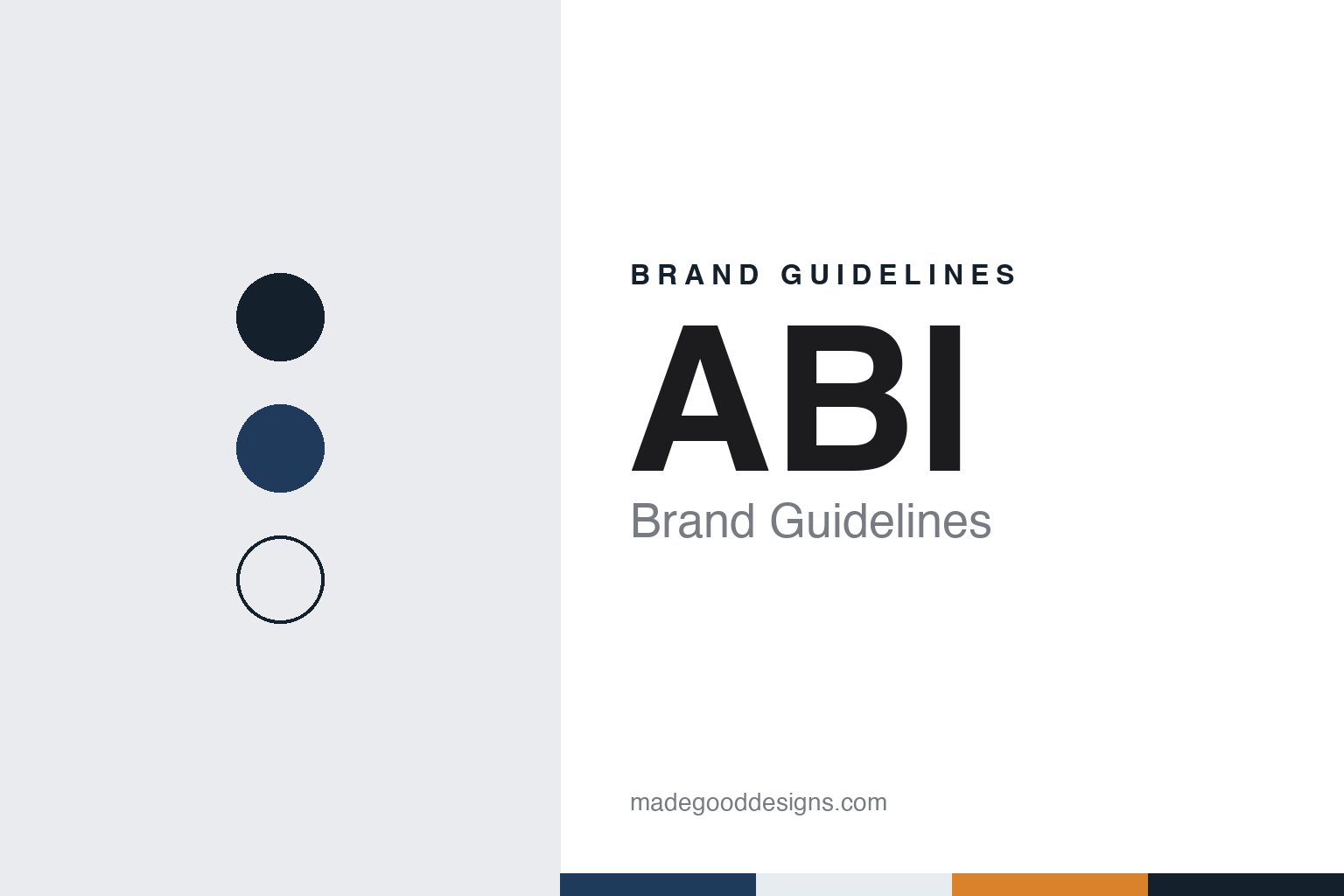
Two constants: an ABI mast blue and site orange palette and an Engineering sans register. Abstract homage — not an ABI product or mark; no machine, logo or nameplate is reproduced.
From Babenhausen to Niedernberg
A sales company, then a machine works.
ABI began as a sales company. Its own history says Alfred Heichel founded the ABI Vertriebsgesellschaft mbH in Babenhausen, in southern Hesse, in 1974, and that a year later it showed its first leader rig, the ABI MOBILRAM RE 7500. The company calls that machine the most important starting point for its future, something, it adds, nobody could have known at the time.
The manufacturing side followed. In 1979, the company says, it founded the ABI Maschinenfabrik GmbH and moved to Niedernberg, a town on the Main near Aschaffenburg in Lower Franconia, with about 30 employees. It added a second hall to its works in 1982, and in 1988 the sales company and the machine works were merged. The group trades today as ABI Maschinenfabrik und Vertriebsgesellschaft mbH, and the company also uses the name “ABI Gruppe” for the group.
It has stayed a family business. The company says Christian Heichel joined the family firm in 1985, and in January 2025 the carrier maker SENNEBOGEN described him as a shareholder of ABI and called ABI “a medium-sized family business” that had grown since 1974 to more than 250 employees. ABI’s own website gives a figure of about 290 and says the MOBILRAM systems and the DELMAG drilling rigs are both built in Niedernberg.
ABI works in what German calls Spezialtiefbau, specialist foundation engineering: driving and pulling sheet piles, installing piles and drilling for foundations. Its products are leader rigs, vibrators and attachments rather than the tracked carriers they sit on.
Colour
MOBILRAM on a SENNEBOGEN carrier.
The MOBILRAM is a partnership product. In a press release of 24 January 2025, SENNEBOGEN, the Straubing maker of cranes and material handlers, said its cooperation with ABI began in 1984 and produced its first joint solutions in 1985. SENNEBOGEN carriers of that period, the SR19T, SR20T, SR26T and SR28T, were completed by ABI with a leader and attachments to form the MOBILRAM systems, it said. The two companies marked forty years of cooperation in November 2024, and SENNEBOGEN handed over a wooden model of an ABI MOBILRAM TM 17 to mark the occasion.
ABI’s history traces the range through trade fairs. At bauma 2010 in Munich it showed the TM 22, which it calls a new generation of leader; at bauma 2013 it showed the TM 17; and at bauma 2022 it presented the TM 13 Hybrid and the TM 26, which it calls its largest telescopic leader. In 2004, the company says, it introduced a driving method it calls directional vibration, which was honoured as an innovation at the Deutscher Baumaschinentag held during bauma. In 2009 it showed a third generation of vibrators, the MRZV-VV, at an open house in Niedernberg, and in 2012 it presented a drive system called the Efficiency Drive.
The group has also grown by buying brands. In 2003, ABI says, it bought the BANUT brand rights and machine range from Sweden, fixed leaders and hydraulic free-fall hammers, and moved production to Niedernberg. In 2009 it took over the INTEROC brand, and in 2017 it bought shares in the Swedish firm SPD Scandinavian Pile Driving AB. It founded a British subsidiary, ABI Equipment Ltd, in 2008.
Typography
Design and documentation.
Piling and foundation rig makers sell machines that do most of their work out of sight, below ground, so their pictures tend to show what stands above it. The common image is a tall mast rising over a building site, often framed against a city skyline or a half-finished bridge, with the rig itself on crawler tracks in mud, gravel or sand. The height of the mast gives the photograph its shape, and the model code painted on it is often the largest lettering in the frame.
A second set of images is about tools. Augers, drilling buckets, casings, grabs and cutter wheels are laid out in rows or shown close up, clean and freshly painted, so that the parts that will disappear into the ground can be seen at all. Vibratory hammers, clamps and power packs are photographed the same way, as objects on their own, before they are lifted by a crane.
Trade fairs matter in this category. The bauma show in Munich is where makers stage large stands, with rigs raised to full height under the hall roof or on the open-air grounds, and where new models, electric versions and anniversaries are announced. Stand design, banners and the colour of the machines themselves are part of how a maker is recognised there.
Many of these companies also carry a family or founder’s name, or grew out of a contractor’s own workshop, and their histories are told through dates, places and model numbers rather than slogans. For this series we look at how each maker presents that history, using an unofficial palette and a stand-in typeface, and reproducing no machine, logo or nameplate.
Aa
An engineering sans — ABI in capitals. (Specimen set in Archivo, a sans STAND-IN; NOT the ABI logo.)
ABI
DELMAG, from Esslingen to Niedernberg.
ABI’s largest purchase was DELMAG, the Esslingen maker of drilling rigs and diesel pile hammers. German Wikipedia, citing the reports of the insolvency administrator Volker Grub and the Esslinger Zeitung, says Delmag applied for court composition proceedings in May 1998 and that bankruptcy proceedings opened on 1 July 1998. The administrator kept the drilling and piling department running, and on 1 February 2000 sold it, with the DELMAG name and mark, the Esslingen works and 53 remaining employees, to ABI. Delmag’s soil-compaction department had been sold separately in 1998 to a new company, Delko.
ABI kept DELMAG as a brand. In 2002, the company says, Matthias Heichel was appointed managing director of the DELMAG subsidiary, and in 2008 ABI began building its own carriers for DELMAG rotary drilling rigs; at bauma 2010 it showed the DELMAG RHV 40 on its own T121D carrier, and in 2013 the RH 24. The Esslingen site did not last. ABI closed it on 30 September 2018, when 35 people still worked there, citing strongly fluctuating orders, the Esslinger Zeitung reported in March 2018, and production moved entirely to Niedernberg. ABI still sells DELMAG diesel hammers alongside its MOBILRAM rigs, excavator attachments and the SPD and Interoc lines.
On where its machines are made, ABI says its MOBILRAM systems and DELMAG rigs are built in Niedernberg, where it opened a new welding shop in 2019 and expanded its machining in 2021, and German Wikipedia says DELMAG production has been fully in Niedernberg since the Esslingen closure. Its official website is abi-group.com; the company has also used the abi-gmbh name in its domains and email.
For a design guide, ABI shows a family firm that presents two names side by side, its own and the older DELMAG mark it bought. Compare Junttan, the Finnish piling-rig maker, and Klemm Bohrtechnik, another German drilling specialist. For this guide we use a mast blue and a site orange with a sans, an unofficial interpretation; no product or logo is reproduced.
Explore & save
Keep ABI’s identity on hand — save it to a board in the Made Good inspiration library.
ABI identity set
Pin the ABI mast blue and site orange palette and the Engineering sans register to your own board.