KME Brand Guidelines
From a 1946 garage in coal country to steel aerials.
Aa
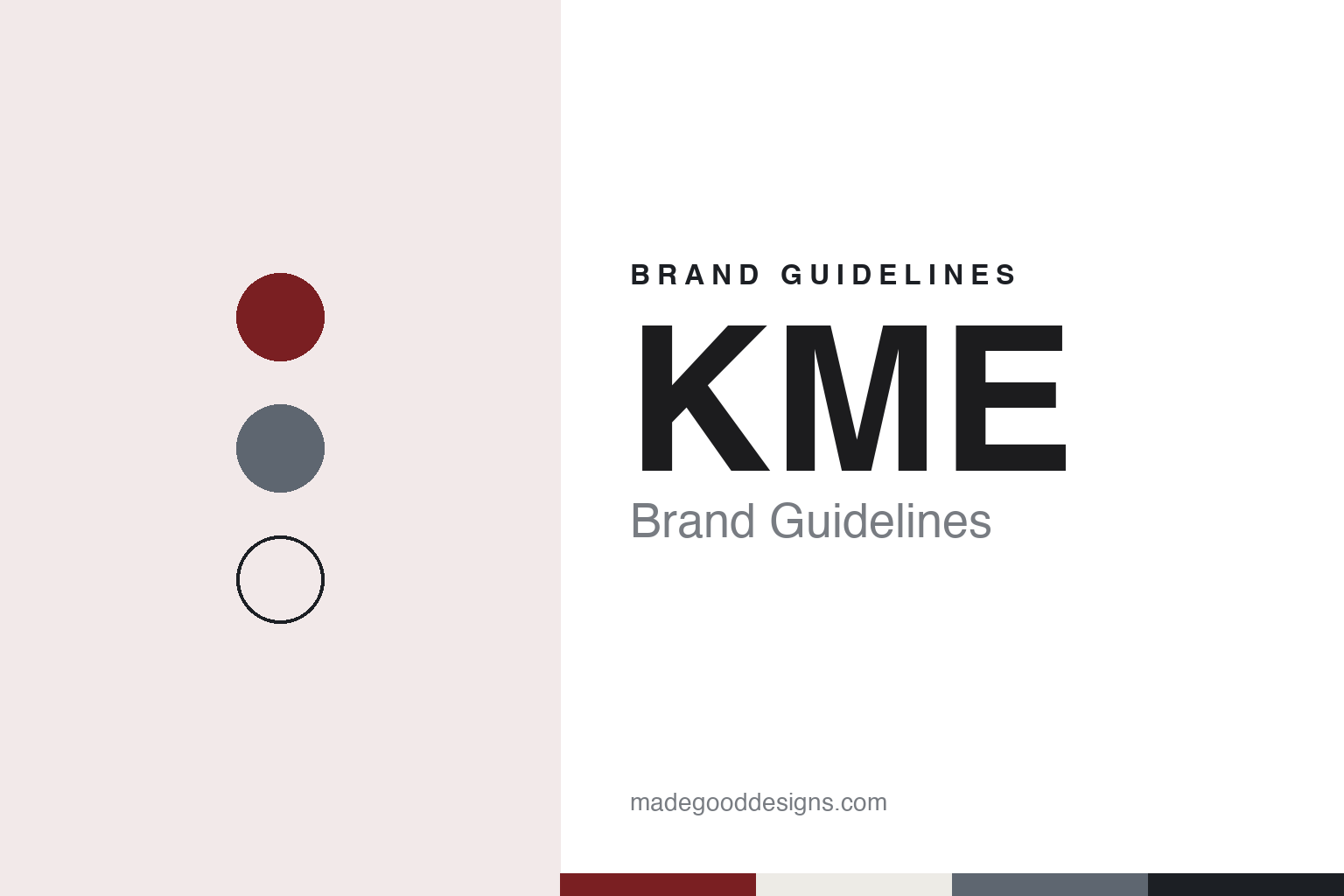
Two constants: a KME oxblood, steel and white palette and a condensed industrial sans register. Abstract homage — not a KME product or mark; no vehicle, logo or lettering is reproduced.
Kovatch Mobile Equipment
A garage, refuelling trucks and a turn to fire engines.
KME stands for Kovatch Mobile Equipment. The Times News of Lehighton, Pennsylvania, reported in September 2021 that founder John “Sonny” Kovatch built the company from a garage he opened in 1946, and that Kovatch Mobile Equipment first produced aircraft refuelling trucks for the military before going into the fire truck business in the 1980s. KME itself gives 1946 as its founding year. A second Times News report, in April 2022, dated the founding of the fire truck company, as Kovatch Mobile Equipment Inc., to the mid-1980s, so the dates depend on whether the garage or the fire truck business is counted as the start.
The company grew up in Nesquehoning, in Carbon County, in the anthracite coal country of eastern Pennsylvania. The Times News called its trucks arguably the county’s second-best-known export after anthracite, and described KME as once the country’s largest family-owned fire truck maker. At its height the Nesquehoning plant employed about 800 people, most of them from Carbon and Schuylkill counties, and many stayed for decades; in 2022 the paper reported an average of 19 years’ service among the remaining workforce.
The work was custom. The Times News described trucks built from start to finish at Nesquehoning to each customer’s specification, in a labour-intensive process where every order needed its own problem solving rather than repeated tasks on an assembly line. KME fire trucks went to the military and to many of the largest fire departments in the United States, the paper reported, naming Los Angeles, New York City and Philadelphia.
Colour
Steel aerials, severe service and its own cabs.
KME describes itself today as making a full line of custom fire apparatus, specialising in steel aerials, tractor-drawn aerials and what it calls severe-service applications. It sells to municipal and federal fire services and to the wildland and urban interface market, the company says, and builds bodies in aluminium, stainless steel and galvanised steel to each department’s order. English Wikipedia adds that the KME name has also covered aviation, petrochemical, industrial and military vehicles.
The aerial line centres on what KME calls its AerialCat ladder, built from Domex steel with a truss structure that uses square rather than round extrusions, which the company says allows longer welds around each joint. A bolt-on system it calls EZ-MRS is meant to make the ladder easier to maintain, and a Flex-Form body pairs formed metal walls with an extruded subframe to enlarge the compartments, KME says.
KME also builds its own cabs and chassis. The Predator and Panther custom chassis are the long-running names, alongside the SSX, offered in 96-inch and 100-inch cab widths for large fleets, and the FC-94, an all-aluminium cab 94 inches wide for pumpers, tankers and rescues. English Wikipedia notes that KME also bodies commercial chassis, among them Mack, Ford, International and Kenworth. At FDIC International in Indianapolis in April 2026 the company showed three trucks, including a severe-service aerial and pumpers, according to its own announcement, which pitched them on craftsmanship and customisation. The Terex Fire Group, of which KME is now a part, hosted a product showcase and its own pavilion at the same show, with product walk-arounds and interviews.
Typography
How fire apparatus makers present themselves.
Fire apparatus makers sell to a small and particular set of customers: city fire departments, volunteer brigades, airports and industrial plants. Their pictures of themselves tend to look alike. Finished vehicles stand in rows outside the works in red, in lime-yellow or in white, depending on what each fire service orders, with roller doors open to show how the equipment is stowed.
The turntable ladder is the set piece. At demonstrations and open days, a ladder or an aerial platform is raised high beside a building or over an empty yard, often with a crew in the basket. Cabs carry chrome, reflective striping and the customer’s own crest and lettering, so a maker’s name can be small on the vehicle itself and much larger on its brochures, websites and service vans.
Handovers are a genre of their own. A new engine is driven out and photographed with its crew and local officials. At the FLORIAN 2026 fair in Dresden, Magirus handed three new engines to the city’s volunteer fire brigades and ran live demonstrations of turntable-ladder work, according to its own news page.
Trade fairs set the calendar. One of them is Interschutz in Hanover, and Magirus invited visitors to its stand there from 1 to 6 June 2026. Some of the makers go back to the age of horse-drawn ladders and hand pumps; others began in the late twentieth century as equipment dealers and repair shops before building vehicles of their own. This guide looks at each maker in turn: who founded it, who owns it now, where it says its vehicles are built, and which claims rest only on the company’s own word.
Aa
A condensed industrial sans for steel and lettering. (Specimen set in Barlow Condensed, a sans STAND-IN; NOT the KME logo.)
REV, Holden and Terex
From a family firm to a corporate fire group.
The Kovatch family sold KME to REV Group in 2016, the Times News reported; English Wikipedia dates the purchase to April of that year. REV, the paper noted, owns several fire truck makers. KME production continued at Nesquehoning under REV for several more years. In September 2021 REV announced that it would stop production at KME’s plants in Nesquehoning and in Roanoke, Virginia, in April 2022, with new orders shifted to its other fire apparatus facilities; more than 350 people then worked at the Nesquehoning site, the paper said.
The last shift at Nesquehoning came on 1 April 2022. The final vehicle was a 109-foot rear-mount ladder truck for the Lehighton Fire Department, so the last Nesquehoning truck stayed in Carbon County; one worker called it the “last real KME.” About 90 workers finished on that final day, REV said staff had been offered the option to relocate, and the Times News put the plant’s lifetime output at more than 10,000 fire trucks. REV said it would keep building KME trucks at a facility in Louisiana that also produces other brands, and KME’s own 2026 announcements are datelined Holden, Louisiana.
Ownership changed again in 2026. On 2 February 2026 Terex Corporation announced that it had completed its merger with REV Group, whose shares then stopped trading, according to a release on PR Newswire. KME now describes itself as part of Terex Corporation’s Specialty Vehicles segment, and its FDIC 2026 announcement directed visitors to the Terex Fire Group pavilion.
For a design guide, KME shows how a family company’s initials can outlast the family sale and the plant that made it. Compare E-ONE, another fire apparatus brand that came under REV Group, and Sutphen, a family-owned maker that stayed independent. For this guide we use a deep oxblood, gunmetal and steel grey with a condensed sans, an unofficial interpretation; no product or logo is reproduced.
Explore & save
Keep KME’s identity on hand — save it to a board in the Made Good inspiration library.
KME identity set
Pin the KME oxblood, steel and white palette and the condensed industrial sans register to your own board.