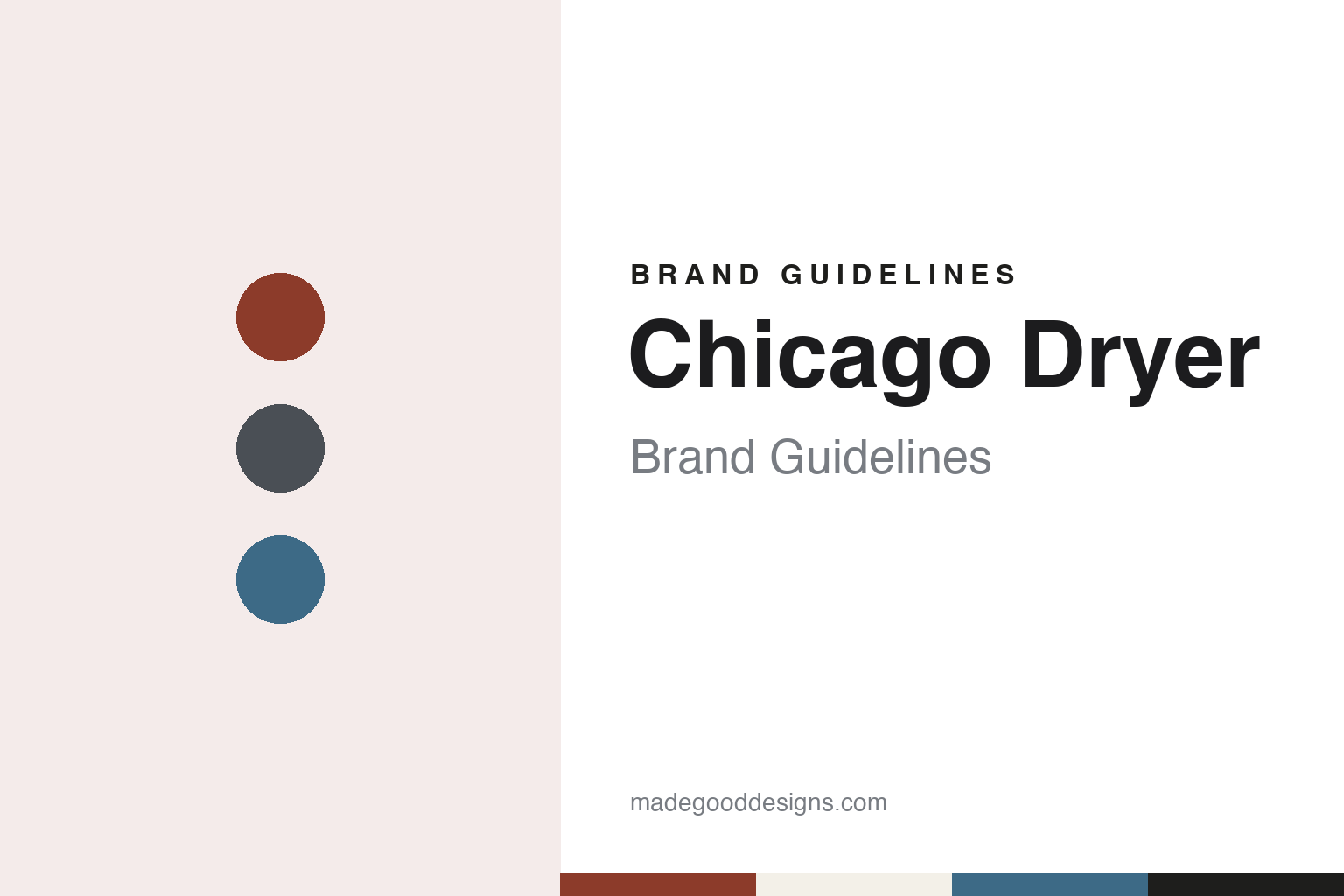
Chicago Dryer Brand Guidelines
The Chicago company that does only the clean side of laundry.
Aa
Two constants: a brick, iron grey and lake blue palette and a condensed sans register. Abstract homage — not a Chicago Dryer product or mark; no machine, logo or nameplate is reproduced.
Cabinet dryers and wooden washers
A Chicago company with a World’s Fair story.
The Chicago Dryer Company tells its own beginnings through a world’s fair. On its website the company says that when its Chicago products first appeared at the 1893 Chicago World’s Fair, the World’s Columbian Exposition, it sold cabinet dryers and wooden washers. It gives no founding year or founder on its pages, and describes itself as having been in the business for more than 100 years. The trade paper Laundry & Cleaning News used the same phrase, “more than 100 years,” in a June 2005 preview of the company’s show stand.
In the company’s account, the range widened before it narrowed. After the cabinet dryers and wooden washers it built copper and steel washers, dryers and accessories, so that a complete laundry could be fitted out with Chicago machines. Then, as demand for more productive equipment grew after the Second World War, it says, it chose to concentrate on flatwork finishing alone: the separating, feeding, ironing and folding of sheets, pillowcases and table linen once they have been washed.
The business is still based in Chicago. The company describes itself as family-owned and operated, designing and manufacturing its equipment in the United States, and says the same focus has carried it “across four generations.” It does not name the family on its website. The trade press names its leadership: American Laundry News identified Bruce Johnson as president of Chicago Dryer Co. in October 2014, and he represented the company at a joint dealer awards event in 2025.
Colour
Separating, feeding, ironing, folding.
Flatwork finishing is the last stage of a commercial laundry, and Chicago Dryer’s whole catalogue sits there. The company says it designs and builds systems to separate, feed, dry and iron, and fold washed sheets, pillowcases and table linen, and also tumble-dried towels, blankets, patient gowns and scrubs. It says it is one of the few makers that build flatwork finishing equipment exclusively, and that it has hundreds of models and configurations, for laundries handling a few hundred pounds of linen a week up to millions of pounds a day.
Each stage has its own product family. At the start of the line, the Cascade and Sort-All machines pull tangled sheets apart; the company says it was the first U.S. company to automate that job, once done by hand. Next come the Edge and King Edge spreader-feeders, which spread a sheet flat and feed it into an ironer; the company says its patented cornerless technology finds the corners electronically. The ironers run from small machines through the mid-range Laser series to the Imperial series and multi-roll modular ironers, with gas, steam and electric models. Folders for large and small pieces, including the Air Chicago and Skyline series, complete the line, and the catalogue also has a combination category.
The show stand has long been where the brand is seen. Laundry & Cleaning News reported in 2005 that Chicago would again have one of the largest stands given only to flatwork finishing, with live demonstrations of the Edge Maxx dual-input cornerless feeder, the Century deep-chest ironer, gas, steam and electric Laser Line ironers, and Skyline and Air Chicago folders. Its exhibitor page for Clean 2022 in Atlanta listed a booth and the same family-owned description, and its news page features the machines it showed at Clean 2025 in Orlando, among them the Comet, the Versa and the SoloFeed with Tri-Star, as well as its CHI•Touch controls.
The company’s industry pages list the places its machines work: commercial laundries for hospitals and hotels, on-premises laundries in hotels, nursing homes and health clubs, prisons, schools, airlines, cruise ships, restaurants, country clubs and party rental firms. It sells through authorised distributors, searchable by U.S. zip code or by country on its website.
Typography
Machines for the clean side and the soiled side.
Commercial laundry equipment is sold to two quite different worlds. At one end are laundromats, hotels and restaurants, where a row of stainless-steel washer-extractors and tumble dryers sits in plain view of customers and staff; at the other are industrial laundries, closed factories that wash for hospitals, hotels, airlines, cruise ships and workwear services. Girbau, for example, divides its business into commercial, self-service and industrial laundries, while Kannegiesser lists healthcare, hospitality and workwear among the uses for its machines.
In the industrial plants the machines become a production line. Soiled linen is sorted, carried on overhead monorails, washed in tunnel washers that move batches from chamber to chamber, then fed into flatwork ironers and folders or, for garments, steamed in tunnel finishers. Kannegiesser presents its range in exactly these terms, as one system from sorting to stacking, and in 2022 added a camera-guided robot that feeds towels into a folding machine.
For smaller customers the brand lives on the machine itself: the stainless front, the porthole door and the control panel. Girbau, for one, also sells a remote monitoring system called Sapphire. Makers speak a shared language of capacity and of water, energy and chemical use, and name their certifications and sustainability programmes prominently; the claims behind them are the makers’ own.
Many of these names remain family firms rooted in particular towns. Girbau grew from a workshop in Vic, in Catalonia, and Kannegiesser from a shed near Vlotho, in East Westphalia; Kannegiesser’s partner Montanari is a family business in Modena, in northern Italy. Several now build close to their customers abroad, as Girbau did when it opened a plant in Oshkosh, Wisconsin, in 2025. This guide sets out what can be checked about each maker — founding, ownership and where it builds — and marks clearly what rests on the company’s own word.
Aa
A tall condensed sans for a plain, machine-plate register. (Specimen set in Barlow Condensed, a sans STAND-IN; NOT the Chicago Dryer logo.)
Chicago Dryer
One city name, one stage of the laundry.
The brand leans on a single word. Its machines are sold as Chicago®, the website refers to the company simply as Chicago, and its own web address shortens the name further, to chidry.com. Its website opens with the line “You’re not done until you cross the finish line.” The company describes its line as the widest range of separating, feeding, ironing, folding and linen handling equipment in the world; that is its own description.
Chicago Dryer also works alongside a neighbour in the trade. American Laundry News reported in October 2014 that the Synergy Group, then Pellerin Milnor, Chicago Dryer and American Dryer, held a biennial sales meeting in Nashville, where dealers toured a hotel laundry using Milnor PulseFlow equipment and two Chicago ironers. In October 2025 the paper described the Synergy Group as the two manufacturers Milnor and Chicago Dryer, gathering their North American dealers in Orlando ahead of the 2025 Clean Show for a day of sales meetings and a dealer awards banquet.
The two companies cover different stages of the same process: Milnor builds washers, tunnel washers and dryers, and Chicago Dryer builds the feeders, ironers and folders that come after them. The trade press names separate leaders for each, with Jim Pellerin at Milnor and Bruce Johnson at Chicago Dryer.
For a design guide, Chicago Dryer shows how a company can make one stage of a process its entire identity and carry its city’s name as the brand. Compare Milnor, its partner in the Synergy dealer group, and JENSEN, another maker of laundry finishing lines. For this guide we use a brick red, an iron grey and a lake blue on pressed-linen white with a condensed sans, an unofficial interpretation; no product or logo is reproduced.
Explore & save
Keep Chicago Dryer’s identity on hand — save it to a board in the Made Good inspiration library.
Chicago Dryer identity set
Pin the Chicago Dryer brick, iron grey and lake blue palette and the condensed sans register to your own board.