Nilpeter Brand Guidelines
The 1919 Copenhagen machine shop behind Slagelse’s label presses.
Aa
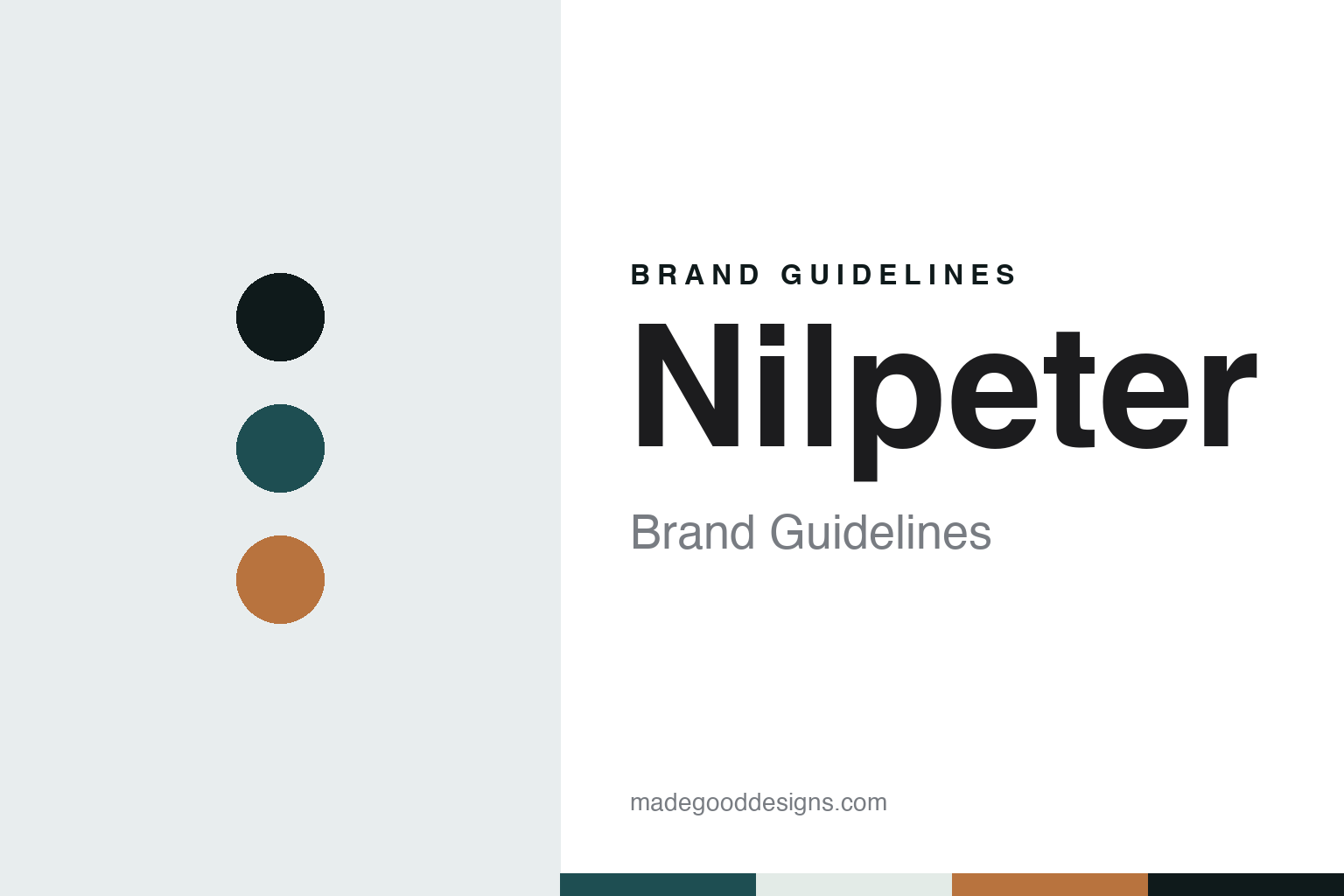
Two constants: a Nilpeter deep teal, sage and copper palette and a Plain grotesque register. Abstract homage — not a Nilpeter product or mark; no press, logo or nameplate is reproduced.
Nielsen and Petersen
Two founders, one joined name.
Nilpeter began in Copenhagen in 1919. Danish Wikipedia names its founders as C.A. Nielsen and A.N. Petersen and the first firm as C.A. Nielsen & Petersens Maskinfabrik; FLEXO, the magazine of the Flexographic Technical Association, gave them in a centenary profile in 2019 as Christian Nielsen and Axel Petersen, who met in a Copenhagen pub. The brand name joins the two surnames — “Nil-Peter,” as a 2019 industry tribute republished by the label association FINAT put it.
The workshop started by servicing newspaper printing machines in central Copenhagen. Its first press, the Simplex, followed in 1924, according to the FLEXO profile and the company’s centenary announcement, while Danish Wikipedia places the first press in the 1930s; in various versions the Simplex stayed in the range until the 1970s. In the 1940s and 1950s, FLEXO’s timeline says, the Simplex was relaunched as a semi-rotary letterpress for printing tickets, and a second press, the Viking Dominator, was developed and sold.
The turn toward labels followed the arrival of self-adhesive materials, the company said in 2019. In the 1960s and 1970s production moved to Slagelse, outside Copenhagen, and an international sales organisation was set up, FLEXO reports; the company introduced the S-330, a combined letterpress and screen machine, and the Rotolabel F-200, which the magazine calls its first full rotary flexo press. A new manufacturing plant followed in the 1980s, known, the magazine says, for a production hall with no interior walls and no closed offices, and in 1992 all activities were centralised in Slagelse. In between, the Rotolabel B-200 letterpress of the 1980s was designed to use the same paper sizes, dies and tools as the S-330, and in the 1990s the F-200 and B-200 became the basis for the wider F-3000 and B-3000.
Colour
A family company and many printing processes.
Nilpeter is a family company. FLEXO described Lars Eriksen and his son Peter Eriksen in 2019 as the third and fourth generation of owners, and dates Lars Eriksen’s leadership to 1981. In February 2026 the Indian trade title The Packman quoted Peter Eriksen as Nilpeter’s chief executive. Danish Wikipedia names the parent company as Nilpeter Holding ApS, whose main subsidiary is C.A. Nielsen & Petersens Maskinfabrikker A/S, and gives the holding company 352 employees in 2024.
Its presses span several printing processes. In 1994, the FLEXO timeline says, Nilpeter launched the MO-3300, which it describes as a true platform press, combining offset, flexo, gravure and screen printing. The company also developed UV flexo, formed a joint venture with Stork in the Netherlands on rotary screen printing, and in 1996 moved into digital printing through an alliance with Xeikon of Belgium.
The FA-Line was launched at Labelexpo in Brussels in 2005 and the sleeve-based MO-4 offset press at Labelexpo Europe in 2007, according to the magazine; the FB and FG lines followed, and in 2018 the company showed a new FA and the PANORAMA Hybrid at Labelexpo Americas in Chicago, its announcements say. In 2019 it announced a partnership with SCREEN around a PANORAMA digital label platform.
The company told FLEXO in 2019 that it built 120 to 140 label and flexible-packaging presses a year, each made to the customer’s order, and that it made all vital components in-house, working in flexo, UV flexo, offset, screen, gravure and UV inkjet.
Typography
How label press makers present themselves.
Label presses are built for converters, the printers who turn reels of paper and film into the labels on bottles, jars and cartons. A narrow-web press is usually a long inline machine: the web unwinds at one end, passes through a row of printing units, often with UV curing between them, then through foil, varnish and die-cutting stations before the finished labels are rewound as a reel at the other end.
The makers present themselves through that machinery. Their brochures and websites show the web path running from unwinder to rewinder, rows of identical printing units, die stations and close-ups of printed label reels, and they describe presses by print width, the processes a line can combine and the materials it can run, from self-adhesive paper to film and carton.
Much of the selling happens in person. Makers run demonstration halls where converters can watch a press run their own jobs: Gallus says its Experience Center in St. Gallen covers nearly 2,500 square metres and also shows partner machines, and Nilpeter listed technology centres in Denmark, the United States, Thailand, India and Brazil in 2019. Gallus asks converters who want a live demonstration to arrange it through Heidelberg’s local sales and service units.
Trade fairs set the rhythm of launches. Labelexpo, held in Brussels for Europe and in Chicago for the Americas, is where many presses are first shown: Nilpeter launched its FA-Line at Labelexpo in Brussels in 2005, according to FLEXO magazine. The makers in this guide range from family companies to subsidiaries of larger press groups, and each guide sets out who founded the brand, who owns it now and what rests only on the company’s own word.
Aa
A plain grotesque for a Danish press maker. (Specimen set in Archivo, a sans STAND-IN; NOT the Nilpeter logo.)
Nilpeter
From Slagelse to Cincinnati and Chennai.
Nilpeter grew abroad in the 2000s. In 2001 it acquired Rotopress of Cincinnati, Ohio, giving it a base in the Americas; in 2007 it began local production of the FBR line in São Paulo, Brazil; and a joint venture, Nilpeter India, became its first manufacturing base outside Europe and the Americas, FLEXO’s timeline says. In September 2018 the company announced a new manufacturing and development facility in Mahindra World City, Chennai. Danish Wikipedia lists production in Denmark, the United States and India. Sales offices followed in Thailand and China in the 2000s, Nilpeter Middle East in Dubai in 2009 and Nilpeter Andina in Peru in 2012, and in 2019 FLEXO put the workforce at about 500, with subsidiaries, branches or agents in 65 countries.
Converters see the presses at technology centres. In 2019 FLEXO listed five, in Denmark, the United States, Thailand, India and Brazil, and said the Danish centre opened in the 2010s with 700 square metres of space. The company marked its centenary on 1 May 2019 at its Slagelse headquarters. In February 2026 The Packman reported that David Kitson had become managing director of Nilpeter UK on 1 February, succeeding Nick Hughes, in what Peter Eriksen called part of a long-term strategy for the British market.
For a design guide, Nilpeter shows how a name built from two founders’ surnames can carry a century of industrial work under one family. Compare Gallus, the Swiss label press maker now inside Heidelberg, and Xeikon, its digital partner from 1996. For this guide we use a deep teal, pale sage and copper with a sans, an unofficial interpretation; no product or logo is reproduced.
Explore & save
Keep Nilpeter’s identity on hand — save it to a board in the Made Good inspiration library.
Nilpeter identity set
Pin the Nilpeter deep teal, sage and copper palette and the Plain grotesque register to your own board.