Mark Andy Brand Guidelines
A basement tape press in Missouri that grew into a family of label lines.
Aa
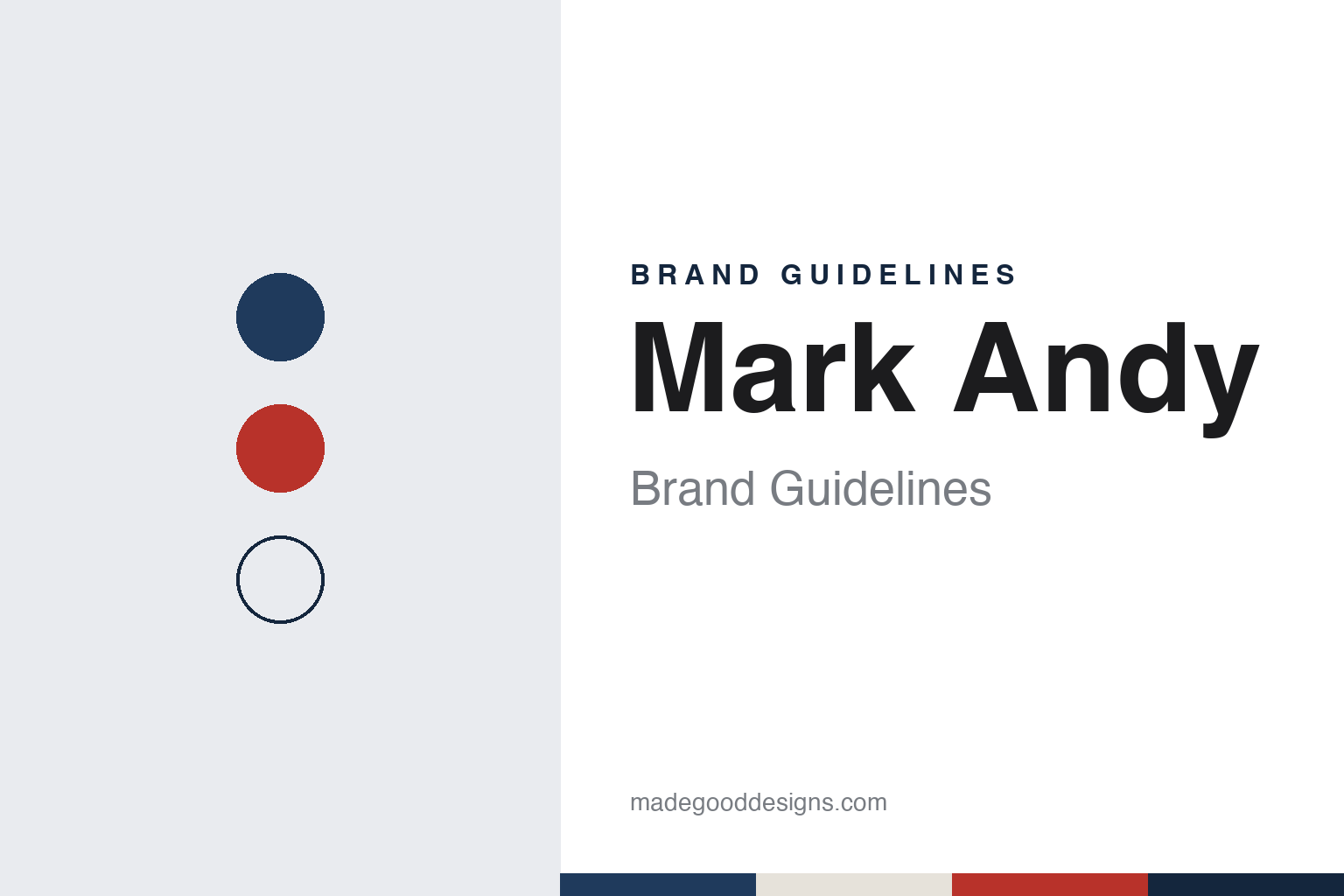
Two constants: a navy, red and stone palette and an industrial sans register. Abstract homage — not a Mark Andy product or mark; no press, logo or nameplate is reproduced.
Kirkwood, 1946
A tape press built in a basement machine shop.
Mark Andy dates itself to 1946, when, the company says, its founder Mark Andrews Sr. built the first Mark Andy tape press in his basement machine shop in Kirkwood, Missouri. The company describes that first press as the start of the pressure-sensitive adhesive roll label industry; that is its own account of its origins, and the claim is Mark Andy’s.
Its published timeline sets out the early steps. A first logo followed in 1948, and in 1951 Mark Andy brought inline flexographic printing presses to market. In 1979 the headquarters moved to Chesterfield, Missouri, and in 1993 the company came through the Great Flood of the Missouri River. In 1997 Mark Andrews Jr. received the label industry’s Man of Achievement award, the company says.
The family business did not stay independent. Mark Andy had been owned by the Dover Corporation since 1995, the Australian print trade title Sprinter reported in October 2006, when it passed to Morgenthaler Partners, a buyout and venture-capital firm based in Cleveland and Boston. At that point, Sprinter wrote, the business ran three brands — Mark Andy, Comco and UV Technology — from a base in St. Louis, with sales and distribution offices in France, Switzerland and the UK, and its existing management team stayed in place.
Colour
Flexo, hybrid and finishing lines.
Mark Andy’s product history is one of narrow- and mid-web presses for labels and packaging. The company’s timeline lists the LP3000 and XP5000 label presses in 2000; the Performance Series in 2009, introduced for faster changeovers; and its QCDC quick-change die-cutting system, which it says won a Technical Innovation Award from the Flexographic Technical Association (FTA) in 2013. It records further FTA Technical Innovation Awards in 2006, for its work in RFID, in 2011, for the Performance Series platform, and in 2017, for its Digital Series.
From 2016 the range moved toward digital printing. The company introduced Digital One, an entry-level dry-toner press with inline converting for short runs of labels, in 2016; the Digital Series HD, which it presents as a hybrid line, in 2018; and the Digital Pro production label press in 2019. In 2017, its timeline adds, it developed Digital Plus Screen, a modular hybrid unit meant to replace conventional rotary screen printing, extended QCDC to a semi-rotary version, and became the exclusive United States distributor of DuPont’s Cyrel flexographic plate products. Its current website groups the machines into flexo presses, among them the Evolution Series, the Performance Series and the Mark Andy 2200; digital presses; and finishing equipment.
Growth also came by acquisition. According to the company, it bought Comco and UVTechnology in 2001, adding mid-web printing and UV curing; Rotoflex International, a maker of inspection and rewind machines, in 2008; Arpeco in 2010, folding its rewinders into the Rotoflex line; the supplies distributor Print Products Inc. in 2012; and the digital offset and plate company Presstek in 2018. In 2008, according to its buyer’s announcement, the business had a second manufacturing site in Cincinnati, Ohio, where Comco machinery and UVT curing systems were built, and about 5,000 Mark Andy machines were installed.
Today the website lists the brands under the Mark Andy Inc. umbrella as Mark Andy, Rotoflex, Mark Andy Print Products, Presstek and Kluge, the foil-stamping, embossing and die-cutting line of Brandtjen & Kluge, and says it still services ABDick, Comco and Arpeco machines. Its timeline also records training through Mark Andy University, launched in 2012, a UK showroom opened the same year, and a facility in Warsaw, Poland, opened in 2015.
Typography
Label presses and their trade.
Label presses are built for converters, the printers who turn reels of paper and film into the labels on bottles, jars and cartons. A narrow-web press is usually a long inline machine: the web unwinds at one end, passes through a row of printing units, often with UV curing between them, then through foil, varnish and die-cutting stations before the finished labels are rewound as a reel at the other end.
The makers present themselves through that machinery. Their brochures and websites show the web path running from unwinder to rewinder, rows of identical printing units, die stations and close-ups of printed label reels, and they describe presses by print width, the processes a line can combine and the materials it can run, from self-adhesive paper to film and carton.
Much of the selling happens in person. Makers run demonstration halls where converters can watch a press run their own jobs: Gallus says its Experience Center in St. Gallen covers nearly 2,500 square metres and also shows partner machines, and Nilpeter listed technology centres in Denmark, the United States, Thailand, India and Brazil in 2019. Gallus asks converters who want a live demonstration to arrange it through Heidelberg’s local sales and service units.
Trade fairs set the rhythm of launches. Labelexpo, held in Brussels for Europe and in Chicago for the Americas, is where many presses are first shown: Nilpeter launched its FA-Line at Labelexpo in Brussels in 2005, according to FLEXO magazine. The makers in this guide range from family companies to subsidiaries of larger press groups, and each guide sets out who founded the brand, who owns it now and what rests only on the company’s own word.
Aa
An industrial sans for a press maker’s name. (Specimen set in Archivo, a sans STAND-IN; NOT the Mark Andy logo.)
Mark Andy
Investor-owned since 1995.
Ownership changed again two years after the Morgenthaler deal. On 8 October 2008, American Industrial Partners announced that its newly formed AIP-MAI Holdings had acquired Mark Andy from Morgenthaler Partners. The announcement gave the company’s headquarters as St. Louis and described its business as narrow- and mid-web flexographic equipment and aftermarket products for the label, packaging and specialty printing markets.
The most recent change on record came in June 2023. On 8 June that year, according to the deal listing PrivSource, Center Rock Capital Partners made a platform investment in MAI Holdings, Inc., the company trading as Mark Andy, with the Desai family remaining as equity holders. PrivSource tied the investment to growth in end markets including consumer packaged goods, pharmaceuticals and food and beverage. Center Rock Capital Partners is an investment firm and is not connected with Center Rock Inc., a maker of drilling tools.
As a brand, Mark Andy leans on its founder’s name, its long timeline and the trade awards it lists, and on a portfolio that now runs from flexo and hybrid presses to finishing machines and pressroom supplies. Its website calls it a pioneer of the graphic arts and printing industry and offers a full lifecycle of equipment, service and supplies under one name.
For a design guide, Mark Andy shows how a founder’s workshop name can carry through several changes of ownership and a growing set of acquired brands. Compare Nilpeter and Gallus, two other makers of label presses. For this guide we use a deep navy, a signal red and a warm stone with a sans, an unofficial interpretation; no product or logo is reproduced.
Explore & save
Keep Mark Andy’s identity on hand — save it to a board in the Made Good inspiration library.
Mark Andy identity set
Pin the Mark Andy navy, red and stone palette and the industrial sans register to your own board.