Gallus Brand Guidelines
The 1923 St. Gallen label press maker now owned by Heidelberg.
Aa
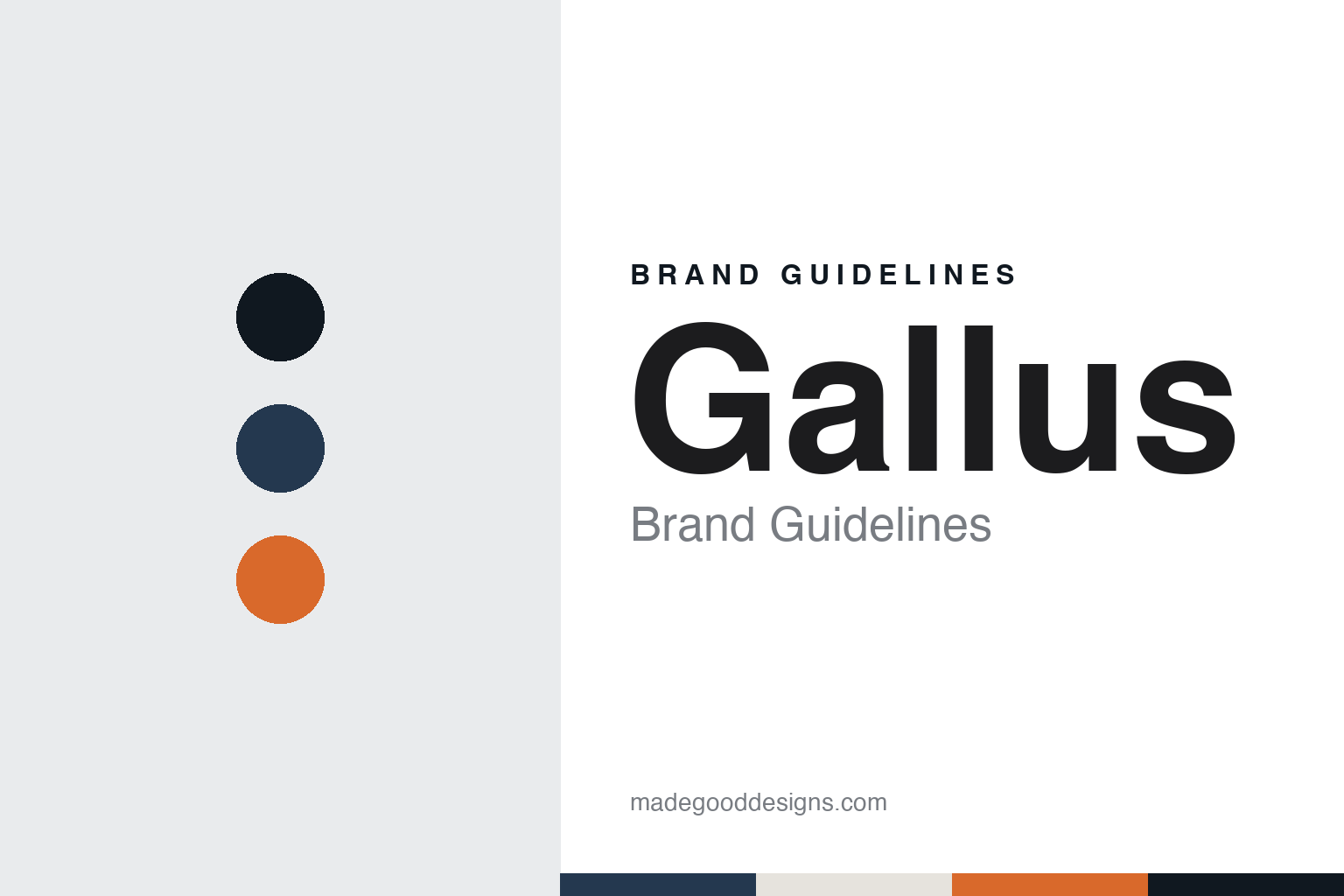
Two constants: a Gallus slate blue, warm grey and orange palette and an Engineered sans register. Abstract homage — not a Gallus product or mark; no press, logo or nameplate is reproduced.
A scale workshop
A calibration office in St. Gallen that turned to label presses.
Gallus began in St. Gallen, in eastern Switzerland, on 6 March 1923, when a sole proprietorship trading as “Ferdinand Rüesch, Eichmeister” was entered in the commercial register as a scale factory, machine workshop and calibration office, the company’s own history says. English Wikipedia names the founder as Ferdinand Rüesch-Baur; the company calls him Ferdinand II Rüesch, one of a line of Ferdinand Rüesches who have run the business.
The label press came two years later. In 1925, the company says, the St. Gallen textile firm Schuster & Co. was recording its fabric samples piece by piece by hand and asked Rüesch for a faster way. With his master craftsman Johann-Georg Schick he designed a small, hand-operated printing press, the Gallus Junior, which the company counts as the first Gallus label press. English Wikipedia also dates the first label press to 1925.
The business grew through the following generations. The company says Ferdinand III Rüesch took over in 1953, expanded exports and moved production to industrial manufacturing, with presses printing silk gift ribbons, discount coupons, airline hang tags and punch cards. It also says that at a graphic arts fair in Chicago in 1950 it showed its first flexographic press and the first printing of self-adhesive material on a label press. English Wikipedia credits Gallus with introducing a segment die-cutting unit in 1960, and says that by 1974 the company had about 220 employees and became a joint-stock company, Gallus Ferd. Rüesch AG — the company name that still appears in its announcements in 2026. The company says it was completely reorganised around 1970 with new production facilities, and that it moved into numerically controlled machining in 1971.
Colour
From family firm to Heidelberg subsidiary.
Gallus’s modern story is tied to Heidelberger Druckmaschinen, the German press maker. The company says Ferdinand IV Rüesch took over from his father in 1990 and set up sales and service subsidiaries in the United States, Australia, Germany, Britain and Denmark; English Wikipedia dates the first US subsidiary to 1981 and adds a holding in Arsoma Druckmaschinen of Langgöns, Germany, in the 1990s. In 1999 Heidelberg took a 30 percent stake in the Gallus Group.
In 2014 Heidelberg took full ownership. Gallus says Rüesch contributed his 70 percent stake to Heidelberg to speed up the joint development of a digital label press, becoming an anchor shareholder of Heidelberg, and that the deal approved by Heidelberg’s management board in June was completed in August 2014. Print21 reported in 2021 that Rüesch had become Heidelberg’s biggest shareholder through the deal. Gallus says he was elected to Heidelberg’s supervisory board in 2018.
A sale nearly took Gallus out of the group. English Wikipedia says Heidelberg announced in July 2020 that it would sell Gallus to the Swiss company benpac holding. On 29 January 2021 Heidelberg said in a formal notice to investors that the sale had not been completed because the buyer had not paid at closing, and that Gallus would remain with Heidelberg. Print21 reported at the time that Gallus’s five sites and about 430 employees stayed in the group, that Heidelberg would keep handling sales and service for the Gallus range, and that Heidelberg would examine options for Gallus’s corporate future.
Gallus also moved into folding cartons for a time: English Wikipedia says it bought BHS Druck- und Veredelungstechnik of Weiden, Germany, in 2006, renamed Gallus Stanz- und Druckmaschinen in 2008. Today the company describes the Gallus Group as two divisions, labels and screen printing.
Typography
How label press makers present themselves.
Label presses are built for converters, the printers who turn reels of paper and film into the labels on bottles, jars and cartons. A narrow-web press is usually a long inline machine: the web unwinds at one end, passes through a row of printing units, often with UV curing between them, then through foil, varnish and die-cutting stations before the finished labels are rewound as a reel at the other end.
The makers present themselves through that machinery. Their brochures and websites show the web path running from unwinder to rewinder, rows of identical printing units, die stations and close-ups of printed label reels, and they describe presses by print width, the processes a line can combine and the materials it can run, from self-adhesive paper to film and carton.
Much of the selling happens in person. Makers run demonstration halls where converters can watch a press run their own jobs: Gallus says its Experience Center in St. Gallen covers nearly 2,500 square metres and also shows partner machines, and Nilpeter listed technology centres in Denmark, the United States, Thailand, India and Brazil in 2019. Gallus asks converters who want a live demonstration to arrange it through Heidelberg’s local sales and service units.
Trade fairs set the rhythm of launches. Labelexpo, held in Brussels for Europe and in Chicago for the Americas, is where many presses are first shown: Nilpeter launched its FA-Line at Labelexpo in Brussels in 2005, according to FLEXO magazine. The makers in this guide range from family companies to subsidiaries of larger press groups, and each guide sets out who founded the brand, who owns it now and what rests only on the company’s own word.
Aa
An engineered sans for a Swiss press maker. (Specimen set in IBM Plex Sans, a sans STAND-IN; NOT the Gallus logo.)
Gallus
St. Gallen presses sold through Heidelberg.
Today Gallus describes itself as a subsidiary of Heidelberger Druckmaschinen AG with production in Switzerland and Germany: headquarters, research and production in St. Gallen, label development and production at Langgöns in Germany, and the screen-printing division, which makes Gallus Screeny printing plates, at Herisau. Its presses are sold through Heidelberg’s sales and service network. The current range includes the conventional Gallus Labelmaster, the digital Gallus One and Gallus Five, and the Gallus Labelfire, which the company describes as combining digital printing with conventional printing and finishing. A unit called Gallus Classics trades, upgrades and reconditions older machines.
The Gallus Experience Center in St. Gallen is a demonstration and test hall of nearly 2,500 square metres, the company says, where converters can see presses run and where partner machines, including one from Prati, are also shown. The company lists the demonstration presses there, among them a Gallus One set up with seven digital inks and a Gallus Labelmaster 440 with eight flexographic units, screen printing, rotary die-cutting and cold foil. In October 2026 Gallus announced that chief executive Dario Urbinati would move to the board of Gallus Ferd. Rüesch AG from 1 November, with finance chief Michael Bsirske as interim chief executive, and said it was expanding its presence in India.
For a design guide, Gallus shows how a family workshop name can survive inside a larger group, with the founder’s company name still on the door in St. Gallen. Compare Heidelberg, its owner since 2014, and Nilpeter, a family-owned label press maker in Denmark. For this guide we use a slate blue, warm grey and a signal orange with a sans, an unofficial interpretation; no product or logo is reproduced.
Explore & save
Keep Gallus’s identity on hand — save it to a board in the Made Good inspiration library.
Gallus identity set
Pin the Gallus slate blue, warm grey and orange palette and the Engineered sans register to your own board.