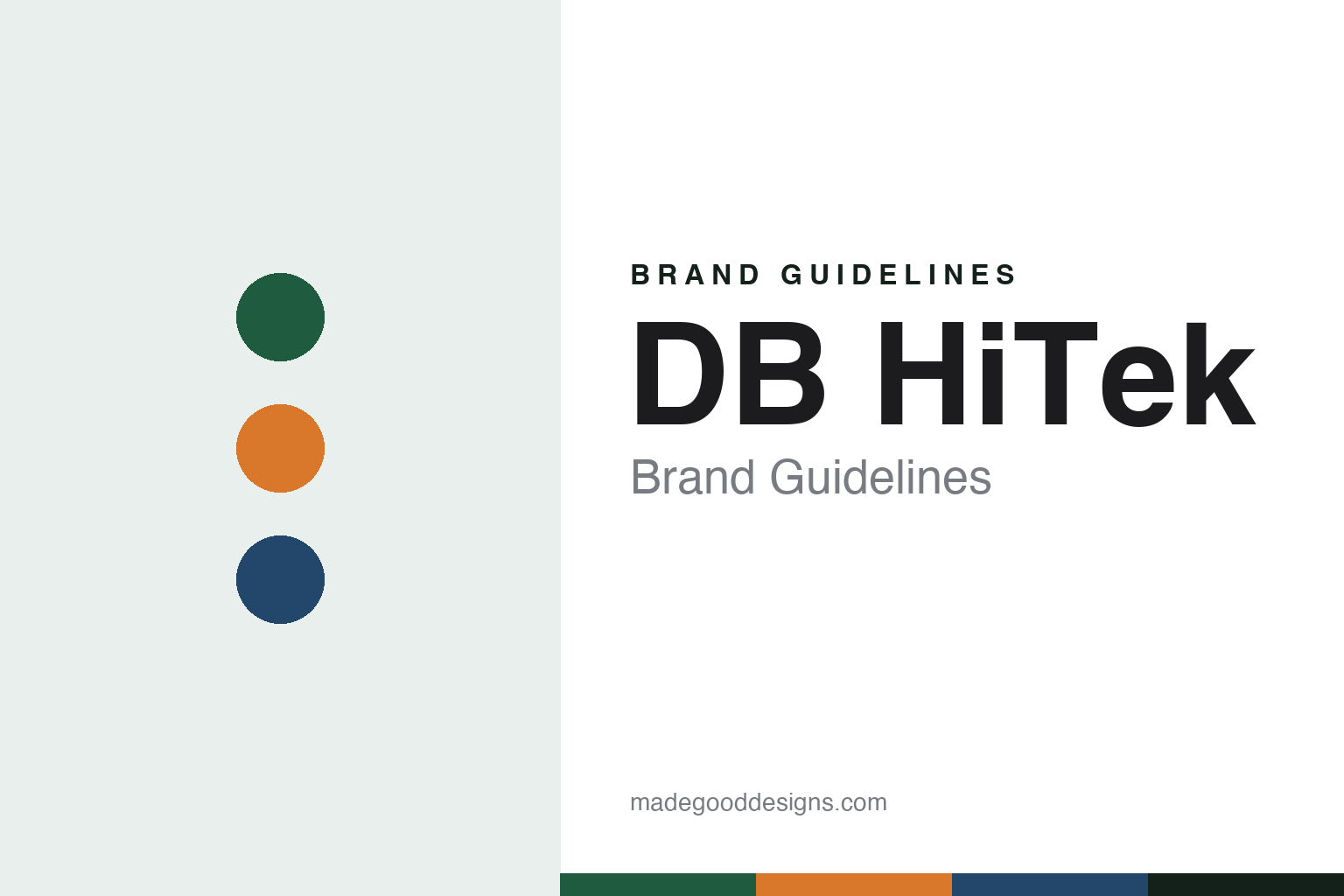
DB HiTek Brand Guidelines
Dongbu’s Bucheon foundry, built on analog and power chips.
Aa
Two constants: a DB HiTek green, orange and blue palette and an Engineered sans register. Abstract homage — not a DB HiTek product or mark; no chip, logo or emblem is reproduced.
Dongbu Electronics
A chemicals listing and a 1997 fab.
DB HiTek is a contract chipmaker based in Bucheon, in Gyeonggi Province, South Korea. English Wikipedia describes it as a semiconductor contract manufacturing and design company and as the country’s second-largest foundry after Samsung Electronics. The company calls itself a “specialized foundry” with analog and power semiconductor technology, and says its foundry business began with the aim of helping to correct an imbalance in Korea’s chip industry, which had been centred on memory.
Its story runs through the Dongbu Group, the business group founded by Kim Jun-ki and now called DB Group. The company’s history page says the group entered the wafer business in 1983 by setting up Kosil, the company now known as SK Siltron, and developed high-purity polycrystalline silicon in 1992. In 1997 the group established Dongbu Electronics and completed Fab1 on its Bucheon campus. English Wikipedia says Dongbu Electronics began as a memory chipmaker and turned to foundry work in 2001; the company dates commercial production at a second fab, on its Sangwoo campus, to 2001, and its first commercial foundry production, on a 0.13-micron process, to 2004. It names Texas Instruments and Toshiba as early partners for technology transfer and product supply. In 2002, English Wikipedia says, Dongbu Electronics bought Anam Semiconductor’s foundry operation from Amkor Technology.
The listed company has older roots in another industry. Korean Wikipedia’s timeline begins with Korea Agrochemical, founded in April 1953, which listed on the Korean stock exchange in 1975, was renamed Hannong in 1981, joined the Dongbu group in 1995 and became Dongbu Hannong Chemical in 1996. In May 2007 it absorbed Dongbu Electronics and took the name Dongbu HiTek. Its other businesses were then split off: metals in 2008, as the company now called DB Metal, and agriculture in 2010, as the business now called FarmHannong, according to the same source. What had been a chemicals company became, step by step, a foundry.
Colour
Analog, power and image sensors.
DB HiTek works on 8-inch wafers. Its website gives its capacity as about 154,000 eight-inch wafers a month as of 2024, with about 2,000 employees; Korean Wikipedia gives a figure of about 151,000 for the same year, and says a cleanroom expansion at the Sangwoo plant in Eumseong, its Fab2, is due to begin from 2026 and add about 23 percent. The company lists its process families as BCDMOS — a process that combines bipolar, CMOS and DMOS transistors on one chip, used for power management — together with analog CMOS, CMOS image sensors, mixed-signal and RF, superjunction MOSFETs, silicon carbide and gallium nitride.
The company dates much of its technical identity to 2008, when, it says, it became the first company in the world to develop a 0.18-micron BCDMOS process; that is the company’s own claim. The same year, it says, it developed and mass-produced LCD driver chips. Later milestones on its list include 0.13-micron BCDMOS and low-noise CMOS processes in 2014, one million analog and power wafers shipped in 2016, RF SOI processes from 2019, and global-shutter and SPAD image-sensor processes in 2020. Its most recent entries, for 2025, are further BCD and superjunction MOSFET process generations.
The road was not smooth. Korean Wikipedia says the business recorded losses for years and was put up for sale, and that it returned to operating profit in 2014, thirteen years after entering the foundry business; in 2016, the same source says, the Korea Development Bank withdrew its plan to sell it. The company also dates its return to operating profit to 2014, crediting financial restructuring and stronger technology.
In November 2017 Dongbu HiTek became DB HiTek, as part of the group’s change of name from Dongbu to DB that year, according to Korean and English Wikipedia and the company’s own history. The company says it has since concentrated on high-growth, high-value products, and in 2022, it says, it published its first sustainability report.
Typography
Foundries and documentation.
Contract chip makers sell a service rather than a product with their own name on it. The chips they make leave the plant under their customers’ names, so a foundry’s identity has to be built from the things it can show: the wafer, the cleanroom, the fab and the people who run it.
The wafer is the usual starting point. Foundry photographs often show a finished wafer held up to the light, its grid of chips throwing back a rainbow sheen, or a stack of wafers in a carrier ready for the next step. Close-ups of patterned silicon give a company a recognisable image without revealing any customer’s design.
Inside the fab, the pictures follow a familiar pattern: engineers in full-body cleanroom suits, often called bunny suits, standing at tools under the yellow light used in lithography areas; long, bright corridors lined with equipment; and overhead transport systems carrying wafer pods along tracks in the ceiling. From outside, aerial shots of fab campuses, with their long, low buildings and utility plants, stand in for scale and capacity.
Foundries also present themselves at trade shows and conferences, such as the SEMICON exhibitions held in several regions, as well as through their own technology events for customers. Their names usually travel as abbreviations or short forms, and their written materials lean on process names, node figures and fab locations. This guide sets out what can be checked about each company — who founded it, who owns it, where it makes wafers — and marks clearly what rests only on the company’s own word.
Aa
An engineered sans — the letters DB as a symbol. (Specimen set in Inter Tight, a sans STAND-IN; NOT the DB HiTek logo.)
DB HiTek
Orange sun, blue water, green life.
In March 2023 DB HiTek’s board took up a plan to spin off its chip-design business into a wholly owned subsidiary, The Asia Business Daily reported on 7 March 2023. The paper said the move aimed to resolve conflicts of interest with foundry customers, and quoted chief executive Jo Gi-seok as saying the company would separate its foundry and fabless businesses in line with the strategic direction of global foundries. The company’s history lists the spin-off of DB GlobalChip, its former design division, in 2023.
The same year brought an activist investor. The investment firm KCGI bought a 7.05 percent stake in March 2023, calling the company undervalued and asking for share buybacks and a more independent board. In December, The Asia Business Daily reported, the group’s holding company, DB Inc., bought 5.63 percent from KCGI’s investment vehicle, lifting its own stake from 12.42 to 18.05 percent. DB HiTek announced a governance plan at the same time, including separating the roles of chief executive and board chair and setting up audit and compensation committees.
The identity is set out on the company’s own corporate-identity page. It says the emblem turns the letters “DB” into a symbol that inherits Dongbu’s tradition, keeping the group’s traditional orange and green and adding blue to stand for the East and for youth. Orange stands for the sun and blue for water, and together they give rise to green, for life, which the company links to balanced growth and a sustainable future. The logotype’s green continues Dongbu’s identity, and the white space inside the letter B is drawn as one continuous line, which the company says stands for a flexible culture and an open mindset. The page sets clear-space rules based on the width of the D, and names gradients as the primary colour treatment, with flat colours where gradients cannot be reproduced.
For a design guide, DB HiTek shows how a group mark can carry a company through a change of name: the Dongbu green stayed when the letters changed. Compare Samsung, which English Wikipedia ranks ahead of DB HiTek among Korean foundries, and X-FAB, another specialty foundry. For this guide we use a forest green, a sunrise orange and a deep water blue with a sans, an unofficial interpretation; no product or logo is reproduced.
Explore & save
Keep DB HiTek’s identity on hand — save it to a board in the Made Good inspiration library.
DB HiTek identity set
Pin the DB HiTek green, orange and blue palette and the Engineered sans register to your own board.