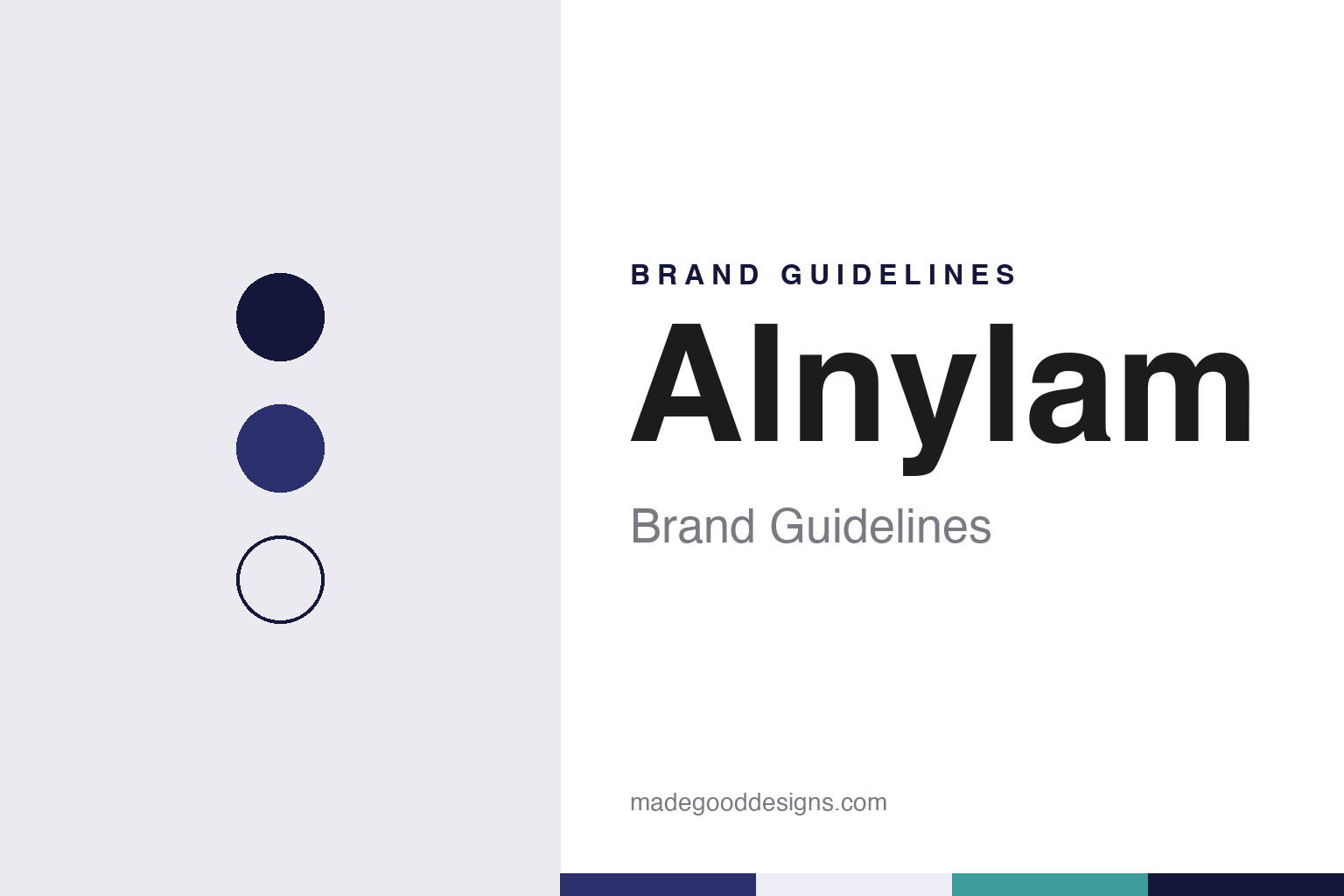
Alnylam Brand Guidelines
A star in Orion’s belt and a gene-silencing medicine.
Aa
Two constants: an indigo, teal and starlight palette and a scientific sans register. Abstract homage — not an Alnylam product or mark; no medicine, pack or logo is reproduced.
A star and a discovery
Five scientists, a set of patents and a name from the night sky.
Alnylam Pharmaceuticals was founded in 2002 in Cambridge, Massachusetts, to turn a recent discovery in biology into medicines. The company says it was founded on 14 June 2002 by the scientists Phillip Sharp, David Bartel, Thomas Tuschl, Paul Schimmel and Phillip Zamore; English Wikipedia adds the investors Christoph Westphal and John Kennedy Clarke to the founding group and names John Maraganore as the first chief executive.
The science is RNA interference, or RNAi: a natural process in which short pieces of RNA switch off particular genes by silencing the messenger RNA that carries their instructions. Its discovery was recognised with the 2006 Nobel Prize in Physiology or Medicine. The Max Planck Society explained in August 2018 that Tuschl and colleagues at the Max Planck Institute for Biophysical Chemistry in Göttingen had shown that the mechanism also works in mammals, and that Alnylam is the exclusive licensee of the society’s patents for therapeutic uses of RNAi. The society calls Alnylam a “Max Planck spin-off company.” Alnylam says it in-licensed those patents, from MIT, Max Planck and the Whitehead Institute, in its founding year.
The name comes from the sky. Alnylam says it is derived from Alnilam, the bright centre star of Orion’s belt, “used by navigators for thousands of years,” and English Wikipedia says the spelling was changed to make the name unique. The company’s own site still spells out the pronunciation, AL-NY-LAM, and admits the name “may not be the easiest to pronounce.”
The early company grew quickly. In 2003 it merged with the German company Ribopharma AG, and in 2004 it listed on the Nasdaq under the ticker ALNY, according to English Wikipedia.
Colour
From a platform to a shelf of medicines.
For its first decade and a half Alnylam was a research and partnership company. English Wikipedia lists alliances with Medtronic, Biogen Idec, Roche, Kyowa Hakko Kirin, Monsanto and others, and records that in 2007 Alnylam and Ionis set up Regulus Therapeutics to work on microRNA. In 2014 Sanofi Genzyme took a stake in Alnylam, and the company bought Sirna Therapeutics from Merck. Alnylam says its first RNAi clinical programme began in 2005 and that its first manufacturing facility opened at Alewife, in Cambridge, in 2012; it broke ground on a plant in Norton, Massachusetts, in 2016.
There were setbacks along the way. In October 2016 a late-stage trial of revusiran, then the company’s lead candidate, was halted and Alnylam ended the drug’s development, English Wikipedia records.
The turning point came in August 2018. The US Food and Drug Administration approved patisiran, sold as Onpattro, for the polyneuropathy of hereditary transthyretin-mediated (hATTR) amyloidosis in adults; the Max Planck Society described it on 23 August 2018 as the first RNAi therapeutic approved by the FDA, and English Wikipedia says it was approved in the European Union the same month. Patisiran is carried into the body in lipid nanoparticles.
Further approvals followed, according to the company’s own timeline: Givlaari (givosiran) in 2019, Oxlumo (lumasiran) in 2020 and Amvuttra (vutrisiran) in 2022, each in the US and the EU. Inclisiran, licensed to Novartis and sold as Leqvio, was approved in the EU in 2020 and in the US in December 2021. In 2023 a request to extend patisiran to the heart form of the disease did not win FDA approval, English Wikipedia notes. On 20 March 2025 the FDA approved vutrisiran for adults with transthyretin amyloid cardiomyopathy, AJMC reported the next day; the medicine is given as an injection under the skin four times a year.
Typography
How biotechnology companies present themselves.
Biotechnology companies sell things that are almost impossible to photograph. A medicine made from a strand of RNA or an engineered antibody has no shape a camera can see, so the sector leans on a small set of stand-in images: rendered molecules, ribbons and double helices, antibodies drawn as glowing Y-shapes, and close-ups of cells under a microscope. These macro images carry most of the visual weight on corporate websites, investor decks and annual reports.
The second familiar picture is the laboratory itself. Scientists at benches with pipettes, racks of sample tubes and gloved hands over a plate reader appear again and again, because they show work in progress rather than a finished product. Alongside them sit patient-advocacy portraits: people living with a rare disease, their families and the groups that represent them, photographed in everyday settings rather than in the clinic.
Architecture does the rest. Glass-fronted lab campuses in clusters such as Cambridge, Massachusetts, Copenhagen and South San Francisco stand in for scale and ambition, and company websites often show their buildings alongside their people. The calendar adds its own stage: the BIO International Convention and the J.P. Morgan Healthcare Conference, held each January in San Francisco, are where pipelines are presented to partners and investors.
Within that common language, names and colours do much of the work of telling companies apart. This guide sets out what can be checked about each brand — who founded it, where it is based, what it makes and what has happened to it — and marks clearly what rests only on the company’s own word. No product, logo or pack is reproduced, and the palettes are our own unofficial interpretation.
Aa
A clean scientific sans for a name taken from a star. (Specimen set in Manrope, a sans STAND-IN; NOT the Alnylam logo.)
Alnylam today
Cambridge headquarters, a Norton plant and a registered slogan.
Alnylam describes itself as an “independent biopharmaceutical company,” and it remains Nasdaq-listed and headquartered in Cambridge. Yvonne Greenstreet, previously chief operating officer, succeeded Maraganore as chief executive on 1 January 2022, according to English Wikipedia. The company opened its first international office, in Maidenhead in the UK, in 2016, and today runs local websites for countries from Austria and Spain to Taiwan.
Its partnerships now carry other companies’ names. The company’s timeline lists fitusiran, licensed to Sanofi and sold as Qfitlia, as approved in the US in 2025, and cemdisiran as licensed to Regeneron. Alnylam also says it is expanding the Norton plant to add enzymatic ligation, a way of making RNAi molecules, and that the FDA accepted that manufacturing platform into its Emerging Technology Program in 2025.
The company’s own copy repeats a few lines. It describes itself as “leading the RNAi Revolution®” and uses a second registered line, “Disrupting Disease®,” on its history page, alongside a series of five-year strategies it names by numbers: Alnylam 5×15 in 2010, Alnylam 2020 in 2016, Alnylam P5x25 in 2021, and an Alnylam 2030 strategy announced in 2026. Of the star behind its name, it says Alnilam “symbolizes our passion for discovery.”
For a design guide, Alnylam shows how a hard-to-say invented name can be anchored by a clear origin story and a single technology repeated in every line of copy. Compare Ionis, its partner in founding Regulus and another company working on RNA-targeted medicines, and Sanofi, whose Genzyme unit took a stake in Alnylam in 2014. For this guide we use a deep indigo, a muted teal and a pale starlight with a sans, an unofficial interpretation; no product or logo is reproduced.
Explore & save
Keep Alnylam’s identity on hand — save it to a board in the Made Good inspiration library.
Alnylam identity set
Pin the Alnylam indigo, teal and starlight palette and the scientific sans register to your own board.