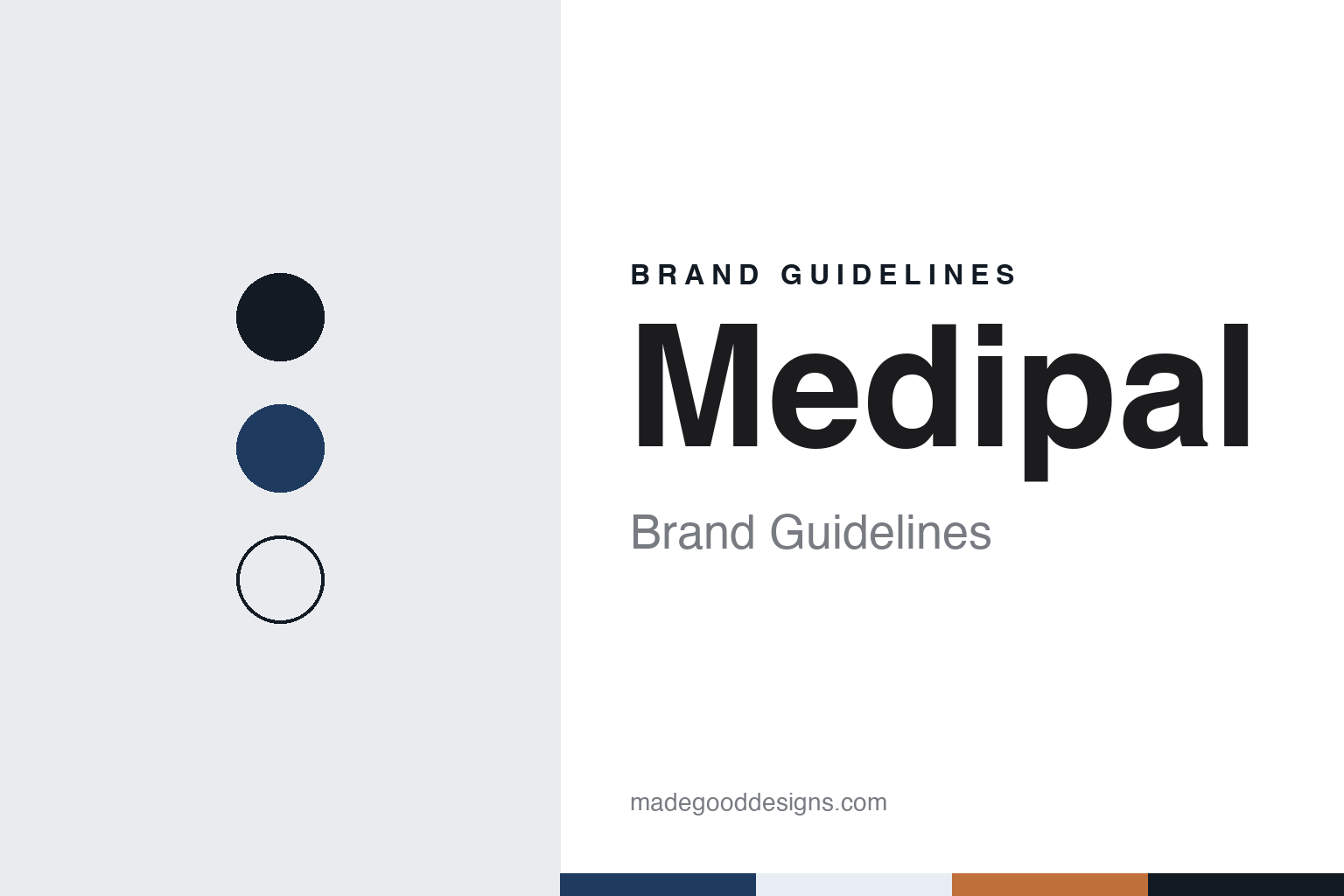
Medipal Brand Guidelines
From a Kobe pharmacy of 1898 to a Tokyo drug wholesaler.
Aa
Two constants: a Medipal navy and clay palette and a Steady sans register. Abstract homage — not a Medipal product or mark; no logo, livery or packaging is reproduced.
Kumada Sanseido
A pharmacy on Motomachi, Kobe.
Medipal is not a company of the 2000s, even though its name is. Medipal Holdings gives its founding date as October 1898 and its legal establishment as May 1923, and its own history traces the group to the oldest of three wholesalers that merged in 2000. That oldest firm began as a pharmacy in Kobe. Mediceo, the group’s main drug wholesaler, says Kumada Saichiro opened a small shop there called Kumada Sanseido, and that his note on the first day recorded that what pleased him most was having nothing out of stock that customers asked for.
A 2026 digest of Fūsetsu nanajūnen, Sanseido’s company history published in 1968, gives more detail. It says Kumada was a 21-year-old pharmacist when he opened on Motomachi, Kobe’s shopping street, on 8 October 1898; that he moved along the street in 1900; and that in 1901 he took part in a hospital tender for the first time, the start of the wholesale business. The firm ran into trouble in 1922 and became the joint-stock company Sanseido in May 1923.
According to the same digest, the founding brothers left the management in March 1931, when the Osaka drug house Takeda Chobei Shoten took over the firm’s debts; by 1935 it held more than 60 percent of Sanseido’s shares, and the debt was repaid early in 1938. Sanseido raised its capital in 1941. The war reached the company directly in 1945: air raids on Kobe in March and June destroyed a Motomachi branch and the wholesale office, leaving only the retail shop, and in August the company rented a burnt-out building to carry on. In 1946 employees returned from the disbanded army and navy to a business with only 52 customers left, and the company began travelling across Hyogo Prefecture for orders, opening an office in Himeji in March 1947.
Colour
Three wholesalers, two renamings.
The modern group took shape through mergers. In April 2000 Sanseido, strong in the Kinki region around Osaka and Kobe, merged with two Kanto wholesalers — Kuraya Yakuhin, founded in 1949, and Tokyo Iyakuhin, founded in 1947 — to form Kuraya Sanseido, based in Chuo ward, Tokyo, according to the company and Japanese Wikipedia. In April 2004 the Hiroshima wholesaler Everlth and the Fukuoka wholesaler Atol became wholly owned subsidiaries and the “Mediceo Group” was launched; that October the parent spun off its wholesale business and renamed itself Mediceo Holdings.
In October 2005 Mediceo Holdings integrated its management with Paltac, the Osaka wholesaler of cosmetics and daily necessities, and became Mediceo Paltac Holdings. Japanese Wikipedia records a basic agreement in October 2008 to merge with Alfresa Holdings in April 2009, withdrawn in January 2009. In October 2009 the parent took its present name, Medipal Holdings, and the prescription-drug business, after absorbing five group wholesalers, became Mediceo. The group now spans three businesses, by its own description: prescription pharmaceuticals; cosmetics, daily necessities and over-the-counter medicines; and animal-health products and food-processing ingredients. It reported 13,024 employees on a consolidated basis at the end of March 2026.
PALTAC, which Japanese Wikipedia says has written its name in capitals since July 2015, was relisted on the stock market in 2010. In May 2026 Medipal, which already held 52.40 percent, launched a tender offer to make it a wholly owned subsidiary; the offer succeeded in July 2026 with Medipal at 92.64 percent and a squeeze-out to follow, Nihon M&A Center and LNEWS reported. Japanese Wikipedia dates full ownership to 13 August 2026.
The group has also been part of a competition case. The trade paper Yakuji Nippo reported in May 2021 that Mediceo was one of four large wholesalers raided by Japan’s Fair Trade Commission in November 2019 over drug tenders for the Japan Community Health care Organization; the commission’s criminal complaint of December 2020 named three other companies, not Mediceo, the paper reported.
Typography
How wholesalers show themselves.
Pharmaceutical wholesalers sit between the companies that make medicines and the pharmacies, hospitals and clinics that hand them out, so their public image is mostly an image of movement. The pictures these companies tend to show are long automated warehouse aisles, conveyor lines carrying plastic totes, and high racks of shelving, with staff in high-visibility vests picking orders between them. The aim of that imagery is to show scale and order rather than any single product.
The second recurring scene is the road. Fleets of liveried vans and temperature-controlled trucks carry the company name through towns and onto motorways and are often the most visible sign of a wholesaler on the street. Close-ups of insulated cold-chain boxes, data loggers and handheld barcode scanners carry the same message at a smaller size: goods are tracked from shelf to doorstep.
The third scene is the pharmacy counter. Because many wholesalers also run pharmacy networks, franchise banners or buying groups, their brochures often show a pharmacist behind a counter talking with a customer, which gives a logistics business a human face. These banners usually carry their own names and colours, separate from the parent company, so one wholesaler can stand behind several identities on the high street.
Beyond that, the visual record is corporate: trade-fair stands, investor presentations and annual reports with supply-chain diagrams of arrows linking factories, distribution centres and pharmacies. For a design study, the useful question is how one identity can work on a lorry side, a carton label, a pharmacy sign and a screen at the same time.
Aa
A steady sans — MEDIPAL in capitals. (Specimen set in IBM Plex Sans, a sans STAND-IN; NOT the Medipal logo.)
Medipal
Joined hands and “Energy and Brightness.”
Medipal explains its symbol mark in its own words: a design that “suggests people holding hands and harmony,” standing for cooperation, coexistence and “the strength to live,” and for a company that grows with its customers and partners. Its group slogan is “Energy and Brightness,” and it names its business fields as “Pharmaceuticals, Health, and Beauty.” In English it writes the name in capitals, MEDIPAL.
Mediceo explains its own name in Latin. It says the word combines medico, to treat with medicine; medi, the centre; Dice, the goddess of justice; and eo, to move forward — and that the letters C, E and O stand for challenge, energy and originality. Its corporate slogan likens the company to an orchestra in support of health, with every department playing its part.
Much of the group’s self-presentation is about logistics. Mediceo dates its Kanagawa distribution centre to May 2009 and calls it Japan’s first urban full-line centre of its kind; it counts the Hanshin centre of September 2023 as the group’s thirteenth and a Tokyo centre, running from January 2026, as the fourteenth. Medipal says it has more than 300 bases from Hokkaido to Okinawa and a network linked to some 240,000 medical institutions, pharmacies and drugstores. Its brand pages describe storage at minus 150 degrees Celsius and lower for difficult-to-transport medicines, satellite phones at key sites and 110 small motor scooters kept mainly in the Tokyo area for use when transport stops after a disaster. These are the company’s own statements.
For a design guide, Medipal shows a brand that carries a nineteenth-century pharmacy inside a twenty-first-century holding name. Compare Suzuken, the Nagoya wholesaler, and Alfresa, its partner in the abandoned 2008 merger plan. For this guide we use a harbour navy and a clay with a sans, an unofficial interpretation; no product or logo is reproduced.
Explore & save
Keep Medipal’s identity on hand — save it to a board in the Made Good inspiration library.
Medipal identity set
Pin the Medipal navy and clay palette and the Steady sans register to your own board.