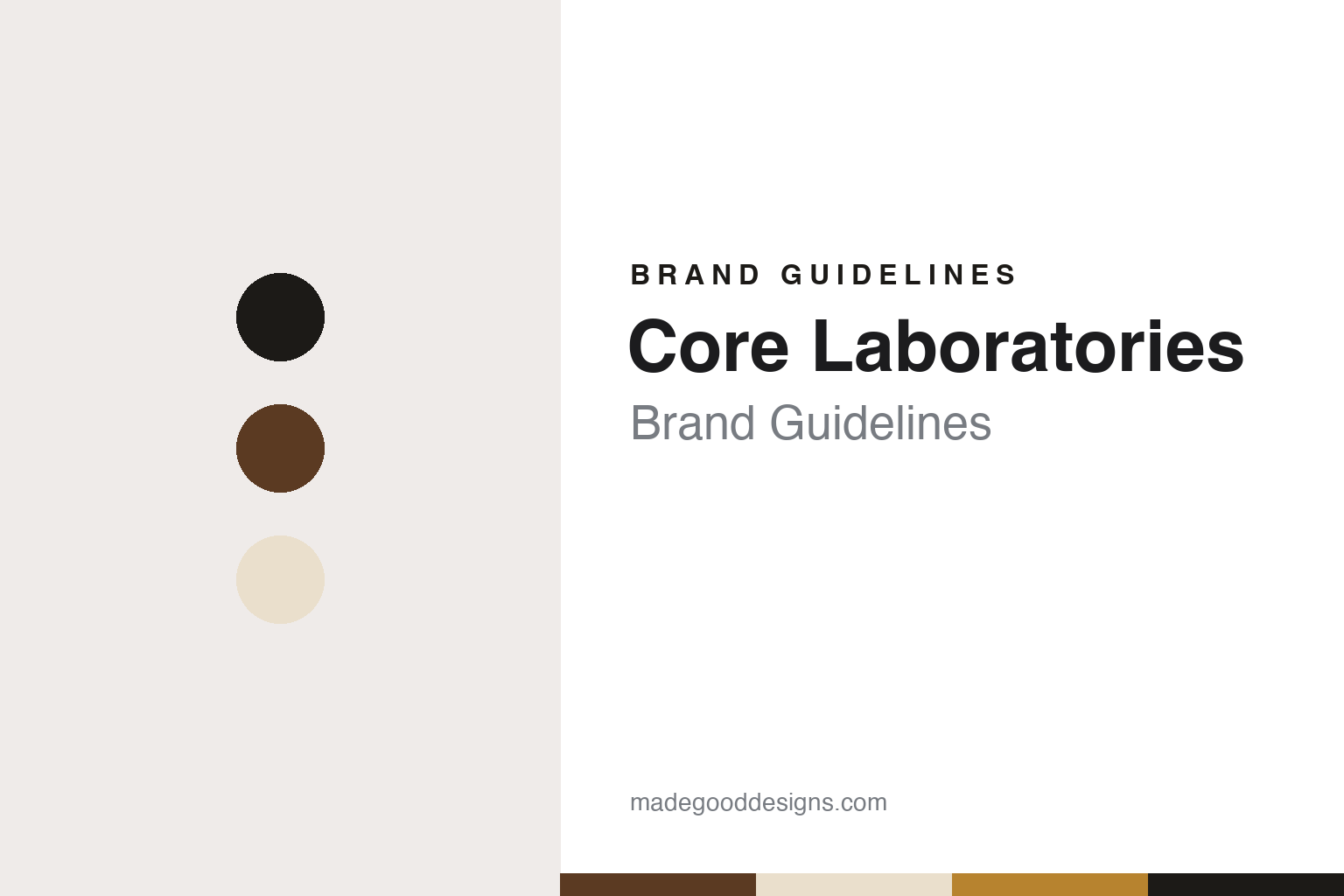
Core Laboratories Brand Guidelines
The 1936 core-analysis lab that became a reservoir-description company.
Aa
Two constants: a core brown, sandstone and amber palette and a laboratory serif register. Abstract homage — not a Core Laboratories product or mark; no instrument, logo or report is reproduced.
Core analysis
A geologist’s laboratory for rock and fluids.
Core Laboratories dates itself to 1936, the founding year it gives in its annual report. English Wikipedia, citing a biography of the geologist, says Everette Lee DeGolyer set up Core Laboratories that year to provide drilling core and fluids analysis, at the same time as he founded the petroleum consulting firm DeGolyer and MacNaughton with Lewis MacNaughton. The name describes the work: the company says it makes measurements on reservoir rocks, on reservoir fluids — crude oil, natural gas and water — and on products derived from them.
The company changed hands in the 1980s. The International Directory of Company Histories (St. James Press, 1995) says the conglomerate Litton Industries bought Core Laboratories Inc. in 1984, describing it as a natural complement to Western Geophysical, another Litton business, and that Litton spun off its commercial businesses as Western Atlas in 1994.
For much of its recent history the listed company was Core Laboratories N.V., a holding company in the Netherlands. When S&P Dow Jones Indices announced on 6 July 2017 that it would join the S&P MidCap 400 index, it gave the company’s headquarters as Amsterdam and described its work as reservoir description, production enhancement and reservoir management services. That changed on 1 May 2023, the company’s 2025 annual report says, when a series of steps merged the Dutch company into a Luxembourg company and then moved it to the United States as Core Laboratories Inc., a Delaware corporation. Its principal executive offices are in Houston, and its shares trade on the New York Stock Exchange under the symbol CLB.
Colour
Reservoir description and production enhancement.
Core Lab reports its business as two operating segments. Reservoir Description covers the analysis of reservoir rock and fluids. Its annual report explains the basic measurements: porosity, which sets how much oil or gas a rock can store, and permeability, which governs how readily fluids flow through it. It describes a commercial field as layered by density, with natural gas typically above oil and oil above water, and says it characterises the rock and all three fluids. The same measurements, it says, are needed for injection projects such as carbon storage and water disposal. The company also studies oil and gas at reservoir pressures and temperatures and correlates its laboratory results with wireline logs and other subsurface data. The same report says this work now extends to carbon capture and storage sites, geothermal projects and the appraisal of lithium deposits.
Part of that business trades under an older name. The company says its testing of crude oil and petroleum products operates under the trade name Saybolt, with laboratory analyses and independent field inspections, and that it has offered such services since 1898 — a date that belongs to the Saybolt name rather than to Core Laboratories itself. Core Lab Instruments makes laboratory equipment for the petroleum industry, and newer imaging work is grouped under the NITRO name, which the annual report says includes dual-energy and micro computed tomography and nuclear magnetic resonance.
Production Enhancement is the hardware and diagnostics side: perforating systems, completion diagnostics and well-abandonment tools. Its perforating business, Owen Oil Tools, says it has operated since 1983 and calls itself the largest independent provider of advanced perforating systems; those are its own claims. ProTechnics, another Core Lab name, offers completion diagnostics, including tracers embedded in polymers that the company says identify the type of fluid flowing into a well. After a field flood begins, the annual report says, Core Lab often monitors its progress for the operator, and its product lines include patented X-SPAN and GTX-SPAN casing patches. The 2025 annual report says Core Lab manufactures products mainly in four facilities: Frépillon in France, Godley in Texas, Red Deer in Alberta and Pyle in Wales.
Typography
How the sector presents itself.
Oilfield service companies sell work that most people never see. Their customers are oil and gas producers, and the jobs happen thousands of metres underground, on remote well pads or on the seabed. So the way these firms present themselves leans on a small set of recurring pictures: crews in branded coveralls and hard hats on a rig floor, frac fleets of pump trucks lined up on a well pad, and service trucks parked at a wellsite with the company name on the door.
Offshore, the pictures change but the method is the same. Remotely operated vehicles hang from launch frames, supply and support vessels sit in a harbour or alongside a platform, and seismic ships tow their streamers across open water. Onshore and offshore alike, the firms photograph their engineering and manufacturing centres too: test bays, laboratories and workshops where pumps, tools and chemicals are made or checked before they go to the field.
Much of the communication is technical. Companies publish papers through industry bodies, case studies that set out a customer’s problem and the tool used to solve it, product data sheets and long catalogues of named technologies. Product names tend to be coined words or trademarks attached to a function — a drilling system, a lift pump, a monitoring service — and many firms keep the names of companies they bought alive as product brands.
Two further registers sit alongside the technical one. Safety pages describe procedures, training and reporting in the industry’s own vocabulary, and investor presentations explain backlogs, contracts and market cycles to shareholders. For many of these firms, mergers, spin-offs and restructurings are part of the history, so the name on the coveralls may be newer than the tools the crew is using.
Aa
A measured serif for a laboratory name. (Specimen set in Source Serif 4, a serif STAND-IN; NOT the Core Laboratories logo.)
Core Lab
A network of laboratories rather than a few plants.
The company works through a wide network rather than a handful of large sites. Its 2025 annual report counts more than 70 offices in more than 50 countries and about 3,300 employees, with five Advanced Technology Centers — in Aberdeen, Abu Dhabi, Houston, Kuala Lumpur and Rotterdam — supporting more than 50 regional specialty centres. On 1 October 2025 it acquired Solintec, a Brazilian provider of geological services, which it placed in its Reservoir Description segment.
Its public language leans on method and longevity. The website speaks of “more than 90 years” of expertise in engineering and laboratory analysis and lists five core values, and the company describes itself as one of the world’s leading providers of reservoir description and production enhancement services; that is its own description. Its filings use the full name and the shorter Core Lab interchangeably, and the shorter form appears in names such as Core Lab Instruments.
For a design guide, Core Laboratories shows how a technical-services company can build an identity around what it measures — rock, fluid and the data drawn from them — rather than around machinery. Compare SLB and Baker Hughes, two other oilfield-services names. For this guide we use a core brown, a sandstone and an amber with a serif, an unofficial interpretation; no product or logo is reproduced.
Explore & save
Keep Core Laboratories’s identity on hand — save it to a board in the Made Good inspiration library.
Core Laboratories identity set
Pin the Core Laboratories core brown, sandstone and amber palette and the laboratory serif register to your own board.