Trafigura Brand Guidelines
A 1993 trader named for transformation.
Aa
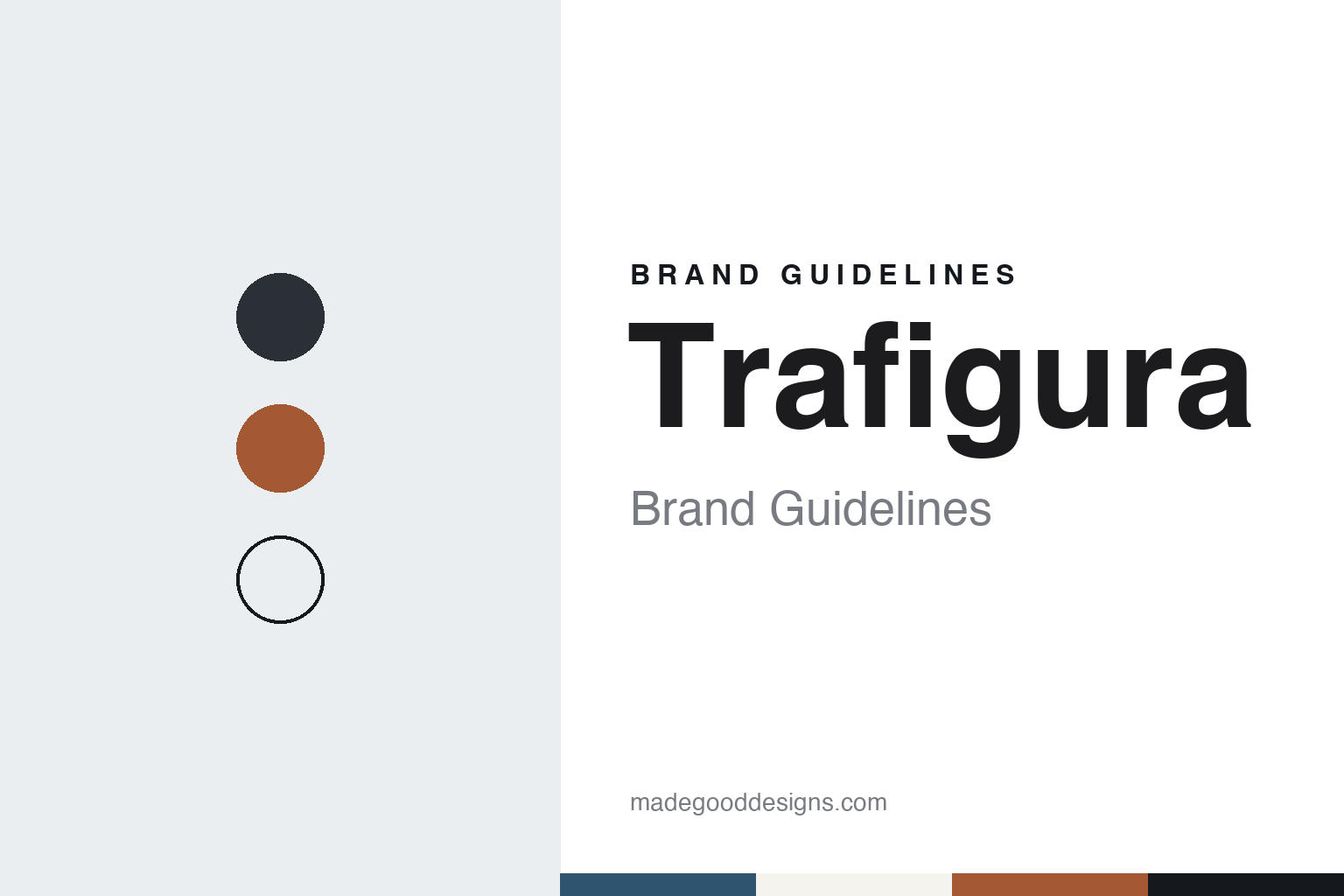
Two constants: a port blue, smelter slate and copper ore palette and a sober text serif register. Abstract homage — not a Trafigura asset or mark; no logo, vessel or smelter is reproduced.
A standing start
Six partners, a borrowed name and a warehouse in Peru.
Trafigura was founded in 1993. The company says it was established by six founding partners led by Claude Dauphin “from a standing start”, and English Wikipedia names Eric de Turckheim among them, adding that the group formed in Geneva and quickly split off from a set of companies run by Marc Rich. According to English Wikipedia, its first markets were oil and minerals in South America, metals in Eastern Europe and oil in Africa.
The name came second-hand. Trafigura says it was bought from an existing company registered in Amsterdam and chosen because it brought to mind the word “transformation”. The company says its first acquisition, a year after the founding, was a metals warehouse in Peru, and English Wikipedia lists a Dutch holding company, Trafigura Beheer BV, among the group’s early units. The parent today is Trafigura Group Pte Ltd, based in Singapore, with regional hubs that English Wikipedia names as Geneva, Houston, Montevideo and Mumbai.
Ownership has stayed inside the firm. Trafigura says it “has proudly been an employee-owned business” since the beginning, and English Wikipedia says it was wholly owned by about 1,400 of its employees in 2024. The company now gives its workforce as about 14,500 people across more than 50 locations, working with producers and customers in more than 150 countries. English Wikipedia describes a succession plan under which Richard Holtum, previously global head of gas, power and renewables, was to become chief executive from January 2025, with Jeremy Weir moving to group chairman.
Colour
Oil, metals, mines and the logistics between them.
Trafigura describes itself as a supplier of metals and minerals, oil and petroleum products, and gas and power. English Wikipedia says it sources, stores, blends and transports oil, refined products, non-ferrous metals, iron ore and coal, and that a third division for gas, power and renewables was added more recently. The company lists LNG, carbon removal credits, hydrogen and renewable energy as markets it is helping to develop.
The metals side reaches into industry. On 31 July 2019 Trafigura announced that it had become the majority owner of the operating business of Nyrstar, the multi-metals group, after a restructuring, with Nyrstar’s new headquarters to be set up at Budel in the Netherlands. In July 2026 ABC News in Australia described Trafigura as the owner of Nyrstar’s smelters in Port Pirie and Hobart, and reported that former Nyrstar shareholders were pursuing a legal dispute in Belgium over the 2019 takeover; Trafigura denies their claims. English Wikipedia adds that in 2015 Trafigura formed a mining joint venture with Mubadala of Abu Dhabi, which took half of the MATSA copper, zinc and lead mines in southern Spain.
Logistics carry the rest. English Wikipedia names Impala Terminals, wholly owned since 2001, as the arm for storage and distribution assets, and records that in 2016 Trafigura held 49 percent of Puma Energy, the fuel storage and retail business active mainly in Central America and Africa. In 2022 the Lobito Atlantic Railway, a joint venture of Trafigura, Portugal’s Mota-Engil and the Belgian rail operator Vecturis, won a 30-year concession for the Lobito rail corridor from Angola into the Democratic Republic of the Congo; English Wikipedia says the transfer was marked in Lobito in July 2023 and port operations began in July 2024. Since 2003 the group has also run Galena Asset Management, a fund management business.
Typography
How trading houses present themselves.
Commodity trading houses sit between the producers of oil, gas, metals and grain and the refineries, smelters, utilities and food makers that use them. Many are privately held, some by their own staff, and few sell anything under their own name to the public. Their brands are written for a narrow audience: lenders, state oil companies, mining partners, regulators and the people they hope to hire.
That audience shapes how they look. Their websites tend to be sober and spare, with short statements of purpose, a handful of photographs and plain navigation by commodity: crude oil and products, gas and power, metals and minerals, agricultural goods. The pictures that do appear are usually of the physical chain rather than of people at screens: tankers at sea, storage terminals and tank farms, ports, rail lines, smelters and grain silos. Trading floors, the image most people associate with the business, appear only rarely.
Much of the identity work is done in documents. Annual reviews and volume statements explain what a physical trader does and how much it moved in a year; responsibility, sustainability and transparency reports set out policies on emissions, human rights and payments to governments; and ethics and compliance pages sit prominently in the main menu. For several of these companies, those pages also have to address court cases, regulatory penalties and settlements that form part of their public record.
This guide looks at each house in turn: where and when it was founded, who owns it, what it trades and which assets it holds, and what independent, dated sources record about it. Where a fact rests only on a company’s own statement, it is marked as such. The palettes and typefaces here are our own unofficial interpretations, not the companies’ brand assets.
Aa
A sober text serif for a trader that writes long reports. (Specimen set in Source Serif 4, a serif STAND-IN; NOT the Trafigura logo.)
Trafigura
A tanker case and two bribery outcomes.
Trafigura’s public record includes the Probo Koala case. In August 2006, according to English Wikipedia, waste from the tanker Probo Koala, chartered by Trafigura, was unloaded in Abidjan, Côte d’Ivoire, by a local contractor after the ship had called at Amsterdam. In 2007 Trafigura reached a settlement with the Ivorian state under which legal proceedings against the company in Côte d’Ivoire were withdrawn, RFI reported in August 2026. English Wikipedia records that a civil claim brought in London was settled in 2009, and that in 2010 a Dutch court found Trafigura guilty of illegally exporting waste from Amsterdam.
Two bribery cases followed later. On 28 March 2024, English Wikipedia records, Trafigura pleaded guilty in the United States to conspiracy to violate the anti-bribery provisions of the Foreign Corrupt Practices Act, over payments to officials of Brazil’s state oil company Petrobras between 2003 and 2014; the agreement requires annual compliance reports to the US Department of Justice over three years. On 31 January 2025 Switzerland’s Federal Criminal Court in Bellinzona convicted the company of organisational failings for not taking all reasonable measures to prevent bribes paid to an Angolan official between 2009 and 2011, the Neue Zürcher Zeitung reported that day. English Wikipedia says Trafigura appealed in 2025, and under Swiss law the judgment is not final while the appeal runs.
The company’s website opens with “critical resources to the world”, tells its history as a short numbered story from 1993 onwards, and gives responsibility its own chapter, describing work on decarbonisation, environmental and social standards and human rights across commodity value chains.
For a design guide, Trafigura shows how a trading house can turn its own name into a statement of intent. Compare Vitol, another employee-owned trader founded in the Netherlands, and Glencore, another commodities trading house. For this guide we use port blue, smelter slate and copper ore with a serif, an unofficial interpretation; no product or logo is reproduced.
Explore & save
Keep Trafigura’s identity on hand — save it to a board in the Made Good inspiration library.
Trafigura identity set
Pin the Trafigura port blue, smelter slate and copper ore palette and the sober text serif register to your own board.