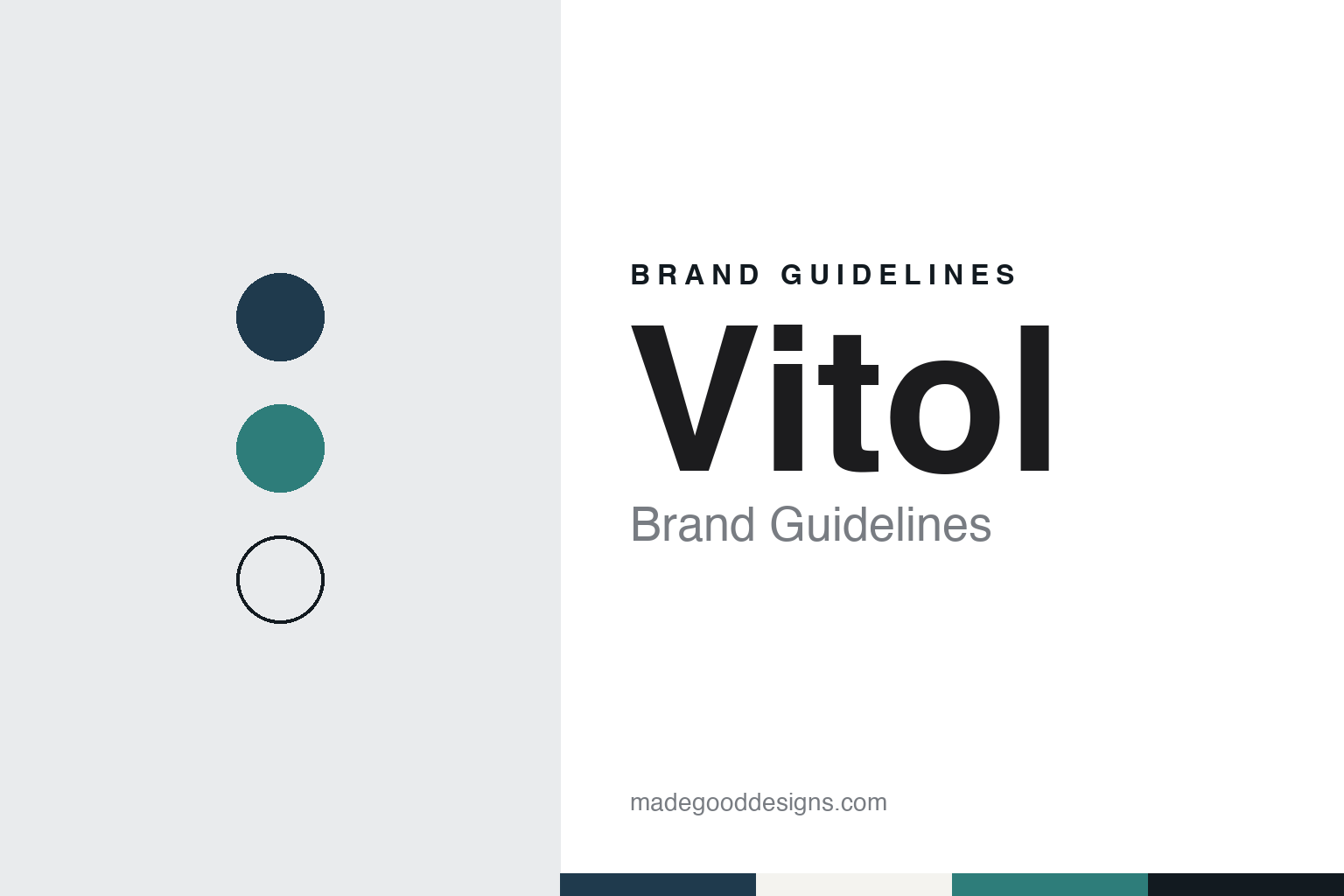
Vitol Brand Guidelines
A 1966 Rotterdam oil trader, owned by the people who run it.
Aa
Two constants: a harbour navy, tanker grey and signal teal palette and a plain grotesque sans register. Abstract homage — not a Vitol asset or mark; no logo, vessel or terminal is reproduced.
Rotterdam, 1966
A coal trader’s new business in a port city.
Vitol began in Rotterdam in 1966. English Wikipedia names its founder as Henk Viëtor, and Dutch Wikipedia describes him as a Rotterdam coal trader. According to Dutch Wikipedia, the business soon reached London, Geneva and Houston; today its head office is in Geneva, and English Wikipedia calls it a Swiss-based Dutch multinational, adding that the name is pronounced “Vee-Tol”. The company lists more than 40 offices, and English Wikipedia names Geneva, Houston, London and Singapore as its largest operations.
Vitol has never been listed on a stock exchange. English Wikipedia says it is privately held by about 400 partners, current and former employees, while Dutch Wikipedia puts the number of shareholders at about 350, all working at the company; the two counts come from different years. The company describes “a flat, meritocratic structure” and says it employs more than 1,900 people of more than 75 nationalities. English Wikipedia notes a long-standing culture of privacy around the business, and that Vitol shares more financial detail with its lenders than with the public.
Size is reported mostly by others. Dutch Wikipedia records that Vitol topped Elsevier’s ranking of the largest companies in the Netherlands in 2022, 2023 and 2024. In its own statement on 2025 volumes, Vitol says it delivered an average of 8 million barrels a day of crude oil and products, that crude and products “remain the core of the business”, and that 2026 is its 60th anniversary. The same statement says the company has spent recent years building a portfolio of long-term assets to sit alongside its trading business.
Colour
Tankers, terminals, refineries and service stations.
Vitol says it trades and distributes energy using its own logistics and infrastructure network. English Wikipedia lists crude oil and refined products alongside coal, natural gas, power, LNG, LPG, naphtha, bitumen and carbon credits, and says the company confirmed in 2024 that it was expanding into metals. Its website now groups the business under five headings: crude oil and products, gas, power, sustainable energy solutions and metals, with iron ore, aluminium, copper and metallurgical coal listed under metals. Vitol says it supplies national oil companies, multinationals, industrial companies and utilities.
Storage runs largely through VTTI. Dutch Wikipedia describes VTTI as a joint venture that began with the Malaysian shipping group MISC, whose stake Vitol bought out in mid-2015, and notes that VTTI owns the Euro Tank Terminal, operating in Rotterdam since 2006. English Wikipedia gives the current owners as Vitol and IFM Investors, with 45 percent each, and the Abu Dhabi National Oil Company with 10 percent, and lists VTTI terminals in eleven countries, from the Netherlands and Belgium to Malaysia and Kenya.
The service-station business carries other companies’ brands. English Wikipedia says Vivo Energy was set up in 2011 by Vitol and the private equity firm Helios Investment Partners to buy a majority of Shell’s downstream fuels business in Africa; it operates as a Shell and Engen licensee, listed in London in May 2018, and was acquired by Vitol in July 2022. In Australia, English Wikipedia reports, Vitol and a partner bought Shell’s downstream business, including the Geelong refinery, in 2014; it trades as Viva Energy, with the Shell brand still on many of its retail products. Vitol says it now counts more than 10,000 service stations.
Refining and power complete the picture. English Wikipedia names the Fujairah refinery as Vitol’s main Middle East asset, and Dutch Wikipedia records the 2017 agreement to take over Koch’s small refinery in Rotterdam’s port, which Vitol now calls VPR. English Wikipedia says Vitol’s first power plant, VPI Immingham in England, came in 2013; Vitol says VPI now runs generation in the UK and Ireland. The company also reports buying the Danish plastics recycler WPU in late 2024, and says 2025 was the first year since its acquisition of Noble Resources, an Asian-focused natural resources business.
Typography
How trading houses present themselves.
Commodity trading houses sit between the producers of oil, gas, metals and grain and the refineries, smelters, utilities and food makers that use them. Many are privately held, some by their own staff, and few sell anything under their own name to the public. Their brands are written for a narrow audience: lenders, state oil companies, mining partners, regulators and the people they hope to hire.
That audience shapes how they look. Their websites tend to be sober and spare, with short statements of purpose, a handful of photographs and plain navigation by commodity: crude oil and products, gas and power, metals and minerals, agricultural goods. The pictures that do appear are usually of the physical chain rather than of people at screens: tankers at sea, storage terminals and tank farms, ports, rail lines, smelters and grain silos. Trading floors, the image most people associate with the business, appear only rarely.
Much of the identity work is done in documents. Annual reviews and volume statements explain what a physical trader does and how much it moved in a year; responsibility, sustainability and transparency reports set out policies on emissions, human rights and payments to governments; and ethics and compliance pages sit prominently in the main menu. For several of these companies, those pages also have to address court cases, regulatory penalties and settlements that form part of their public record.
This guide looks at each house in turn: where and when it was founded, who owns it, what it trades and which assets it holds, and what independent, dated sources record about it. Where a fact rests only on a company’s own statement, it is marked as such. The palettes and typefaces here are our own unofficial interpretations, not the companies’ brand assets.
Aa
A plain grotesque sans for a company that says little in public. (Specimen set in Archivo, a sans STAND-IN; NOT the Vitol logo.)
Vitol
A record set down in courts and regulators’ decisions.
Vitol’s legal record is part of its public story. English Wikipedia records that in 2007 Vitol pleaded guilty in a New York court in a case connected with surcharges paid under the United Nations oil-for-food programme for Iraq. In 2018 the sanctions committee of France’s energy regulator, the CRE, penalised VITOL S.A. for market manipulation on the southern French gas trading point between 2013 and 2014; France’s Council of State confirmed the sanction in June 2021.
In December 2020 Vitol’s US affiliate, Vitol Inc., admitted bribing officials in Brazil, Ecuador and Mexico and entered a deferred-prosecution agreement with US authorities, The Rio Times reported in May 2026; English Wikipedia describes the resolution as covering authorities in both the United States and Brazil. The Rio Times adds that the case barred Vitol from doing business with the Mexican state oil company Pemex, and that in 2026 Vitol was preparing a fuel terminal near the US border, its first physical foothold in Mexico’s refined-products market. Separately, English Wikipedia notes that in 2022 Vitol said it would stop trading Russian crude and oil products by the end of that year.
The company presents itself in plain terms. Its website calls Vitol “a global energy and commodities company”, sets out its values as integrity, entrepreneurship, excellence, respect and collaboration, and places ethics and compliance pages next to its careers pages.
For a design guide, Vitol shows how a partner-owned trader can stay almost invisible while the brands on its forecourts belong to others. Compare Shell, whose brand Vivo Energy and Viva Energy carry, and Glencore, another commodities trading house. For this guide we use harbour navy, tanker grey and signal teal with a sans, an unofficial interpretation; no product or logo is reproduced.
Explore & save
Keep Vitol’s identity on hand — save it to a board in the Made Good inspiration library.
Vitol identity set
Pin the Vitol harbour navy, tanker grey and signal teal palette and the plain grotesque sans register to your own board.