Castleton Commodities Brand Guidelines
A Louis Dreyfus energy arm of 1997, renamed in Stamford in 2012.
Aa
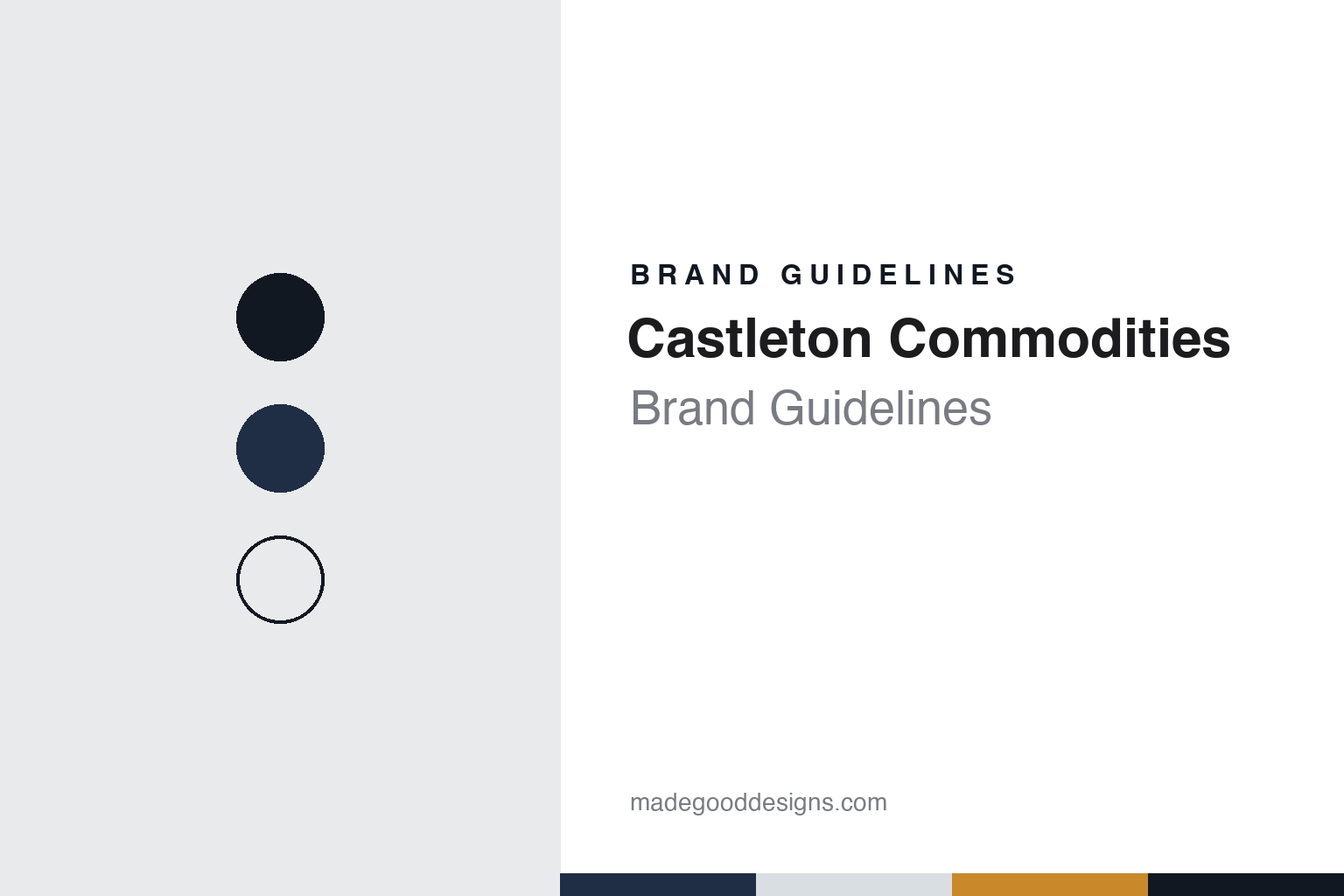
Two constants: a navy, slate and amber palette and a plain corporate sans register. Abstract homage — not a Castleton Commodities asset or mark; no logo, plant or vessel is reproduced.
From Louis Dreyfus
An energy arm of a grain house.
Castleton Commodities International — CCI in its own shorthand — did not start under that name. Its history page says it “was established in 1997 as a subsidiary of the Louis Dreyfus Group”, the agricultural merchant that still trades under that family name. English Wikipedia gives the early name as Louis Dreyfus Energy, set up to trade energy, and says that by 2006 it ranked among the ten largest natural gas marketers in the United States.
The second step came in 2006. The company says the New York hedge fund Highbridge Capital Management made “a significant minority equity investment” in the Louis Dreyfus energy subsidiary, which became Louis Dreyfus Highbridge Energy LLC, often shortened to LDH Energy; English Wikipedia describes the arrangement as a joint venture. In 2011, by the company’s timeline, LDH Energy sold its midstream energy assets.
The present name dates from 2012. In October that year, English Wikipedia says, a group of investors agreed to buy LDH Energy from Louis Dreyfus and Highbridge; Louis Dreyfus wanted to raise capital for its agricultural trading business. CCI’s own account is that the business “was acquired by management and a group of private investors” and renamed Castleton Commodities International LLC. It has stayed privately held since then. Its headquarters are in Stamford, Connecticut, and English Wikipedia lists offices in Calgary, Houston, Geneva, London and Singapore.
In short, the company is a renamed division: an energy desk built inside a grain and agricultural merchant, then sold to its own managers and a group of investors.
Colour
Merchant desks and power plants.
CCI describes two halves. Its merchant side trades natural gas, power, and oil and oil products, physically and financially; on its oil page it lists middle distillates and fuel oil, gasoline and bio blending, and storage and transport capacity. Its assets side owns and runs energy infrastructure, which the company presents as a way to “express long-duration research theses” in markets it already trades.
The most widely reported deal is oil. On 11 May 2015 the Associated Press, in a report carried by KSL.com, said that Morgan Stanley was selling its oil storage and transport business to Castleton: terminal storage agreements, inventory, purchase, sale and supply contracts, and freight shipping contracts. The report noted that the bank had agreed to sell the same unit to Rosneft in December 2013 and that the earlier deal fell through, and it said the companies hoped to complete the sale in 2015. CCI’s timeline lists the purchase of Morgan Stanley’s Global Oil Merchanting business as a 2015 event.
The power side has grown plant by plant. The company says it bought two gas-fired plants, Rensselaer in New York and Signal Hill in Texas, in 2012, the Roseton station in New York in 2013, Bizkaia Energía in the Basque Country in February 2020, a majority stake in New Salem Harbor in Massachusetts in April 2023 and Hunlock in Pennsylvania in September 2024. It also lists wind farms, gas plants in the Netherlands and a power portfolio in New England that it later sold, which it calls “monetizing.”
Batteries are the newer thread. CCI says it took a controlling interest in S4 Energy, a Dutch developer of grid-scale battery storage, in January 2023, and in June 2025 folded its British battery business, L48 Energy, into it. In a press release dated 11 February 2026 it said a subsidiary had bought Linden VFT, a transmission link in Linden, New Jersey, from GE Vernova; its timeline for 2026 also records the sale of its stake in TG Natural Resources and of the Roseton plant.
Typography
How commodity traders present themselves.
Commodity trading houses sit between the producers of oil, gas, metals and grain and the refineries, smelters, utilities and food makers that use them. Many are privately held, some by their own staff, and few sell anything under their own name to the public. Their brands are written for a narrow audience: lenders, state oil companies, mining partners, regulators and the people they hope to hire.
That audience shapes how they look. Their websites tend to be sober and spare, with short statements of purpose, a handful of photographs and plain navigation by commodity: crude oil and products, gas and power, metals and minerals, agricultural goods. The pictures that do appear are usually of the physical chain rather than of people at screens: tankers at sea, storage terminals and tank farms, ports, rail lines, smelters and grain silos. Trading floors, the image most people associate with the business, appear only rarely.
Much of the identity work is done in documents. Annual reviews and volume statements explain what a physical trader does and how much it moved in a year; responsibility, sustainability and transparency reports set out policies on emissions, human rights and payments to governments; and ethics and compliance pages sit prominently in the main menu. For several of these companies, those pages also have to address court cases, regulatory penalties and settlements that form part of their public record.
This guide looks at each house in turn: where and when it was founded, who owns it, what it trades and which assets it holds, and what independent, dated sources record about it. Where a fact rests only on a company’s own statement, it is marked as such. The palettes and typefaces here are our own unofficial interpretations, not the companies’ brand assets.
Aa
A plain corporate sans for a firm that publishes little imagery. (Specimen set in IBM Plex Sans, a sans STAND-IN; NOT the Castleton Commodities logo.)
Castleton Commodities
A private merchant that explains itself in timelines.
Castleton presents itself soberly. Its website opens with the line “Unlocking Value in Energy Markets” and calls the firm “a leading global energy commodities merchant and infrastructure asset investor” — its own description. The pages carry a short set of figures about offices, staff and years in the market, a list of press releases, and a long year-by-year history made up almost entirely of purchases and sales. The visual weight sits with the plants rather than with traders: the asset pages describe each power station by place, fuel and type of turbine.
The firm uses the initials CCI almost everywhere, and its web address is built on them. The same three letters are used by many unrelated companies, so the full name Castleton Commodities International is the safer search term. Its press releases follow a fixed form: a dated Stamford dateline, a short statement of the deal and a standard paragraph describing CCI as “a global energy commodity merchant with integrated businesses” in trading and in commodity infrastructure.
Responsibility has its own page. CCI says it has adopted a sustainability framework aligned with the United Nations Sustainable Development Goals, organised in three pillars — corporate governance and compliance, people and social responsibility, and environment, safety and health — and that all employees take annual compliance training under a code of business conduct. Those are the company’s own statements.
The name change in 2012 was a clean break. Under Louis Dreyfus and Highbridge the business carried both owners’ names; after the sale it took a new name with neither, and the timeline on its website still begins with the Louis Dreyfus years.
For a design guide, Castleton Commodities shows how a spun-out trading business builds an identity from a new name, a set of initials and a record of assets. Compare Louis Dreyfus Company, the house it came from, and Hartree Partners, another American merchant that began inside a larger company. For this guide we use a navy, a slate and an amber with a sans, an unofficial interpretation; no product or logo is reproduced.
Explore & save
Keep Castleton Commodities’s identity on hand — save it to a board in the Made Good inspiration library.
Castleton Commodities identity set
Pin the navy, slate and amber palette and the plain corporate sans register to your own board.