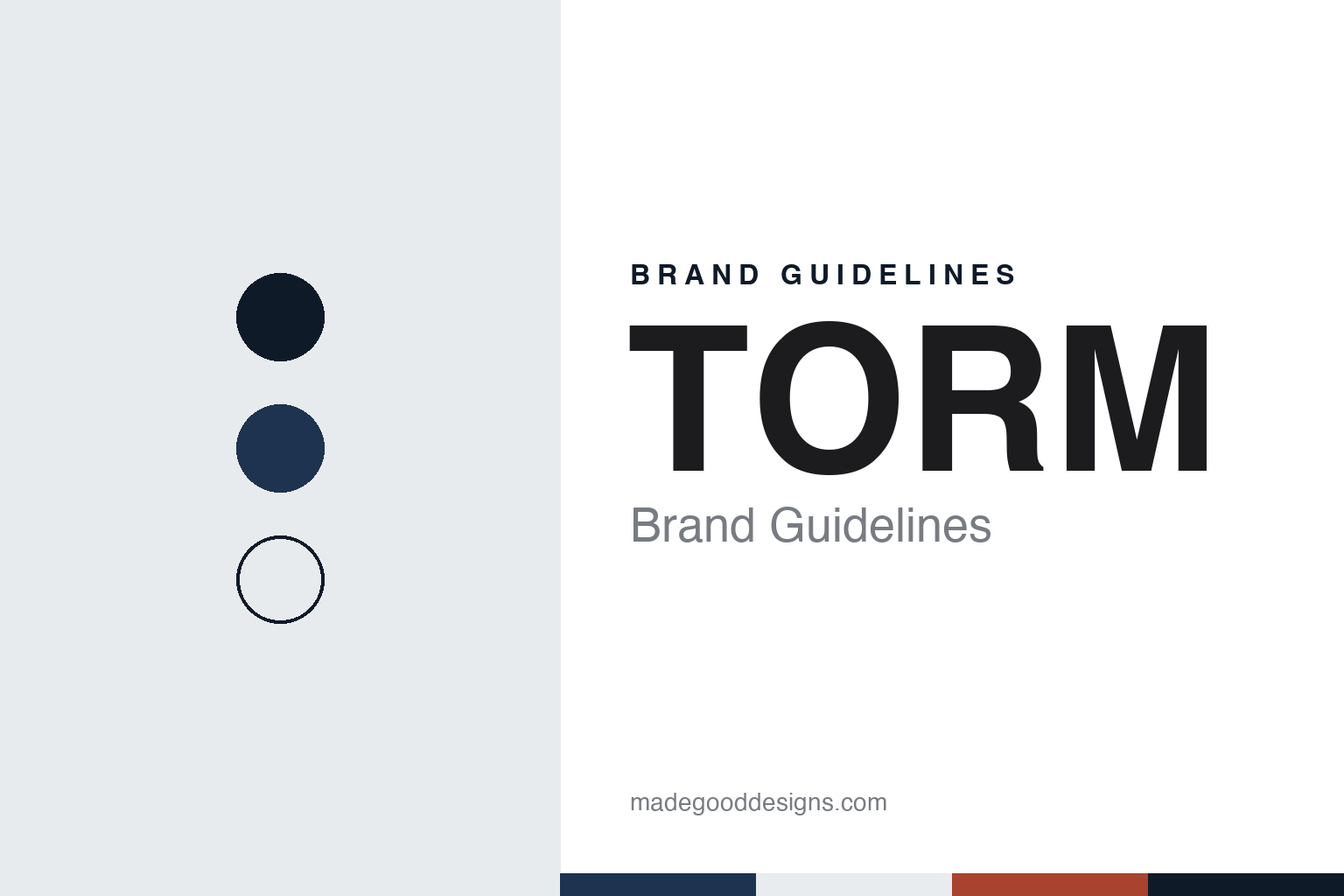
TORM Brand Guidelines
An 1889 Danish shipowner that became a product tanker company.
Aa
Two constants: a TORM navy, steel and brick palette and a Plain sans register. Abstract homage — not a TORM vessel, flag or mark; no funnel mark, logo or house flag is reproduced.
Ditlev Torm
A captain, a partner and a steamer.
TORM is a Danish shipowner that has traded under the same name since 1889. It was founded that year by the ship’s captain Ditlev Torm and Christian Schmiegelow, according to the Danish national encyclopaedia Lex, whose entry carries text from Den Store Danske. English Wikipedia, citing the Dansk Biografisk Leksikon, says Torm had gone to sea at 14, had already started a steamship company for the Bornholm trade in 1879, and in the new partnership ran the office while Schmiegelow sailed the first ship, the steamer Alice.
The early business, Lex says, concentrated on shipping and freight in the North Sea and the Baltic, and the company was listed on the Copenhagen stock exchange as early as 1905. English Wikipedia adds that Ditlev Torm chaired Fællesrepræsentationen for dansk skibsfart, a joint body for Danish shipping, from 1900 to 1907. The company kept the founder’s surname, and it is written in capitals, TORM, in its listed name and in Lex.
The sources used for this guide do not say how TORM’s ships and business fared during the German occupation of Denmark from 1940 to 1945. Lex picks up the story after the Second World War, when the company widened its trade with liner services linking the west coast of North America with ports in South America and the Mediterranean.
Colour
From liners to product tankers.
The liner trade did not last. In 2002, Lex says, TORM sold its liner activity to A.P. Møller, the Danish group behind Maersk, to concentrate on two kinds of ship: dry-bulk carriers and product tankers. Product tankers carry refined oil products rather than crude oil; English Wikipedia lists the cargoes on TORM’s ships as gasoline, jet fuel, naphtha and diesel oil.
Growth then came by acquisition. On 8 June 2007, English Wikipedia records, TORM and the Canadian shipowner Teekay announced that they had completed the purchase of the American tanker company OMI Corporation, which became their jointly owned subsidiary. TORM took over 24 of OMI’s product tankers from 1 August that year, along with OMI’s technical operations in India and part of its American organisation. Lex gives the same figure of 24 tankers, and says that by 2012 the company owned about 90 tankers and eight bulk carriers.
The global financial crisis then put TORM in serious financial difficulty, Lex says. The crisis ended in a thorough reconstruction in 2015, when the American investment firm Oaktree Capital Management, through a company called OCM Njord Holdings, converted debt into shares. That made Oaktree the largest shareholder, with up to 99 per cent of the new share capital, while Oaktree’s own fleet of 31 tankers was added to TORM’s. In the same year TORM sold its last bulk carriers — English Wikipedia says the last two went in 2015 — and became a pure product tanker company.
The group structure changed next. Lex dates to 2017 the restructuring that made the listed parent the British-registered TORM plc, while the Danish business is still run from the head office at Hellerup, north of Copenhagen. Its shares trade on Nasdaq Copenhagen and on Nasdaq in New York, and Danish Wikipedia lists offices in Hellerup, Mumbai, Houston, Manila and Singapore. Lex names Jacob Balslev Meldgaard as chief executive and Kim Balle as chair of the board.
Typography
Design and documentation.
A tanker or dry-bulk owner sells a service rather than a product, so its identity has to live on its ships and in its paperwork. The oldest signs are the funnel mark and the house flag, painted or flown on every vessel the company operates; today the same hull in company livery is more often seen in an aerial photograph taken from a drone, the ship shown loaded and under way, filling the first screen of a corporate website.
Behind that picture sits the fleet list. Owners publish their ships by class and by name, from the very large crude carriers and Suezmax tankers of the crude trade to Capesize and smaller bulk carriers. Frontline’s home page, for example, counts its VLCCs, Suezmaxes and LR2/Aframax tankers, while CMB.TECH groups its ships under division names such as Euronav for oil tankers and Bocimar for dry bulk. Vessel names can run in a family too: Bocimar’s ships usually carry the prefix Mineral, English Wikipedia says.
Most owners also give space to crew welfare and safety, to environmental reporting and to the next generation of ships. Newbuilding and fuel announcements carry much of the story: CMB.TECH, for one, uses the slogan “Decarbonise Today, Navigate Tomorrow” and in 2026 presented a dry-bulk ship it describes as ammonia-powered, while Frontline’s 2026 fleet-renewal deal was framed around scrubber-fitted “ECO” newbuildings.
Because so many of these companies are listed in New York, Oslo or Brussels, the investor-relations section often does the heaviest lifting: quarterly results, presentations, dividend histories and charts of freight rates. This guide sets out what can be checked about each company — where it was founded, who controls it and what became of its name — and marks clearly what rests only on the company’s own word.
Aa
A plain sans — the founder’s name in capitals. (Specimen set in Archivo, a sans STAND-IN; NOT the TORM logo.)
TORM
A new shareholder and a merger question.
Oaktree’s holding has shrunk over the years, Lex says. In September 2025 Hafnia, the Singapore-based product tanker company controlled by the BW Group, agreed to buy about 14 per cent of TORM from Oaktree; The Maritime Executive reported on 23 December 2025 that the purchase had been completed after Danish and Brazilian regulators approved it, and that it gave Hafnia consultation rights on the appointment of one TORM board member. Hafnia kept buying: after further purchases in September 2026, Euroinvestor reported on 24 September that it held about 19.85 per cent of TORM’s share capital.
A combination of the two companies has been discussed but not agreed. In September 2025 Hafnia said, according to Maritime Danmark, that exploring a merger could benefit both sets of shareholders, but that no discussions had begun and there was no guarantee of a transaction. In December 2025 it said it planned to discuss merger possibilities with TORM’s board, The Maritime Executive reported, and in September 2026 Maritime Danmark wrote that Hafnia had made clear it sees possibilities in merging the two. No merger had been agreed at the time of writing, in November 2026.
TORM is meanwhile adding ships. At its third-quarter results on 4 November 2026, Xinde Marine News reported, it added eight LR2 product tanker newbuildings through a 50:50 joint venture, taking its committed newbuilding programme, including ships bought as resales, to 22 vessels, with deliveries scheduled through 2030. Figures from Seatrade Maritime, quoted by Maritime Danmark in September 2025, put the fleet expected at the end of that quarter at 88 ships, 68 of them owned. One of its ships is the tanker TORM Innovation, whose voyage from Saudi Arabia to Asia by way of the Suez Canal and the Cape of Good Hope Xinde Marine News has described.
For a design guide, TORM shows how a 19th-century founder’s surname can carry a company through changes of trade, owner and country of registration. Compare Hafnia, the product tanker company that became a major TORM shareholder in 2025, and Maersk, the Danish group that bought TORM’s liner business in 2002. For this guide we use a harbour navy, a steel grey and a brick red with a sans, an unofficial interpretation; no product or logo is reproduced.
Explore & save
Keep TORM’s identity on hand — save it to a board in the Made Good inspiration library.
TORM identity set
Pin the TORM navy, steel and brick palette and the Plain sans register to your own board.