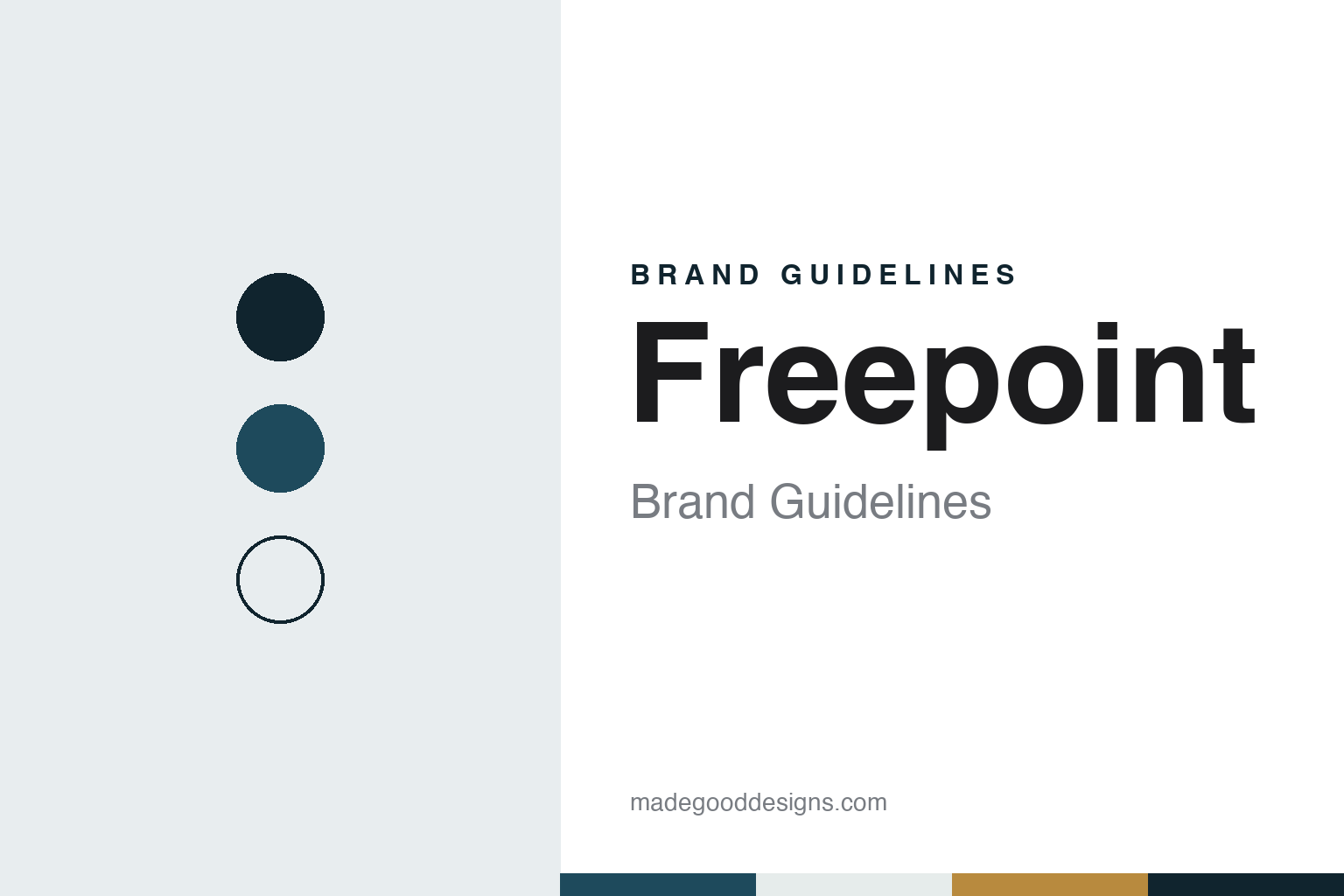
Freepoint Brand Guidelines
The Stamford merchant trader built with Stone Point in 2011.
Aa
Two constants: a teal, ink and brass palette and a corporate sans register. Abstract homage — not a Freepoint asset or mark; no logo or document is reproduced.
A merchant platform
A Connecticut trader backed by private equity.
Freepoint Commodities is a physical commodity trader based in Stamford, Connecticut. Reuters, in a report carried by Claims Journal in May 2025, described it as a “U.S. trading company” and a Stamford-based firm; English Wikipedia gives the same home. The company trades as Freepoint Commodities LLC, and its own pages shorten the name to plain “Freepoint.”
Its story is a short one by the standards of the trade. Freepoint says it partnered with Stone Point Capital in 2011 “to build a physical commodity merchant platform,” and it describes Stone Point as a private equity firm that invests in businesses in the financial services industry. Together, the company says, they have built an enterprise of more than 600 employees in over a dozen locations around the world. Freepoint lists its chief executive as David Messer, whom it describes as a thirty-five-year veteran of financial services, and says its vice chairman also chairs a sister business, Freepoint Solar.
The firm describes its position in a single line: it operates “at the intersection of commodity, capital, and physical asset markets.” Its site divides the business into three parts. Merchant Trading covers the buying, moving and selling of physical commodities; Merchant Finance covers financing and structured deals for counterparties; and Retail Solutions is described as meeting the energy needs of business customers. Freepoint says it has “a distinct vantage point in both the financial and physical markets.” It says its experience with physical assets, from transport and terminals to storage and power plants, lets counterparties rely on it to optimise “the movement, storage, and transformation of commodities.”
Colour
Gas, power, carbon and edible oils.
Freepoint’s market pages are unusually broad for a firm of its age. In natural gas, the company says it manages sales, purchases, storage and transport logistics “across the entirety of North America” for producers, midstream companies and end users. In Europe it describes itself as a participant in physical and financial gas markets from its London and Geneva offices, trading at the main hubs in the UK, Germany, the Netherlands, France, Italy, Austria and Spain, and says it holds a portfolio of storage and transport capacity to back that trading. A separate liquefied natural gas team offers short- and long-term supply, from local gas sourcing to liquefaction, shipping and delivery.
In power, Freepoint says it trades in US markets within the territories of the independent system operators, the regional bodies that run American grids. In carbon, it says its emissions team trades in the European Union Emission Trading System on several platforms and over the counter, and that its Asia-Pacific carbon team is looking to become an active participant in China’s national carbon trading scheme, offering route-to-market and carbon asset management services.
Agriculture is the other strand. Freepoint says its agricultural business in Asia imports and distributes edible oils for the China market from North America, South America and Southeast Asia, and that it also sources and supplies crop-based and waste-based renewable feedstocks for biofuels. Its home page also links to Freepoint Eco-Systems, under the line “Closing the loop for a sustainable tomorrow.”
The company’s public face is restrained. Its home page repeats a single tagline, “Our Experience. Your Advantage.”, over three short promises about knowledge, value and reliability, and the site is offered in Chinese, Bahasa and Portuguese as well as English. A values panel is headed “Responsibility, Authenticity & Integrity,” and the company’s mission statement speaks of “consistency, authenticity and integrity in every aspect of what we do.”
Typography
How trading houses present themselves.
Commodity trading houses sit between the producers of oil, gas, metals and grain and the refineries, smelters, utilities and food makers that use them. Many are privately held, some by their own staff, and few sell anything under their own name to the public. Their brands are written for a narrow audience: lenders, state oil companies, mining partners, regulators and the people they hope to hire.
That audience shapes how they look. Their websites tend to be sober and spare, with short statements of purpose, a handful of photographs and plain navigation by commodity: crude oil and products, gas and power, metals and minerals, agricultural goods. The pictures that do appear are usually of the physical chain rather than of people at screens: tankers at sea, storage terminals and tank farms, ports, rail lines, smelters and grain silos. Trading floors, the image most people associate with the business, appear only rarely.
Much of the identity work is done in documents. Annual reviews and volume statements explain what a physical trader does and how much it moved in a year; responsibility, sustainability and transparency reports set out policies on emissions, human rights and payments to governments; and ethics and compliance pages sit prominently in the main menu. For several of these companies, those pages also have to address court cases, regulatory penalties and settlements that form part of their public record.
This guide looks at each house in turn: where and when it was founded, who owns it, what it trades and which assets it holds, and what independent, dated sources record about it. Where a fact rests only on a company’s own statement, it is marked as such. The palettes and typefaces here are our own unofficial interpretations, not the companies’ brand assets.
Aa
A plain corporate sans for a firm that sells experience. (Specimen set in Archivo, a sans STAND-IN; NOT the Freepoint logo.)
Freepoint
Integrity as the headline.
That emphasis on integrity sits next to a legal record. In December 2023, according to a US Justice Department statement reproduced by Townhall in December 2025, Freepoint admitted to bribing officials in Brazil in violation of the anti-bribery provisions of the US Foreign Corrupt Practices Act, in a case concerning fuel oil business with the state-owned oil company Petrobras. It entered a deferred prosecution agreement with the department’s Fraud Section and the US Attorney’s Office for the District of Connecticut. Reuters, in May 2025, described it as a three-year agreement and reported that one of its conditions was that Freepoint strengthen its corporate governance. Freepoint’s site now carries links to its code of conduct, a regulatory information page and a global grievance hotline in its footer, alongside a sustainability report organised under governance, people, planet and prosperity.
For a design reader the interest lies in how little a trader of this kind needs to show. Freepoint sells no consumer product and carries no shelf presence; its identity lives in a website, a newsroom, credit announcements and the documents a counterparty reads before a deal. The site’s structure, with “Who We Are,” “What We Do,” “Markets We Serve” and “Sustainability” as its four pillars, puts the explanation of what a physical trader does ahead of any imagery, and the same three words, experience, integrity and reliability, recur across its pages.
For a design guide, Freepoint shows how a young merchant trader builds credibility with a calm corporate sans, a short tagline and a governance page placed as prominently as its market list. Compare its Stamford neighbour in our Castleton Commodities brand guidelines, the New York trader in our Hartree Partners brand guidelines, or the Swiss giant in our Glencore brand guidelines. For this guide we use a harbour teal, night ink, mist and brass with a sans, an unofficial interpretation; no product or logo is reproduced.
Explore & save
Keep Freepoint’s identity on hand — save it to a board in the Made Good inspiration library.
Freepoint identity set
Pin the Freepoint teal, ink and brass palette and the corporate sans register to your own board.