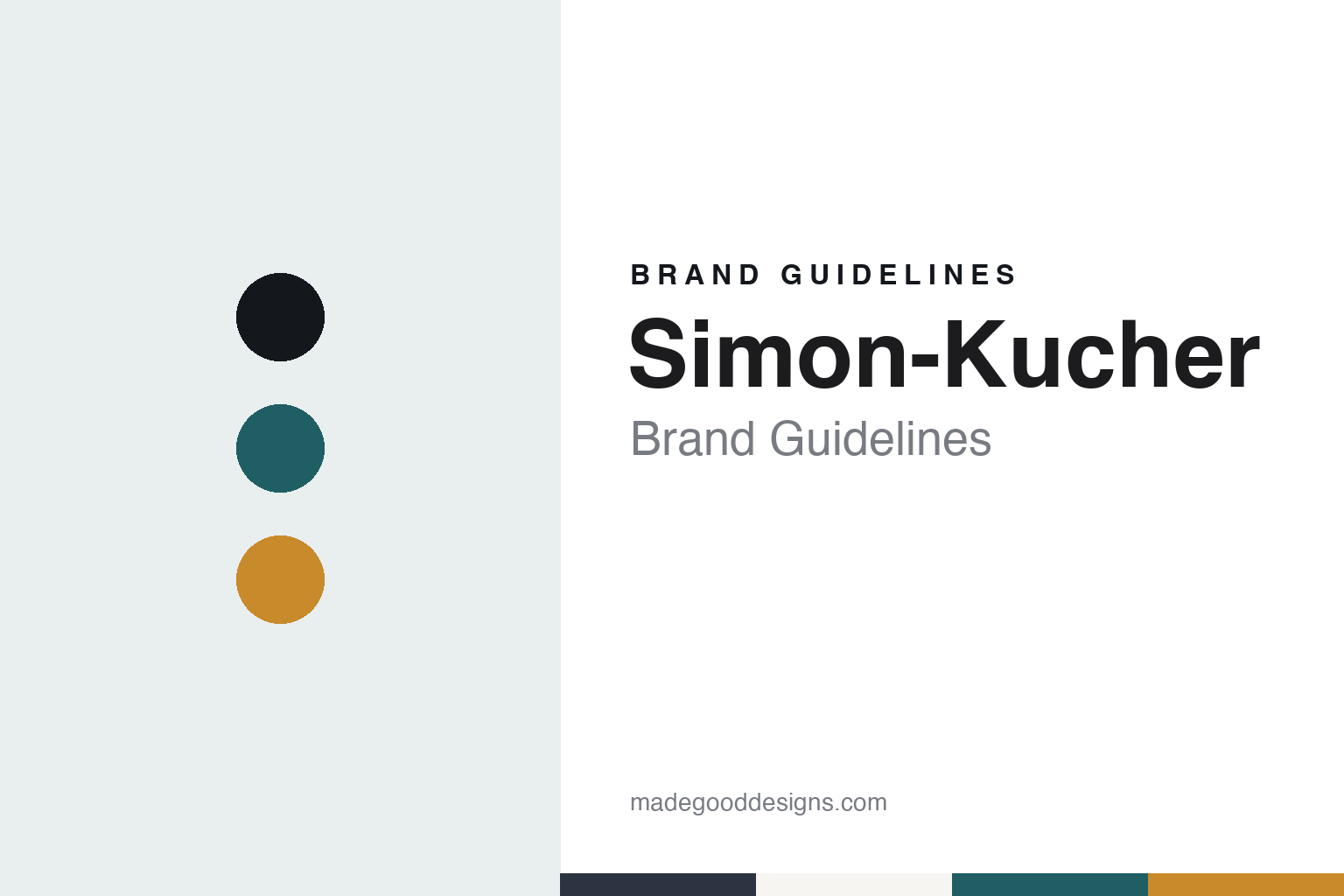
Simon-Kucher Brand Guidelines
A 1985 Bonn university spinoff built around pricing.
Aa
Two constants: a slate, teal and amber palette and a clean geometric sans register. Abstract homage — not a Simon-Kucher asset or mark; no logo or document is reproduced.
A university spinoff
A professor and two doctoral students in Bonn.
Simon-Kucher began in Germany in 1985. English Wikipedia says it was founded in Bonn by Hermann Simon and two of his doctoral students, Eckhard Kucher and Karl-Heinz Sebastian, at a time when Simon was a professor at the University of Bielefeld. The company describes itself as a university spinoff and says the founders wanted to help companies grow by applying scientific methods to real business problems. Simon’s own English Wikipedia entry gives his academic career as a professorship at Bielefeld from 1979 to 1989 and at the University of Mainz from 1989 to 1995, alongside visiting posts at schools including INSEAD, Stanford and the London Business School.
For its first decade the firm worked from Germany. In 1996 it opened an office in Cambridge, Massachusetts, which English Wikipedia describes as the first subsidiary abroad set up by an independent German consultancy; Paris, Zurich, Tokyo and Munich followed. German Wikipedia says the American company, still based in Cambridge, was built up by Klaus Hilleke, while the parent holding company sits in Bonn and a separate partnership operates in Singapore.
Leadership has changed hands several times. Hermann Simon ran the firm from 1995 until 2009, both Wikipedias say. English Wikipedia dates Georg Tacke’s time as chief executive from 2009; Consultancy.uk, writing in February 2016, described Tacke and Klaus Hilleke as the firm’s co-CEOs from late 2010. Andreas von der Gathen and Mark Billige were co-CEOs from 2020 to 2024, and Gunnar Clausen and Jörg Krütten have shared the role since 1 January 2025, according to English Wikipedia, which also says a board of nine partners from different countries leads the firm.
Colour
Price as a discipline of its own.
Outside observers tied the firm to pricing early on. German Wikipedia records that BusinessWeek described Simon-Kucher in 2004 as a “world leader in giving advice to companies on how to price their products,” and that WirtschaftsWoche called it a market leader in pricing strategy in 2007. Hermann Simon wrote widely on the subject: English Wikipedia lists Power Pricing (1997) and the German handbook Preismanagement among his books, and credits him with coining the phrase “hidden champions,” the title of his 1996 Harvard Business School Press book Hidden Champions.
The work has since widened from price alone. On its profile with Consultancy.uk, the firm lists commercial strategy consulting, pricing and revenue management, a digital growth practice called Elevate and software for commercial growth called Engine, alongside transaction services for private equity and corporate buyers. Its website describes its method as working on every commercial lever — product, price, innovation, marketing and sales — based on what customers want and value. In 2022, Consultancy.uk reported, it launched a European transaction services team focused on commercial due diligence.
Growth has come mostly through new offices. German Wikipedia lists Istanbul and Dubai in 2012; São Paulo and Santiago de Chile in 2013; Geneva, Hamburg, Stockholm and a second Silicon Valley office in 2016; Hong Kong in 2017; and Chicago, Shanghai, Mexico City and Cairo, its first office in Africa, in 2018. In 2016 Consultancy.uk counted 860 employees in more than 30 offices, most of them in Europe; by February 2023 it reported 45 offices in 30 countries, 190 partners and about 2,000 employees, with new offices in Seoul, Johannesburg and Mumbai. The company now gives its size as more than 2,200 people in over 30 countries.
German rankings have followed the firm for years. German Wikipedia says surveys of senior managers by manager magazin placed it first among marketing and sales advisers in 2007, 2011 and 2021, that brand eins and Statista named it a top-rated adviser in marketing, brand and pricing each year from 2014, and that the Financial Times listed it in 2018 as a leading UK consultancy for marketing, brand and pricing.
Typography
How consultancies present themselves.
Management consultancies sell advice, so their brands have to stand in for something a client cannot hold. Most begin with a name — often a founder’s surname, a set of initials or a coined word — set as a confident wordmark, and pair it with one signature colour that runs from the website to the cover of every report. The visual system is usually restrained, leaving the work itself to carry the message.
Much of that work is published. Firms put out thought-leadership articles, surveys and recurring indexes, along with yearly outlooks on trends in a sector; many also run podcasts and newsletters. Their websites are organised around industry pages and capability pages, so that a hospital chief, a utility executive or a private-equity partner can find the team that speaks to them.
Case studies are a staple, but clients are often anonymised: a “global insurer” or a “regional health system” rather than a named company, with the results stated as outcomes. Alongside them sit the signals of scale and standing that firms like to show — office maps, rankings and awards from business magazines, and partnerships with technology companies.
The people side is just as visible. Large consultancies keep alumni networks for former staff, many of whom go on to become clients, and their careers pages explain the hiring process in detail, often with guides to the case interview. Many also publish annual impact or responsibility reports. The guides that follow look at how individual firms handle these conventions, and where their own stories — origins, owners and names — set them apart.
Aa
A clean geometric sans for a firm that sells clarity about price. (Specimen set in Manrope, a sans STAND-IN; NOT the Simon-Kucher logo.)
Simon-Kucher
Two founders’ names and a shorter mark.
The name carries the surnames of two of the three founders, joined by a hyphen. Until January 2023 the firm traded as Simon-Kucher & Partners, German Wikipedia says, and has since used the shorter Simon-Kucher. The change came with a wider refresh: in February 2023 Consultancy.uk reported that the consultancy had unveiled a new corporate brand identity, with a refreshed logo and a new tagline, “Unlocking better growth.” Co-CEO Andreas von der Gathen told the publication that the firm should “practice what we preach” on growth, and his fellow co-CEO Mark Billige said the next chapter would centre on growth as the issue every company faces.
The tagline now runs through the company’s own story. Its website describes a purpose of unlocking better growth that increases long-term sales, value and profit, and contrasts this with short-term, finance-driven actions that can damage a business. It lists four values — impact, entrepreneurial spirit, opportunity and authentic relationships — and frames its heritage in one line: the firm “was born from science.” The company also publishes recurring consumer research, such as its annual US holiday shopping study, which Consultancy.uk covered in October 2026 as the eighth edition.
The founders’ academic roots remain part of the identity. Hermann Simon became the firm’s chairman in 2009, his English Wikipedia entry says, after fourteen years leading it. The firm’s English Wikipedia entry still describes its focus as growth strategy, marketing, pricing and sales — the same commercial ground the founders started from in Bonn.
For a design guide, Simon-Kucher shows how a consultancy can make a single discipline — price — the centre of its brand, and then widen the promise to growth without losing that anchor. Compare Roland Berger, another German strategy firm named after its founder, and L.E.K. Consulting, a strategy house with its own pricing work. For this guide we use slate, a deep teal and a warm amber with a sans, an unofficial interpretation; no product or logo is reproduced.
Explore & save
Keep Simon-Kucher’s identity on hand — save it to a board in the Made Good inspiration library.
Simon-Kucher identity set
Save the Simon-Kucher slate, teal and amber palette and the clean geometric sans register to your own board.