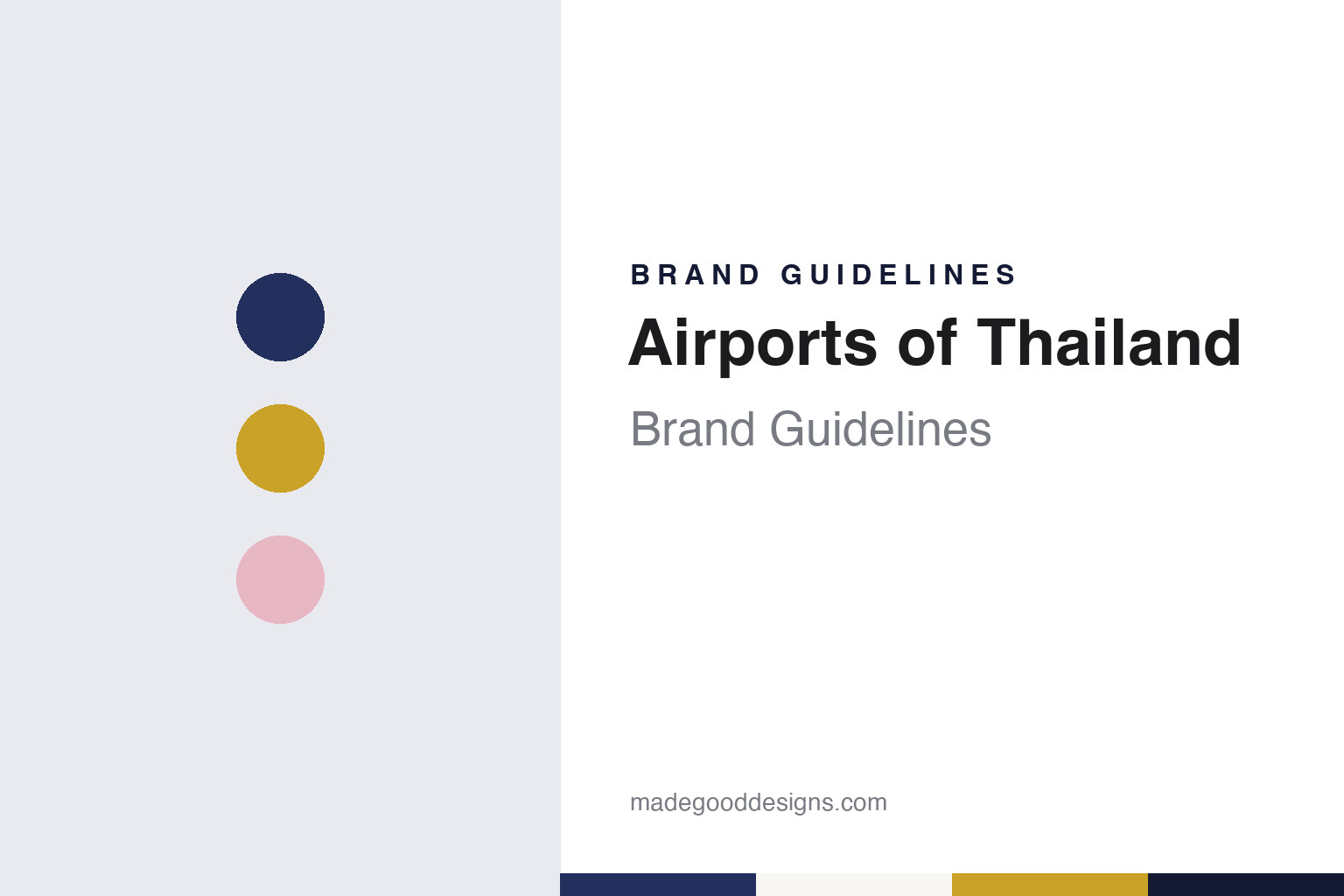
Airports of Thailand Brand Guidelines
A 1979 authority that grew into six airports and a listed company.
Aa
Two constants: a deep indigo, gold and lotus palette and a Thai-Latin sans register. Abstract homage — not an Airports of Thailand asset or mark; no logo, sign or livery is reproduced.
Don Mueang to an authority
A 1914 airfield and a 1979 law.
Airports of Thailand dates itself to 1 July 1979. That is the day staff began work under the Airports Authority of Thailand Act B.E. 2522, the 1979 law that created the Airports Authority of Thailand, the company’s history page says; English Wikipedia also records that AOT, as the authority’s successor, treats that date as its founding day. From the same day the new authority managed Bangkok Airport, the company says.
Bangkok Airport was the old Don Mueang, and its story starts long before the authority. According to the company and English Wikipedia, aviation in Thailand began with a flying display by the Belgian pilot Charles Van den Born at the Sa Pathum racecourse, now the Royal Bangkok Sports Club, in February 1911; three Thai officers went to train as pilots in France that year and came home in 1913 with eight aircraft the government had ordered. Sa Pathum proved too small and poorly placed, and the first aircraft landed at Don Mueang on 8 March 1914. The Royal Thai Air Force set up a civil aviation division in 1940, Don Mueang became an international airport in 1948, and it was renamed Bangkok Airport on 21 June 1955, the company says.
As an authority, the company says, it moved towards a more business-like way of running its airports and grew into a financially stable state enterprise. It also took over four regional international airports from the Department of Commercial Aviation: Chiang Mai, Hat Yai, Phuket and Chiang Rai, which was later given the royal name Mae Fah Luang – Chiang Rai International Airport.
Colour
A public company and a new gateway.
Corporatisation came in 2002. The company says it was registered as a juristic person under the name Airports of Thailand Public Company Limited on 30 September 2002; English Wikipedia dates its establishment to 20 September 2002 and describes the step as the privatisation of the state-owned authority, with the Thai government holding 70 per cent of the shares. Today the company describes itself as a state enterprise under the Ministry of Transport and a company listed on the Stock Exchange of Thailand. Thailand’s many smaller regional airports are run by a separate agency, the Department of Airports, Wikipedia says.
On 4 August 2003 AOT took over the project to build Suvarnabhumi Airport, the company says, and it opened the airport on 28 September 2006. Suvarnabhumi, in Samut Prakan province, replaced Don Mueang as the country’s main international gateway, and Bangkok Airport took the name Don Mueang International Airport on 13 March 2007. The company says Suvarnabhumi now welcomes more than 40 million travellers a year. Its architecture is the subject of our separate Suvarnabhumi Airport guide.
The company’s website lists six airports: Suvarnabhumi, Don Mueang, Chiang Mai, Mae Fah Luang – Chiang Rai, Phuket and Hat Yai. In 2015, English Wikipedia says, these six airports together handled just under 110 million passengers, a record at the time, and almost 728,000 take-offs and landings. Traffic fell during the COVID-19 pandemic; Wikipedia gives a figure of around 20 million people travelling through Thailand’s airports in 2021.
Typography
How airport operators present themselves.
An airport operator has an unusual design problem: most of the people who meet its brand never think about the company at all. They read its signs. Wayfinding is the core of the identity, and operators typically commission a sign typeface, a pictogram set and a colour code for departures, arrivals, gates and exits, then apply them to everything from motorway approach signs to the backs of check-in desks. The corporate logo often sits quietly in a corner while the directions do the work.
Architecture carries the rest of the image. Operators’ own photography tends to favour terminals at dusk, when glazed façades glow against a darkening sky, long roofs read as clean lines and an apron full of parked aircraft becomes a pattern of lights. Interiors are shown as wide, calm halls rather than queues, and new piers or façades are announced with renderings long before they open.
The numbers come next. Route maps radiating from a single hub, new long-haul destinations and passenger milestones are standard material for press pages and annual reports, because traffic is what airlines, investors and local governments want to see. Alongside them sit pages on sustainability and noise: carbon programmes, noise contour maps, insulation schemes for nearby homes and community funds, often written for neighbours rather than travellers.
Finally, an airport is also a shopping centre and a lounge network. Retail, food and lounge promotions follow a lighter, more commercial register, with seasonal campaigns and partner brands, while investor reports return to a sober corporate grid of charts and tables. The operators in this series show how one company can speak in all of these voices at once: public utility, landlord, retailer and listed or state-owned business.
Aa
A Thai-Latin sans for a company named in Thai and English. (Specimen set in Sarabun, a sans STAND-IN; NOT the Airports of Thailand logo.)
Suvarnabhumi, again
A satellite terminal and a duty-free rethink.
Growth at Suvarnabhumi has driven most of AOT’s recent projects. A satellite terminal, SAT-1, with 216,000 square metres of floor space and 28 aircraft stands, was due for a soft opening in September 2023, the Bangkok Post reported in June 2023; the same report described a planned North Expansion with a separate domestic terminal, and an East Expansion of about 60,000 square metres to the main terminal, and said AOT was preparing a 723-rai plot of land near the airport for commercial use under an Airport City and duty-free area project, with bidding then expected in 2024. In July 2024 the Bangkok Post reported that SAT-1 had been open since September 2023 and, citing AOT, that it had raised the airport’s annual capacity from 45 million to 60 million passengers. English Wikipedia notes that on 23 November 2024 AOT’s board told the Stock Exchange of Thailand it had agreed to acquire land for the East Expansion from King Power Suvarnabhumi.
The commercial floor is changing too. In November 2026 The Thaiger reported that AOT planned to cut the floor area given to duty-free shops at Suvarnabhumi, moving more sales to pick-up counters and handing some of the space to automated gates, while preparing a paid Premium Service that would separate its users from general passengers on arrival and departure. AOT was still in talks with King Power, its main duty-free partner, the report said, and the airport’s fifth master plan was with the Transport Ministry before going to Cabinet. These were plans, announced in November 2026 and not completed at the time of writing.
For a design guide, Airports of Thailand shows how a state authority’s name, shortened to three letters, can sit across a capital’s two airports and four regional ones. Compare Suvarnabhumi Airport, its main gateway, and Malaysia Airports, the operator to the south that went private in 2025. For this guide we use a deep indigo, a temple gold and a lotus pink with a sans, an unofficial interpretation; no product or logo is reproduced.
Explore & save
Keep Airports of Thailand’s identity on hand — save it to a board in the Made Good inspiration library.
Airports of Thailand identity set
Pin the Airports of Thailand deep indigo, gold and lotus palette and the Thai-Latin sans register to your own board.


