Venture Global Brand Guidelines
The Arlington start-up that set out to build LNG plants from factory modules.
Aa
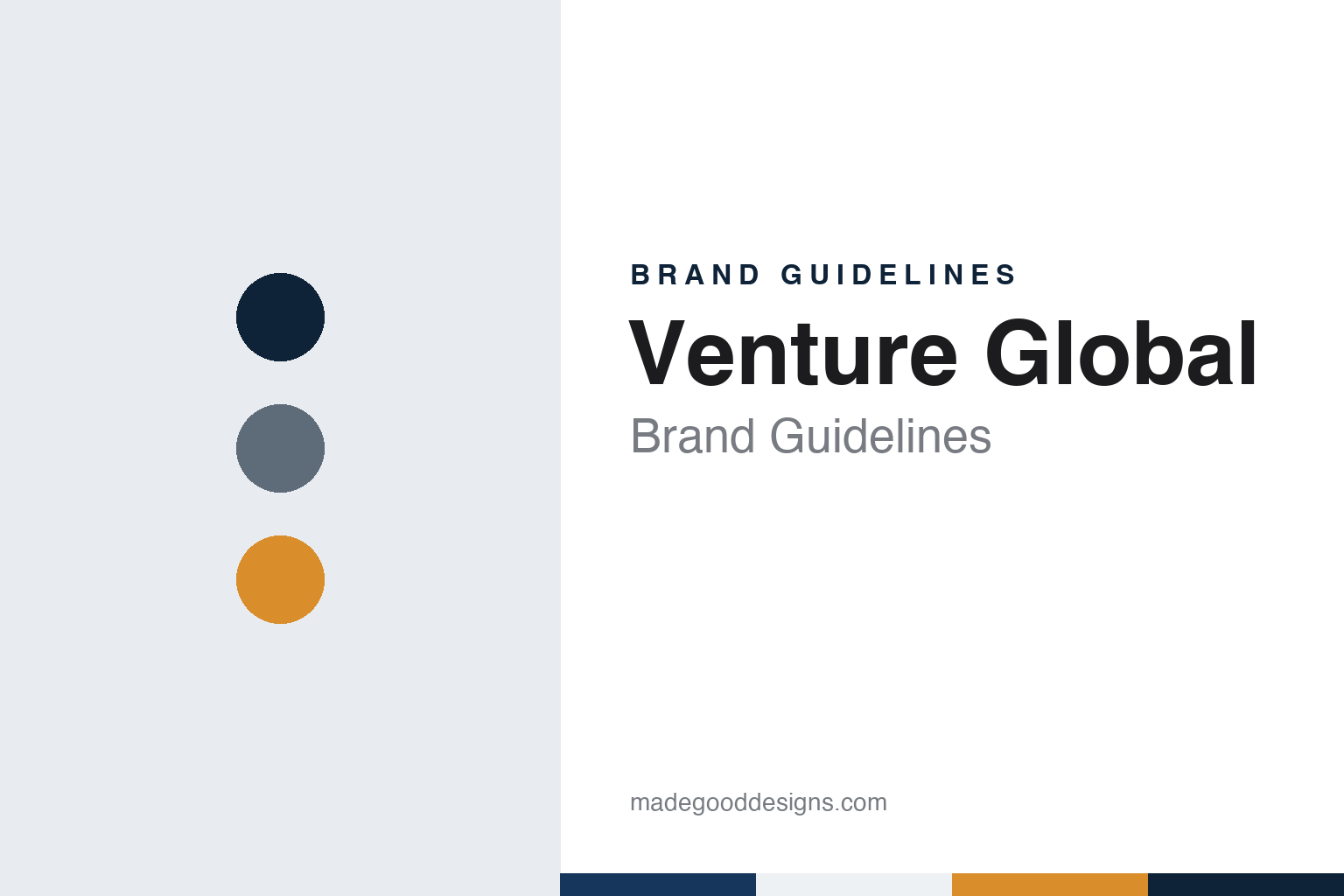
Two constants: a navy, steel and amber palette and an engineering sans register. Abstract homage — not a Venture Global asset; no plant, vessel, logo or mark is reproduced.
Arlington, 2013
A lawyer and a banker with a modular idea.
Venture Global is an American exporter of liquefied natural gas based in Arlington, Virginia. It was founded in 2013 by Robert “Bob” Pender and Michael Sabel, according to Project Finance International’s 2020 yearbook, which the company republishes on its own website. The yearbook describes Pender as a former partner at the law firm Hogan Lovells, where he co-led its global energy and natural resources team, and Sabel as a former executive vice-president of the commercial finance company First Sierra Financial and, before that, an investment banker. The company now lists Sabel as chief executive, executive co-chairman and founder, and Pender as executive co-chairman and founder.
The founding idea, Project Finance International wrote, was to build export plants from modular, mid-scale units that could go up faster than the large projects then coming to market from Cheniere Energy and Freeport LNG. The company says its liquefaction modules are fabricated off site, tested and delivered fully assembled, and grouped in “blocks” of two trains, each with a cold box using single mixed refrigerant technology. It calls the result a factory-built plant, in contrast with projects “stick-built” almost entirely on site.
The financing of the first plant, Calcasieu Pass, was named North American Deal of the Year in the same 2020 yearbook, which called it the first major project financing for modular LNG construction in the United States.
The company went public in January 2025. Its press release of 23 January 2025 said its Class A shares would begin trading on the New York Stock Exchange the next day under the symbol “VG”. Besides Arlington, the company says it has offices in Tokyo, London, Houston, Singapore and Washington, D.C.
Colour
Three plants on the Louisiana coast.
All of Venture Global’s plants so far sit on the Louisiana coast. The first, Calcasieu Pass, is in Cameron Parish, south of Lake Charles, on the Calcasieu Ship Channel; the company describes a 432-acre site with an export capacity of more than 11 million tonnes a year. It began exporting in 2022, but declared commercial operations only on 15 April 2025, ending a commissioning period of more than three years, Reuters reported in an article carried by MarineLink. The company attributed the delay to the pandemic, two hurricanes and a force majeure event caused by problems with the plant’s power island, and said a multi-year rectification of key components had been completed.
The second plant, Plaquemines LNG, stands on about 630 acres beside the Mississippi River, roughly 20 miles south of New Orleans, the company says. OilPrice.com reported on 2 November 2026 that the plant began producing and exporting in December 2024, and that Venture Global declared commercial operations for its first phase on 31 October 2026, just over 53 months after the final investment decision of May 2022. Shell received the first cargo under a long-term contract on 1 November. The same report put the first phase’s nameplate capacity at about 13.3 million tonnes a year, with long-term buyers including Shell, Orlen and EDF, and said the second phase was expected to begin supplying long-term customers in mid-2027. During commissioning, it noted, the company sold its cargoes on the spot market.
A third plant, CP2 LNG, is under construction on about 1,150 acres next to Calcasieu Pass, with its marine facility on Monkey Island, between the ship channel and the pass. The company announced financing for CP2’s first phase in July 2025 and a final investment decision for its second phase on 13 March 2026, and says CP2 will have a peak capacity of 29 million tonnes a year. A fourth project, CP3 LNG, is in development nearby. The company also says it has invested in nine LNG carriers and is developing carbon capture and storage projects at each of its plants.
Typography
Plants, ships and timelines.
LNG and natural-gas companies sell something few customers ever see. Gas is cooled to a liquid, carried across oceans and warmed back into gas before it reaches a power station, a factory or a kitchen, so the companies in this guide tend to present themselves through the places and machines that do that work rather than through the product itself.
For exporters, the plant is the picture. Websites and press releases show liquefaction trains, storage tanks and loading docks, often lit at dusk or photographed from the air, and describe each site by its location, acreage and capacity in million tonnes a year. Shipping and floating-terminal companies lean on their vessels instead: membrane tankers, floating storage and regasification units and floating liquefaction ships, each with its own name. Utilities and gas distributors tend to come closer to home, with blue flames, kitchen hobs and heating, and with tariffs and service pages.
The other common thread is time. Projects are told as sequences of milestones: permits, sales agreements, a final investment decision, first cargo and the start of commercial operations, each with a date. Investor presentations add capacity charts, contract tables and maps of buyers in Europe and Asia, while safety, environment and community pages, along with grievance and regulatory notices, sit alongside them, often written for the neighbours of a plant as much as for its customers.
This guide sets out what can be checked about each company: who founded it, who owns it, where its plants and ships operate, and what has happened to them, including outages, disputes and changes of ownership, stated with dates. It marks clearly what rests only on the company’s own word, and the colours and typefaces shown are our own unofficial interpretation, not any company’s brand standard.
Aa
An engineering sans for a company that talks in modules and milestones. (Specimen set in Archivo, a sans STAND-IN; NOT the Venture Global logo.)
The arbitrations
A long commissioning, and customers who went to arbitration.
The long commissioning at Calcasieu Pass led to a series of arbitrations. Shell, BP, Orlen, Edison and Repsol filed claims saying the company had held back the start of commercial operations so it could sell cargoes at high spot prices after Russia’s 2022 invasion of Ukraine, instead of delivering under their long-term contracts, Reuters reported in April 2025; Venture Global said a faulty power system had delayed normal operations. Portugal’s Galp also filed a claim.
The outcomes have differed. Venture Global prevailed against Shell in August 2025, and on 3 March 2026 a New York state court rejected Shell’s bid to overturn that award, Reuters reported in an article carried by New Orleans CityBusiness; Repsol had also lost its case. In October 2025 a tribunal of the International Chamber of Commerce found for BP, ruling that Venture Global had breached its obligations to declare commercial operations in a timely manner and to act as a “reasonable and prudent operator,” Reuters reported; a separate hearing on damages was expected in 2026. The company said at the time that it was disappointed and would continue to defend its position. On 26 March 2026 Venture Global and Edison announced a settlement agreement, with completion expected by the end of the second quarter of 2026. The sources used for this guide do not say whether it was completed. In October 2026 a tribunal ruled that the company had breached its supply agreement with Galp, OilPrice.com reported.
The company’s public face is built around engineering and pace. Its website leads with the line “Innovating to provide low-cost LNG to the world,” its project pages describe each site by parish, acreage and capacity, and its press releases count milestones in months from final investment decision. Its leadership page names the two founders first, and its strategy page explains the modular approach with factory-built blocks rather than with images of people.
For a design guide, Venture Global shows how a young infrastructure company can build an identity on a method — factory modules, numbered projects and dated milestones — while its contracts are argued in public. Compare Shell, a long-term customer and one of the parties to the arbitrations, and Cheniere, the earlier U.S. exporter. For this guide we use a deep navy, a steel grey and a flare amber with a sans, an unofficial interpretation; no product or logo is reproduced.
Explore & save
Keep Venture Global’s identity on hand — save it to a board in the Made Good inspiration library.
Venture Global identity set
Pin the Venture Global navy, steel and amber palette and the engineering sans register to your own board.