KOGAS Brand Guidelines
Korea’s 1983 state gas company, from Pyeongtaek to a blue globe.
Aa
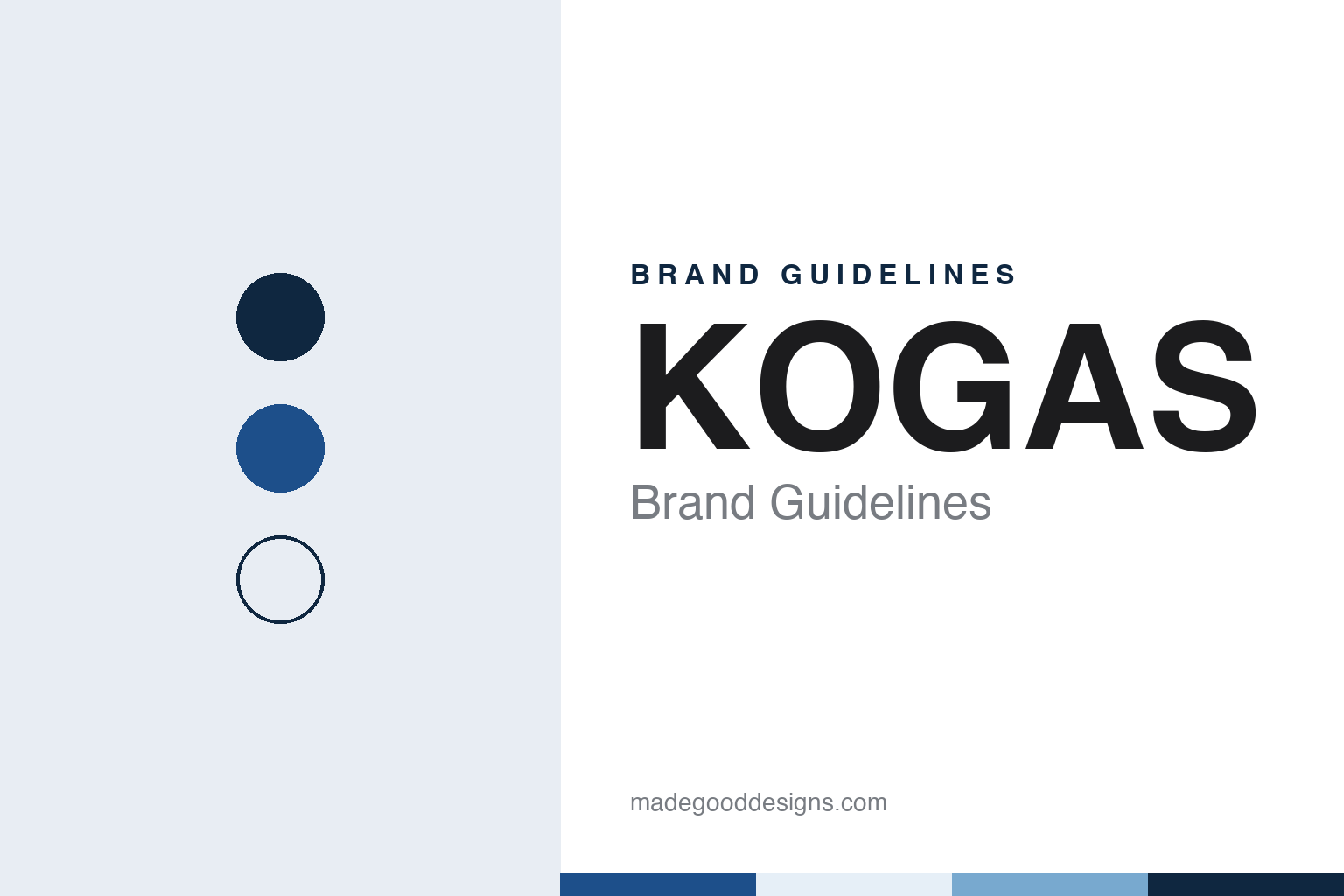
Two constants: a KOGAS harbour blue and frost palette and a Public-sector sans register. Abstract homage — not a KOGAS asset or mark; no logo, mascot or terminal is reproduced.
A gas company by law
Set up in 1983 to bring LNG to Korea.
KOGAS is the short name of the Korea Gas Corporation, a South Korean state-owned company created by statute rather than by founders. The Korea Gas Corporation Act was enacted in December 1982, and the company was established in August 1983, according to both the company and English Wikipedia. KOGAS says it was set up “to enhance people’s convenience and welfare through the supply of clean natural gas.” Korean Wikipedia places the decision in the years after the second oil shock, when the government wanted to diversify the country’s fuel imports away from a heavy dependence on oil; it traces the planning to a feasibility study commissioned by the state power company in 1979 and an LNG master plan adopted in 1981.
The first cargo came three years after the company was founded. KOGAS’s own history dates its first LNG import to October 1986 and the start of gas supply to power plants to November that year; English Wikipedia names the first customer as the Pyeongtaek Thermal Power Plant. City gas for the Seoul metropolitan area followed in February 1987, and the company dates the establishment of its Pyeongtaek LNG production base to April 1987. Pipelines then reached central Korea in 1993, the southern mainland in 1995, the west coast in 1999 and the Gangwon region in 2002, the company says.
KOGAS was listed on the Korean stock exchange in December 1999 and designated a “market-type public corporation” in April 2007, so it is both listed and state-owned. It moved its headquarters to Bundang in 1997, according to its history; on 30 September 2014 it moved again, to the Sinseo Innovation City in Dong-gu, Daegu, and began work there on 1 October 2014, Korean Wikipedia says. Its central control centre followed from Bundang in March 2015.
Colour
Five terminals and a single loop.
The company’s business is the middle of the gas chain. KOGAS describes its main work as building terminals and a supply pipeline network, importing LNG, regasifying it and supplying it to local gas companies and power plants. It names its import sources as the Middle East, Southeast Asia, Russia’s Sakhalin, Australia and the United States.
English Wikipedia says KOGAS operates five LNG regasification terminals. Korean Wikipedia gives their start dates as Pyeongtaek in November 1986, Incheon in October 1996, Tongyeong in September 2002, Samcheok in July 2014 and Jeju in October 2019; KOGAS’s own history records the Incheon terminal’s construction as completed in October 1997, so the two sources differ on that date. Korean Wikipedia also lists a planned fifth LNG base at Dangjin’s Seongmun industrial complex. Between them, the terminals feed a national grid that, the company says, became a single loop once the main trunk line was complete; it reports a network of more than 5,346 kilometres as of January 2026, supplying 216 cities and counties.
KOGAS is also one of the world’s large LNG buyers. In a press release dated 9 September 2025, TotalEnergies called it “currently the world’s largest LNG importer” when the two signed a heads of agreement, after an international tender, for 1 million tonnes a year over ten years from the end of 2027. The Korea Times reported on 15 March 2026 that KOGAS and Japan’s JERA, which it described as “the world’s two largest LNG buyers,” had signed a memorandum in Tokyo on LNG supply and demand management, building on a 2023 agreement and a cargo swap completed in June 2025.
Overseas, the company lists upstream and LNG interests including GLNG in Australia, which it says began operating in October 2015, and Mozambique’s Area 4, where it dates the first LNG production and sale to September 2022. English Wikipedia adds a stake in the Prelude floating LNG facility off Australia, alongside Shell, Inpex and CPC.
Typography
Design and documentation.
LNG and natural-gas companies sell something few customers ever see. Gas is cooled to a liquid, carried across oceans and warmed back into gas before it reaches a power station, a factory or a kitchen, so the companies in this guide tend to present themselves through the places and machines that do that work rather than through the product itself.
For exporters, the plant is the picture. Websites and press releases show liquefaction trains, storage tanks and loading docks, often lit at dusk or photographed from the air, and describe each site by its location, acreage and capacity in million tonnes a year. Shipping and floating-terminal companies lean on their vessels instead: membrane tankers, floating storage and regasification units and floating liquefaction ships, each with its own name. Utilities and gas distributors tend to come closer to home, with blue flames, kitchen hobs and heating, and with tariffs and service pages.
The other common thread is time. Projects are told as sequences of milestones: permits, sales agreements, a final investment decision, first cargo and the start of commercial operations, each with a date. Investor presentations add capacity charts, contract tables and maps of buyers in Europe and Asia, while safety, environment and community pages, along with grievance and regulatory notices, sit alongside them, often written for the neighbours of a plant as much as for its customers.
This guide sets out what can be checked about each company: who founded it, who owns it, where its plants and ships operate, and what has happened to them, including outages, disputes and changes of ownership, stated with dates. It marks clearly what rests only on the company’s own word, and the colours and typefaces shown are our own unofficial interpretation, not any company’s brand standard.
Aa
A clear public-sector sans for a statutory company. (Specimen set in IBM Plex Sans, a sans STAND-IN; NOT the KOGAS logo or its fixed typefaces.)
KOGAS
A white core inside a blue globe.
KOGAS publishes its corporate identity on its English website, and it is unusually explicit. The company says its logo is “the image of a global giant,” meant to express a world-class energy company that “creates a better world through clean energy.” It explains the parts: the white shape on the central axis stands for the core, or nucleus, of energy; the blue gradation and white contrast signify clean energy; and the round shape stands for the whole world. The logo should in principle sit on white, the company says, but may also be printed in a colour it calls KOGAS ultramarine, or in black, silver or gold.
Its Korean and English wordmarks are fixed typefaces that, in the company’s words, “cannot be changed arbitrarily under any circumstances,” set in a dark grey, the ultramarine or black, and reversed to white on dark grounds. KOGAS also has a mascot that combines a child’s face with a flame shape, which it says is meant to show a friendly, service-minded public institution and to act “as a catalyst between KOGAS and customers.” Its identity pack extends to signatures in Korean, English and the KOGAS abbreviation, and to marks for its taekwondo team, founded in 1997; the company also founded the Pegasus professional basketball team, based in Daegu, in September 2021.
The company’s structure may change. Chosunbiz reported on 12 September 2026 that the government had announced, earlier that month, a plan to merge KOGAS with the Korea National Oil Corporation into a body tentatively named the “Energy Resources Corporation.” The merger was announced in September 2026 and had not been completed at the time of writing.
For a design guide, KOGAS shows how a statutory utility can publish its own rules — what each shape means, which grounds the logo may sit on, which typefaces may never change. Compare JERA, its Japanese counterpart as a buyer, and TotalEnergies, one of its suppliers. For this guide we use a harbour blue, a pale frost and a sky tone with a sans, an unofficial interpretation; no product or logo is reproduced.
Explore & save
Keep KOGAS’s identity on hand — save it to a board in the Made Good inspiration library.
KOGAS identity set
Pin the KOGAS harbour blue and frost palette and the Public-sector sans register to your own board.