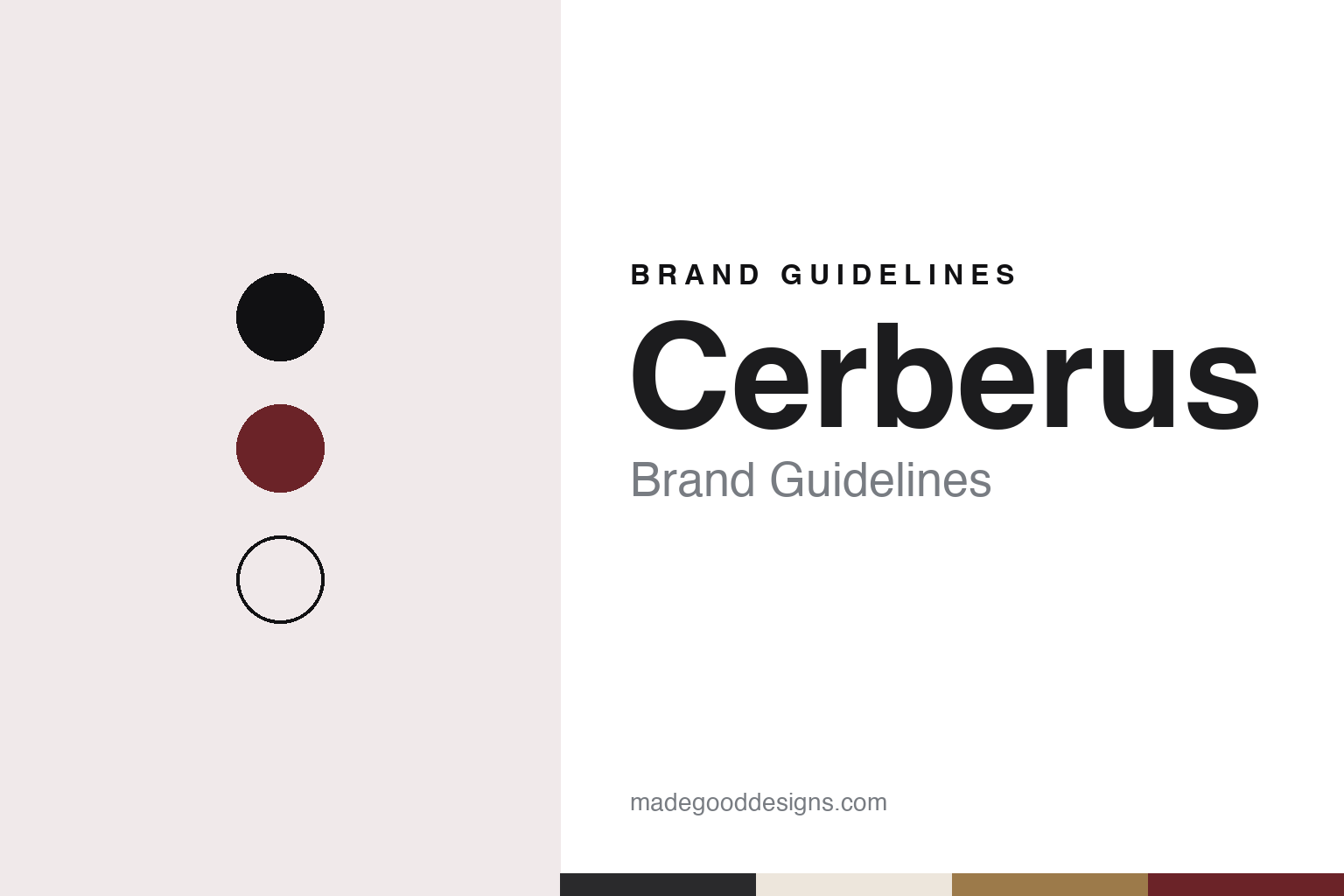
Cerberus Brand Guidelines
A 1992 New York firm named for a three-headed dog.
Aa
Two constants: an oxblood, charcoal and bronze palette and a Grotesque sans register. Abstract homage — not a Cerberus asset; no logo, document or mark is reproduced.
A Three-Headed Name
Founded in New York in 1992.
Cerberus Capital Management was founded in New York in 1992, the date the firm gives on its own website. English Wikipedia names Steve Feinberg and William L. Richter as its co-founders and says the firm is named after Cerberus, the three-headed dog that guards the gates of the underworld in Greek mythology; Wikipedia adds that Feinberg later said he regretted the choice of name. The firm is based in New York City, with offices in the United States, Europe and Asia, and its largest locations include New York, Chicago and Boise, Idaho, Wikipedia says.
Credit sits near the start of its story. The firm says corporate credit has been one of its core strategies since its inception, that its real estate platform was established in 1993, and that Cerberus Business Finance, its middle-market direct lending platform, was established in 1995 and works with private equity sponsors and businesses. It describes itself today as an established alternative investment adviser with assets across credit, private equity and real estate, about 1,000 employees and around 90 managing directors and senior leaders.
Its website groups the business into platforms. The core four are direct lending, corporate credit, operational private equity and real estate; beside them sit teams for non-performing loans, residential opportunities and commercial mortgage-backed securities, as well as Cerberus Frontier, for frontier and emerging markets, and Cerberus Ventures, for early-stage investing. The firm says it was among the largest buyers of European non-performing loans and portfolios between 2013 and 2021, citing reports by Cushman & Wakefield and Evercore. It also runs its own operating arms, including the Cerberus Operations and Advisory Company and Cerberus European Servicing.
Colour
Holdings, with dates.
Its holdings have ranged across banking, groceries and cars. In September 2003 Cerberus bought SoftBank’s 49% stake in the Japanese lender Aozora Bank; it cut its holding to 7.7% in January 2013 and sold the remainder in August 2013, English Wikipedia says. In June 2006 a Cerberus-led group of investors completed its purchase of 655 Albertsons grocery stores, forming Albertsons LLC of Boise, Idaho; the company went on to buy Safeway, completing that deal on 30 January 2015, according to Wikipedia’s Albertsons article. Also in 2006, General Motors sold a 51% interest in its finance arm, GMAC, now Ally Financial, to Cerberus.
Then came Chrysler. On 14 May 2007 DaimlerChrysler announced the sale of 80.1% of Chrysler Group to Cerberus, and the carmaker became Chrysler LLC, Wikipedia says. Chrysler filed for Chapter 11 bankruptcy protection on 30 April 2009 and emerged on 10 June 2009 with new owners including Fiat. Cerberus gave up its equity in the carmaker as a condition of the federal rescue, but kept the finance arm, Chrysler Financial, until April 2011, according to Wikipedia’s Cerberus article.
The same article lists other holdings with dates. Cerberus acquired the bankrupt ANC Rental, then owner of the National and Alamo car rental chains, in October 2003 and sold them to Enterprise Rent-A-Car in 2007; it acquired the Austrian bank BAWAG P.S.K. in December 2006; and in 2005 it completed its purchase of debis AirFinance, an aircraft leasing business later renamed AerCap.
Later entries in Wikipedia’s list are dated too. In May 2016 Cerberus sold its 57% stake in the school bus maker Blue Bird Corporation to an affiliate of American Securities; in February 2018 it acquired the German lender HSH Nordbank; and in October 2019 it acquired Stratolaunch Systems, the aerospace company that built the aircraft of the same name, which now offers high-speed flight test services.
Typography
How private credit managers present themselves.
Private credit firms lend to companies directly rather than through banks or public bond markets, and they present themselves mainly to the investors whose money they manage rather than to consumers. Their websites tend to be restrained: a few corporate colours, plain sans or serif type, photographs of offices and people, and pages organised by investment strategy and by the kinds of client they serve. Blue Owl, for example, sorts its site by audience — asset managers, financial advisors, institutional investors and insurance companies — while Oaktree groups its work into credit, equity and real estate.
Writing carries much of the identity. Managers publish insight pieces, market outlooks and explanatory charts on how direct lending works, where loans sit in a company’s capital structure and how risk is shared. Oaktree’s co-founder Howard Marks has posted his memos publicly on the firm’s website for years, and its pages set out its investment philosophy as a short list of tenets. Team pages, dated timelines and accounts of past deals and portfolio companies do the work that advertising does for a consumer brand.
Listed vehicles add another layer. Many firms run business development companies, American funds that lend to private companies, some traded on a stock exchange and some not. Each needs its own investor-relations pages, with filings, results and shareholder letters; non-traded funds typically offer quarterly tender offers of up to 5% of shares, Reuters explained in July 2026, so their letters on withdrawal requests are public documents in their own right.
Ownership changes often. Many of the firms in this group were formed by merger, spun out of a bank or another manager, or bought by a larger asset manager, and their names, sites and visual identities are adjusted as they move. This guide sets out what can be checked about each firm — who founded it, who owns it and how it describes its business — and marks clearly what rests only on its own word.
Aa
A grotesque sans for a one-word mythological name. (Specimen set in Archivo, a sans STAND-IN; NOT the Cerberus logo.)
Cerberus
One name across lending, buyouts and property.
The deals continue. In September 2026 the British engineering group Goodwin plc agreed to sell large parts of its mechanical engineering division to Cerberus, including Goodwin Steel Castings, Goodwin International, the German business Noreva and Easat, the trade publication ADS Advance reported on 11 September 2026. The transaction needs clearance under the UK’s National Security and Investment Act 2021, along with other approvals, and completion was expected in the first quarter of 2027; it had been agreed in September 2026 and was not completed at the time of writing.
The firm’s homepage pairs a short statement of what it does with a few firm facts — the 1992 founding year, its headcount and its platforms — followed by notes on the limits of its own statements. It also warns that the Cerberus name, brand and reputation may be misused by unauthorised third parties, and says it does not give investment advice or seek capital through social media or chat apps such as Telegram, WhatsApp or Signal.
The single word does most of the work. The firm uses it across its platform and operating names, from Cerberus Business Finance to Cerberus Frontier, Cerberus Ventures and Cerberus European Servicing.
For a design guide, Cerberus shows how a firm founded in 1992 can carry one mythological name across lending, private equity and real estate. Compare Oaktree, another credit manager in this series, and KKR. For this guide we use oxblood, charcoal and a bronze with a sans, an unofficial interpretation; no product or logo is reproduced.
Explore & save
Keep Cerberus’s identity on hand — save it to a board in the Made Good inspiration library.
Cerberus identity set
Pin the Cerberus oxblood, charcoal and bronze palette and the Grotesque sans register to your own board.