Oaktree Brand Guidelines
TCW roots, public memos and a Brookfield buyout.
Aa
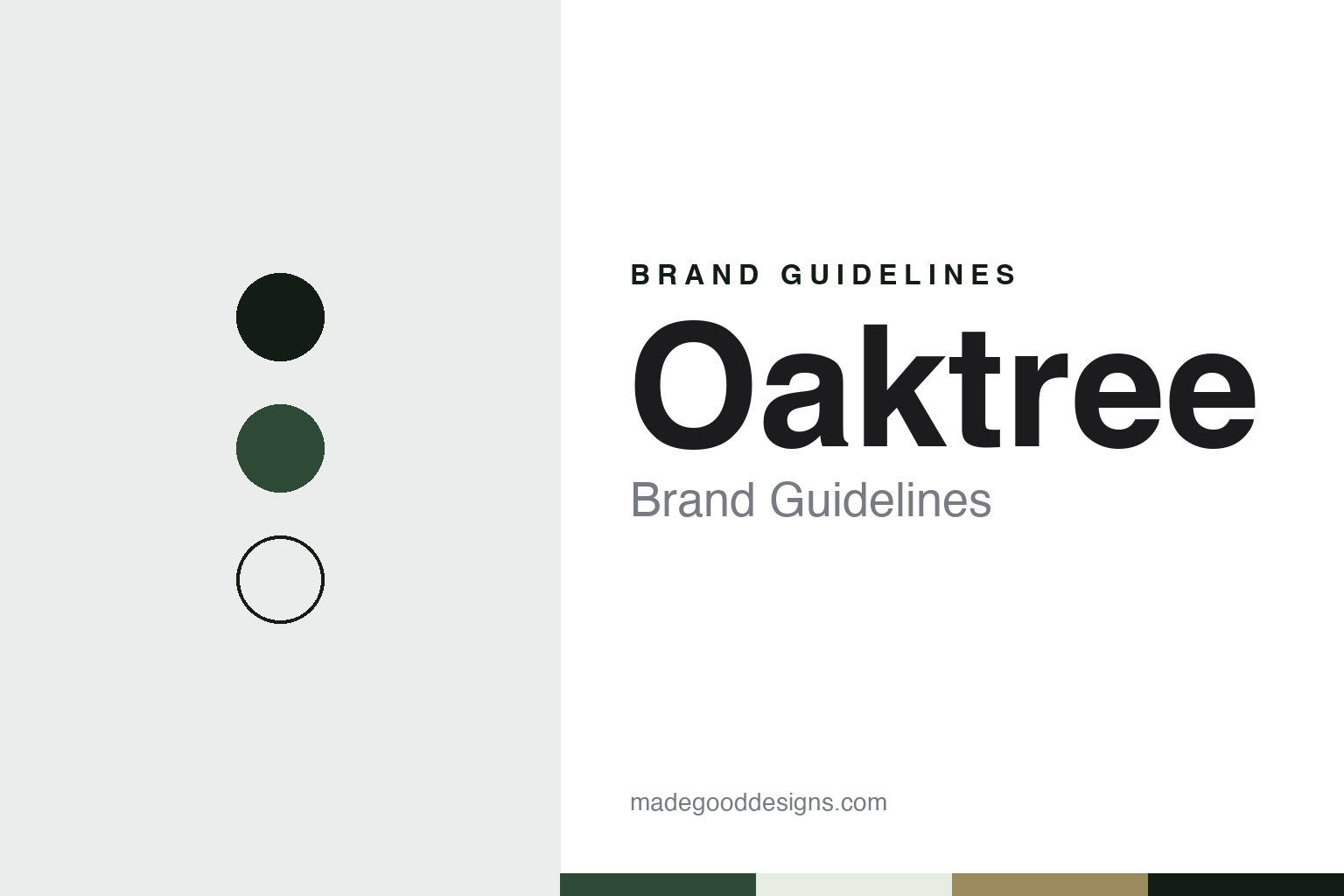
Two constants: an Oaktree oak green and bark gold palette and a Bookish serif register. Abstract homage — not an Oaktree product or mark; no logo or emblem is reproduced.
Out of TCW
Five partners and a distressed-debt record.
Oaktree Capital Management is a Los Angeles investment firm founded in 1995. Its founders had worked together at the TCW Group. English Wikipedia says Howard Marks joined TCW in 1985 to lead its high-yield and convertible-bond investing, and that in 1988 he and Bruce Karsh organised one of the first distressed-debt funds run by a major financial institution. In 1995 Marks, Karsh and three colleagues left to found their own firm. Within three months of its founding, English Wikipedia says, more than 30 TCW clients had moved assets to Oaktree.
Oaktree tells the same story on its own timeline. Marks began investing in the then-young high-yield bond market in 1978, Karsh joined him for distressed-debt investing in 1988, and Oaktree was founded in 1995 “starting with seven strategies, including high yield bonds and opportunistic credit.” The firm now groups its work into three categories — credit, equity and real estate — and calls its approach “opportunistic, value-oriented and risk-controlled.”
Growth came through what the firm calls “step-out” strategies, usually opened together with new offices and focused on Europe and Asia, English Wikipedia says. It lists Emerging Markets Absolute Return in 1997, European High Yield Bonds and Power Opportunities in 1999, Mezzanine Finance in 2001, and Asia Principal Opportunities, European Principal Investments and European Senior Loans in 2006. Oaktree’s own timeline adds that it began managing performing private credit in the 2000s and scaled structured and private credit in the 2010s.
Colour
The memos and the six tenets.
Oaktree’s most distinctive form of communication is Marks’s writing. His essays, called “memos,” are posted publicly on the firm’s website, English Wikipedia says, and the site keeps a full archive along with compilations such as “The Complete Collection.” Recent titles include “Is It a Bubble?” from December 2025, “AI Hurtles Ahead” from February 2026 and “What’s Going on in Private Credit?” from April 2026. Marks has also written books on investing, among them The Most Important Thing (2011) and Mastering the Market Cycle (2018).
The firm sets out its thinking in plain lists. Its investment philosophy has six tenets that it says have stayed unchanged since its founding: the primacy of risk control, an emphasis on consistency, the importance of market inefficiency, the benefits of specialisation, the view that macro-forecasting is not critical to investing, and the disavowal of market timing. It sums up the first in one sentence: “if we avoid the losers, the winners will take care of themselves.” A separate page of business principles covers research, conflicts of interest, staff and client communication, and speaks of delivering for clients “while taking the high road.”
Oaktree became a listed company on 12 April 2012, when Oaktree Capital Group began trading on the New York Stock Exchange under the ticker OAK, English Wikipedia says; it had earlier traded on GSTrUE, a private market run by Goldman Sachs. In 2022, it says, Oaktree bought a majority stake in 17Capital, a London private-credit firm, and in 2023 it launched Oaktree Lending Partners, a fund that finances private-equity takeovers. Its website also lists Oaktree Specialty Lending Corporation, a listed vehicle, among its public investors’ pages.
Its record includes public programmes and stakes in other managers. In 2009, English Wikipedia says, Oaktree was one of nine managers selected by the U.S. Treasury, alongside firms such as BlackRock and Invesco, for the government’s Public-Private Investment Program, and in the same year it took a 20% stake in DoubleLine Capital, a Los Angeles fixed-income firm. In July 2025 it bought the media company FilmRise and announced plans to combine it with Shout! Studios under a new holding company, Radial Entertainment.
Its holdings have included football clubs. Oaktree took over the French club SM Caen in 2020 and took control of Inter Milan in May 2024, after the club’s owner, Suning, could not repay its debts and the lender exercised its rights, Goal reported in August 2026.
Typography
Lenders that explain themselves.
Private credit firms lend to companies directly rather than through banks or public bond markets, and they present themselves mainly to the investors whose money they manage rather than to consumers. Their websites tend to be restrained: a few corporate colours, plain sans or serif type, photographs of offices and people, and pages organised by investment strategy and by the kinds of client they serve. Blue Owl, for example, sorts its site by audience — asset managers, financial advisors, institutional investors and insurance companies — while Oaktree groups its work into credit, equity and real estate.
Writing carries much of the identity. Managers publish insight pieces, market outlooks and explanatory charts on how direct lending works, where loans sit in a company’s capital structure and how risk is shared. Oaktree’s co-founder Howard Marks has posted his memos publicly on the firm’s website for years, and its pages set out its investment philosophy as a short list of tenets. Team pages, dated timelines and accounts of past deals and portfolio companies do the work that advertising does for a consumer brand.
Listed vehicles add another layer. Many firms run business development companies, American funds that lend to private companies, some traded on a stock exchange and some not. Each needs its own investor-relations pages, with filings, results and shareholder letters; non-traded funds typically offer quarterly tender offers of up to 5% of shares, Reuters explained in July 2026, so their letters on withdrawal requests are public documents in their own right.
Ownership changes often. Many of the firms in this group were formed by merger, spun out of a bank or another manager, or bought by a larger asset manager, and their names, sites and visual identities are adjusted as they move. This guide sets out what can be checked about each firm — who founded it, who owns it and how it describes its business — and marks clearly what rests only on its own word.
Aa
A bookish serif — for a firm known for its memos. (Specimen set in Source Serif 4, a serif STAND-IN; NOT the Oaktree logo.)
Oaktree
From partner to part of Brookfield.
Oaktree passed to Brookfield in two steps. On 13 March 2019 Brookfield Asset Management announced that it had agreed to buy a majority of Oaktree — 62%, English Wikipedia says — and completion was announced on 30 September 2019. The listed company was renamed Brookfield Oaktree Holdings, the name Oaktree’s investor pages now use. In June 2023 Robert O’Leary and Armen Panossian were named as Oaktree’s incoming co-chief executives, English Wikipedia says.
On 13 October 2025 Brookfield and Oaktree announced a proposed transaction under which Brookfield would acquire the roughly 26% of Oaktree it did not already own. Brookfield announced on 3 August 2026, in a release issued in New York, that it had completed the acquisition, describing it as the next step in a partnership that began in 2019. Under the new arrangement Marks and Karsh are co-chairs of Oaktree, Karsh remains its chief investment officer, and O’Leary and Panossian are co-chief executives of Brookfield’s Credit Group. Oaktree’s about page now tells the two firms’ histories as one timeline, from Brookfield’s founding in 1899 to the 2026 integration.
For a design guide, Oaktree shows how a firm can build its identity on one founder’s writing as much as on any logo, and keep its own name inside a larger owner. Compare Brookfield Asset Management, its owner, and HPS Investment Partners, another private-credit manager. For this guide we use an oak green and a bark gold with a serif, an unofficial interpretation; no product or logo is reproduced.
Explore & save
Keep Oaktree’s identity on hand — save it to a board in the Made Good inspiration library.
Oaktree identity set
Pin the Oaktree oak green and bark gold palette and the Bookish serif register to your own board.