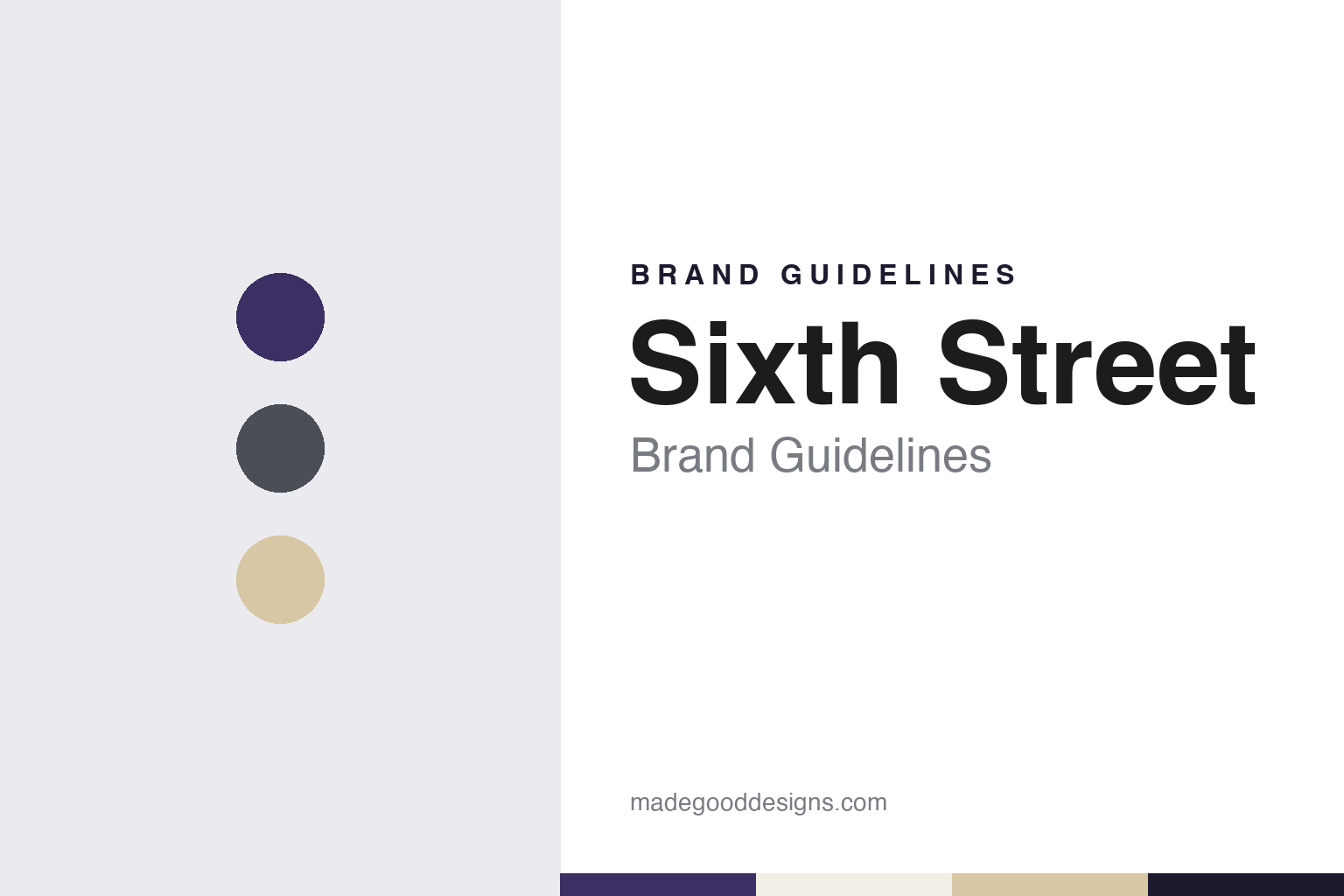
Sixth Street Brand Guidelines
TPG’s 2009 credit partner, independent since 2020 and now a sports investor.
Aa
Two constants: a violet, graphite and sand palette and a geometric sans register. Abstract homage — not a Sixth Street asset or mark; no logo, team crest or fund document is reproduced.
TPG Sixth Street Partners
A credit platform partnered with a buyout firm.
Sixth Street was founded in 2009 in partnership with the private equity firm TPG. A press release issued on 22 June 2017 by the firm, then called TPG Sixth Street Partners, or TSSP, described it as “the global credit and credit-related investment platform partnered with TPG,” co-founded in 2009 by its managing partner, Alan Waxman, and founded by its management team and TPG. English Wikipedia says Waxman set it up to recreate a type of investing platform he had run at Goldman Sachs, that TPG made large fund commitments to the team and held a minority stake, and that the two operated autonomously; it names eight other founding partners alongside Waxman, among them David Stiepleman and Joshua Easterly.
The same 2017 release announced that Dyal Capital Partners, then a division of Neuberger Berman, had closed a passive, non-voting minority investment in TSSP, with the proceeds kept in the business to expand it. By then, the release said, the firm had offices in San Francisco, New York, London, Dallas, Houston, Boston, Luxembourg and Melbourne, and invested across industries and capital structures, in distressed assets as well as in healthy and growing companies.
Independence came in 2020. English Wikipedia says the firms became formally independent in May 2020, and that TPG Specialty Lending, the listed business development company the firm advises, was renamed Sixth Street Specialty Lending with effect from 15 June 2020; it trades on the New York Stock Exchange under the ticker TSLX. On 3 September 2024 Commercial Observer reported that TPG, which it said “was part of the founding of Sixth Street in 2009,” had cut its holding from 30 percent to 10 percent in the 2020 deal and had now sold that last stake back to Sixth Street, formally ending the partnership. The paper said, citing a source, that a clause in the 2020 agreement let Sixth Street buy the shares back if TPG returned to the credit business, which TPG did with its purchase of Angelo Gordon in October 2023.
Colour
Credit, flexible capital and a sports team.
Sixth Street calls itself “a global, multi-strategy private capital firm,” and English Wikipedia says it runs nine investment platforms, covering growth investing, direct lending, fundamental public strategies, infrastructure, special situations, agriculture and par liquid credit among them. Wikipedia also notes that financial reporters have remarked on the unusual structure of its largest fund, which is open-ended and can hold investments for longer. Deals it lists include a 2016 investment in Spotify through convertible debt, co-led with others; the purchase in May 2016 of a portfolio of debt and equity investments from Credit Suisse; a co-led investment in Airbnb in spring 2020; and the January 2021 purchase of Talcott Resolution, the former life insurance and annuity business of The Hartford.
The firm’s Sports, Media and Entertainment team, as it calls it, invests in clubs and venues. In January 2021 Sixth Street took a majority interest in Legends Hospitality, the venue-services company co-founded by affiliates of the New York Yankees and the Dallas Cowboys, English Wikipedia says. On 22 June 2021 SportsPro reported that it had bought a 20 percent stake in the NBA’s San Antonio Spurs, a move approved by the league’s board of governors. In 2022, according to English Wikipedia, it agreed a 20-year partnership with Real Madrid and Legends over new businesses at the Santiago Bernabéu stadium, and acquired rights to a share of FC Barcelona’s LaLiga television income through a company called Locksley, in which Barcelona kept 49 percent.
In April 2023 the National Women’s Soccer League awarded a Bay Area expansion team to a group led by Sixth Street. The club was named Bay FC in June 2023, and English Wikipedia says it was the first professional team in the United States with an institutional investor as its majority owner. Sixth Street’s multi-club company, Bay Collective, agreed to buy a majority of Sunderland Women in April 2026, BBC Sport reported, and the deal was completed on 18 June 2026 after approval from the Women’s Super League, according to the firm, with Sunderland AFC keeping a minority stake.
The firm’s own releases record two more. In November 2025 it closed a minority investment in the New England Patriots, which it called its seventh professional sports franchise investment, after the Spurs, the San Francisco Giants, Real Madrid, FC Barcelona, the Boston Celtics and Bay FC. On 3 September 2026 it announced a minority investment in the Seattle Seahawks, approved by the NFL on 26 August 2026.
Typography
How private credit firms present themselves.
Private credit firms lend to companies directly rather than through banks or public bond markets, and they present themselves mainly to the investors whose money they manage rather than to consumers. Their websites tend to be restrained: a few corporate colours, plain sans or serif type, photographs of offices and people, and pages organised by investment strategy and by the kinds of client they serve. Blue Owl, for example, sorts its site by audience — asset managers, financial advisors, institutional investors and insurance companies — while Oaktree groups its work into credit, equity and real estate.
Writing carries much of the identity. Managers publish insight pieces, market outlooks and explanatory charts on how direct lending works, where loans sit in a company’s capital structure and how risk is shared. Oaktree’s co-founder Howard Marks has posted his memos publicly on the firm’s website for years, and its pages set out its investment philosophy as a short list of tenets. Team pages, dated timelines and accounts of past deals and portfolio companies do the work that advertising does for a consumer brand.
Listed vehicles add another layer. Many firms run business development companies, American funds that lend to private companies, some traded on a stock exchange and some not. Each needs its own investor-relations pages, with filings, results and shareholder letters; non-traded funds typically offer quarterly tender offers of up to 5% of shares, Reuters explained in July 2026, so their letters on withdrawal requests are public documents in their own right.
Ownership changes often. Many of the firms in this group were formed by merger, spun out of a bank or another manager, or bought by a larger asset manager, and their names, sites and visual identities are adjusted as they move. This guide sets out what can be checked about each firm — who founded it, who owns it and how it describes its business — and marks clearly what rests only on its own word.
Aa
A geometric sans for a firm that built its own name. (Specimen set in Manrope, a sans STAND-IN; NOT the Sixth Street logo.)
Sixth Street
Dynamic by Design.
Today Sixth Street is independent of TPG, and it is based in San Francisco. Its website says that “since 2009” it has been building “a global, multi-strategy private capital firm,” and it cites more than 750 team members and activity in more than 25 countries as of mid-2026. The listed lending vehicle, Sixth Street Specialty Lending, keeps the firm’s name on the New York Stock Exchange.
The website’s headline is “Dynamic by Design,” and it explains the firm’s approach with the image of a prism: “A prism reveals what a single perspective cannot,” it says, describing how each opportunity is examined “through multiple lenses.” It presents the staff as “One Team” and quotes Waxman on being “investor first.” Its newsroom mixes deal announcements, such as a June 2026 growth equity investment in the data company Kpler and the May 2026 purchase of the Park Hyatt Beaver Creek resort, with videos and podcast interviews, among them a July 2026 conversation between Waxman and Bob Iger.
For a design guide, Sixth Street shows how a firm that started under a partner’s name can build an identity of its own once it separates. Compare TPG, its founding partner, and HPS, another credit firm that spun out of a larger house. For this guide we use a deep violet, a graphite and a warm sand with a sans, an unofficial interpretation; no product or logo is reproduced.
Explore & save
Keep Sixth Street’s identity on hand — save it to a board in the Made Good inspiration library.
Sixth Street identity set
Pin the Sixth Street violet, graphite and sand palette and the geometric sans register to your own board.


