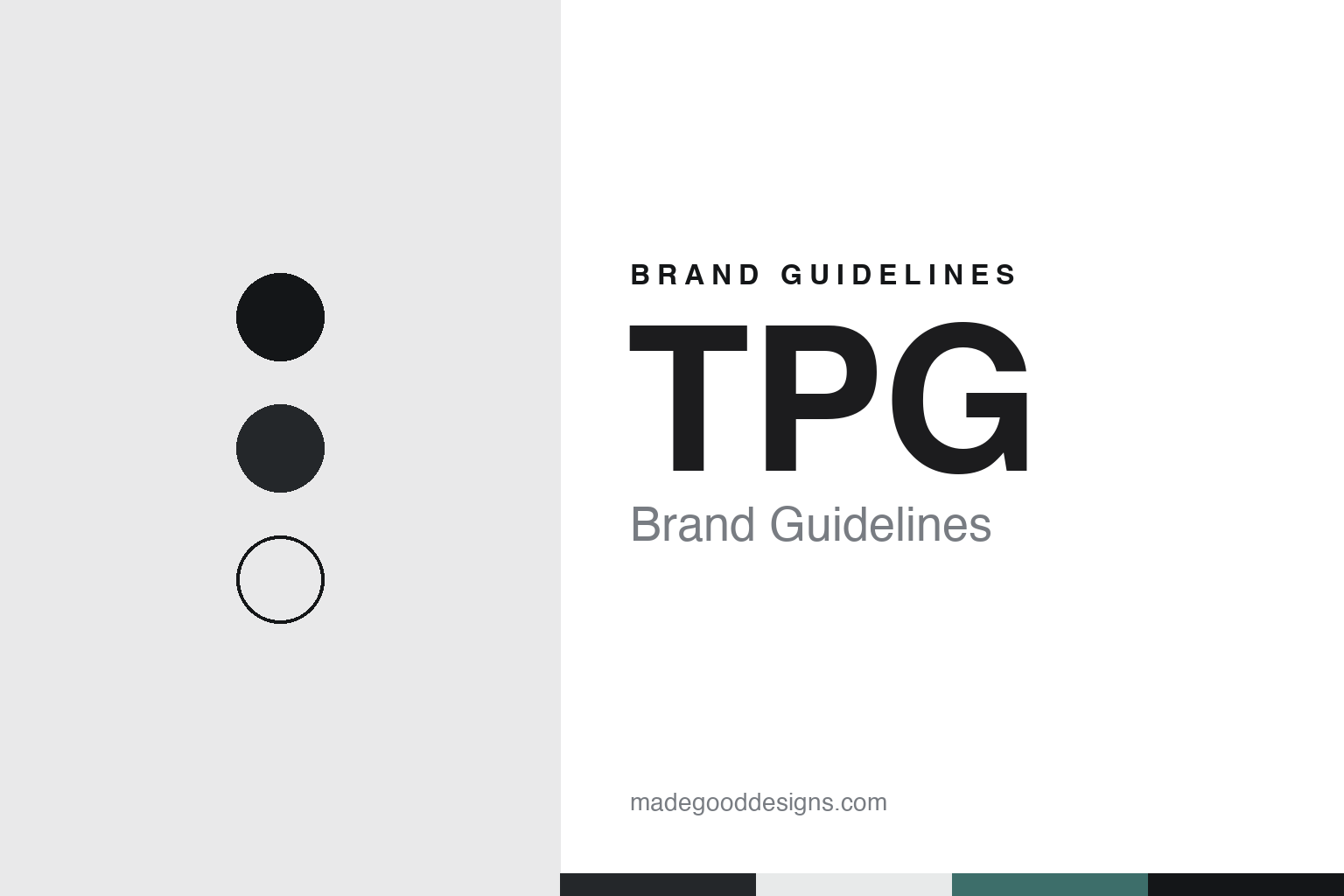
TPG Brand Guidelines
Texas Pacific Group, shortened to three letters.
Aa
Two constants: a charcoal, fog and teal palette and an initials sans register. Abstract homage — not a TPG asset; no logo or mark is reproduced.
Texas Pacific Group
Two colleagues from a family office.
TPG began in 1992 as Texas Pacific Group. English Wikipedia names its founders as David Bonderman, James Coulter and William S. Price III; Bonderman and Coulter had earlier made buyout investments in the 1980s for the Texas investor Robert Bass. The firm’s own website names Jim Coulter and David Bonderman, “former colleagues at the Bass Family Office,” as the pair who created TPG in 1992, and says they opened its first offices in San Francisco. A Reuters report carried by South Africa’s BusinessDay in January 2022 said instead that the firm was launched in Mill Valley, California.
The Texas link remains. Reuters called TPG Fort Worth-based in that 2022 report, and English Wikipedia lists the firm as based in Fort Worth, Texas, with main offices in New York and further offices in Washington, Miami, San Francisco and abroad.
Its first major deal was the 1993 buyout of Continental Airlines, then in bankruptcy, which Wikipedia says Bonderman and Coulter completed with Price, a former GE Capital executive. In 1994 TPG joined Blum Capital and ACON Investments to form Newbridge Capital, a joint venture investing in emerging markets, especially in Asia. Consumer brands followed: TPG invested in Beringer Wine and Ducati in 1996, took control of the retailer J.Crew in 1997, and invested in the Italian scooter maker Piaggio and the Swiss shoe brand Bally in 1999, according to Wikipedia.
Colour
Buyouts, then growth and impact.
Through the 2000s TPG was a regular member of buyout consortiums. In 2002 it bought Burger King from Diageo with Bain Capital and Goldman Sachs’s private-equity arm; Wikipedia notes that the burger chain then went through a brand overhaul, including the use of its “The Burger King” character in advertising. In 2005 TPG and Sony led the consortium that bought the film studio Metro-Goldwyn-Mayer, and the same year TPG was one of seven firms in the buyout of SunGard.
The name changed in early 2007, when, Wikipedia says, the firm became simply TPG and rebranded all its funds across regions under the three letters. In April 2008 TPG led an investment in Washington Mutual; the bank was taken over by the US government that September and TPG lost its investment, Wikipedia records. Reuters wrote in 2022 that the firm “spent years recovering from a string of poor investments in the 2000s,” while diversifying into growth and social-impact investing.
That diversification has names. In 2016 TPG launched The Rise Fund, a social-impact fund, with the musician Bono and Jeff Skoll; in 2021 it announced the first close of TPG Rise Climate, a fund for commercially viable climate technologies, with a final close in April 2022, Wikipedia says. Growth equity and smaller buyouts sit with TPG Growth.
The portfolio has kept moving between sectors. In 2001 TPG started T3 Partners to invest alongside its main fund in technology companies; in the mid-2010s it raised a fund dedicated to real estate, exceeding its target by October 2015; and in 2017 it took a majority stake in Novotech, an Australian clinical research company, Wikipedia records. In 2020 TPG joined Diligent Corporation’s Modern Leadership Initiative and pledged to create five new board roles for racially diverse candidates across its portfolio companies. In April 2022 it bought a majority stake in Sodali & Co, a New York proxy adviser, according to the same source.
Typography
Private equity and its presentation.
Private equity firms sell nothing that sits on a shelf, so their identities have to work without a product. The usual answer is restraint: a short wordmark, often initials or a surname set in a plain sans or a quiet serif, with one dark colour and a lot of white space. The name does most of the work, and the mark is meant to sit comfortably beside the logos of pension funds, banks and the companies a firm owns.
The physical setting carries the same message. Headquarters tend to be in glass-walled towers in financial districts, and the photography on firm websites leans on offices, skylines and people in meetings rather than on objects. When a firm wants to show what it does, it usually shows its portfolio companies: a factory floor, a data centre, a hospital corridor or a shop, each credited to the business rather than to the investor.
Much of the visible design lives in documents. Annual letters to investors, responsible-investment and sustainability reports, investor-day presentations and quarterly results decks are where the typography, charts and colour systems are most fully worked out. Listed firms add the formal layer of a public company, from stock-exchange filings to shareholder reports, and the same restrained palette usually runs through all of them.
Beyond the page, these firms present themselves through institutions. Founders and partners appear as donors to museums, concert halls and universities, and firm names turn up on fellowships, research centres and sponsorships. For a design reader, the category is a study in how far a brand can be carried by a name, a typeface and a tone of voice alone.
Aa
A plain sans for three initials. (Specimen set in IBM Plex Sans, a sans STAND-IN; NOT the TPG logo.)
TPG
A 2022 listing and a move into credit.
TPG became a public company on 13 January 2022, when its shares began trading on the Nasdaq under the ticker TPG. Reuters, in the report carried by BusinessDay, said the shares rose nearly 12% on the first day and that the listing came “a decade after most of its major peers went public.” Chief executive Jon Winkelried told Reuters the firm would keep building through “organic growth, seeing opportunities and building into it.”
Since the listing TPG has widened into credit. It agreed in May 2023 to acquire the alternative investment firm Angelo Gordon, and its website says the 2023 acquisition marked “a significant expansion into credit investing” and added real-estate capabilities. In 2021 TPG took a 30% stake in DirecTV when AT&T spun the business off, according to Wikipedia; on 4 July 2025 Advanced Television reported that TPG had completed its purchase of AT&T’s remaining 70%, making DirecTV a wholly owned portfolio company of TPG Capital, the firm’s US and European private-equity platform. The company says Jon Winkelried became sole chief executive in 2021 after serving as co-CEO since 2015.
As a brand, TPG works with initials and a culture story rather than products. Its website speaks of “family office roots, entrepreneurial heritage, and West Coast base,” and of “an affinity for disruption and technology.” The three letters, adopted in the 2007 rename, abbreviate the original Texas Pacific Group, and newer funds such as Rise carry names of their own.
For a design guide, TPG shows how a firm can turn a regional name into initials and let its funds carry new names. Compare Bain Capital, its partner in the Burger King buyout, and Carlyle, another American private equity firm. For this guide we use a charcoal, a pale fog grey and a muted teal with a sans, an unofficial interpretation; no product or logo is reproduced.
Explore & save
Keep TPG’s identity on hand — save it to a board in the Made Good inspiration library.
TPG identity set
Pin the TPG charcoal, fog and teal palette and the initials sans register to your own board.