Cinven Brand Guidelines
A coal pension fund’s investment arm that bought itself out.
Aa
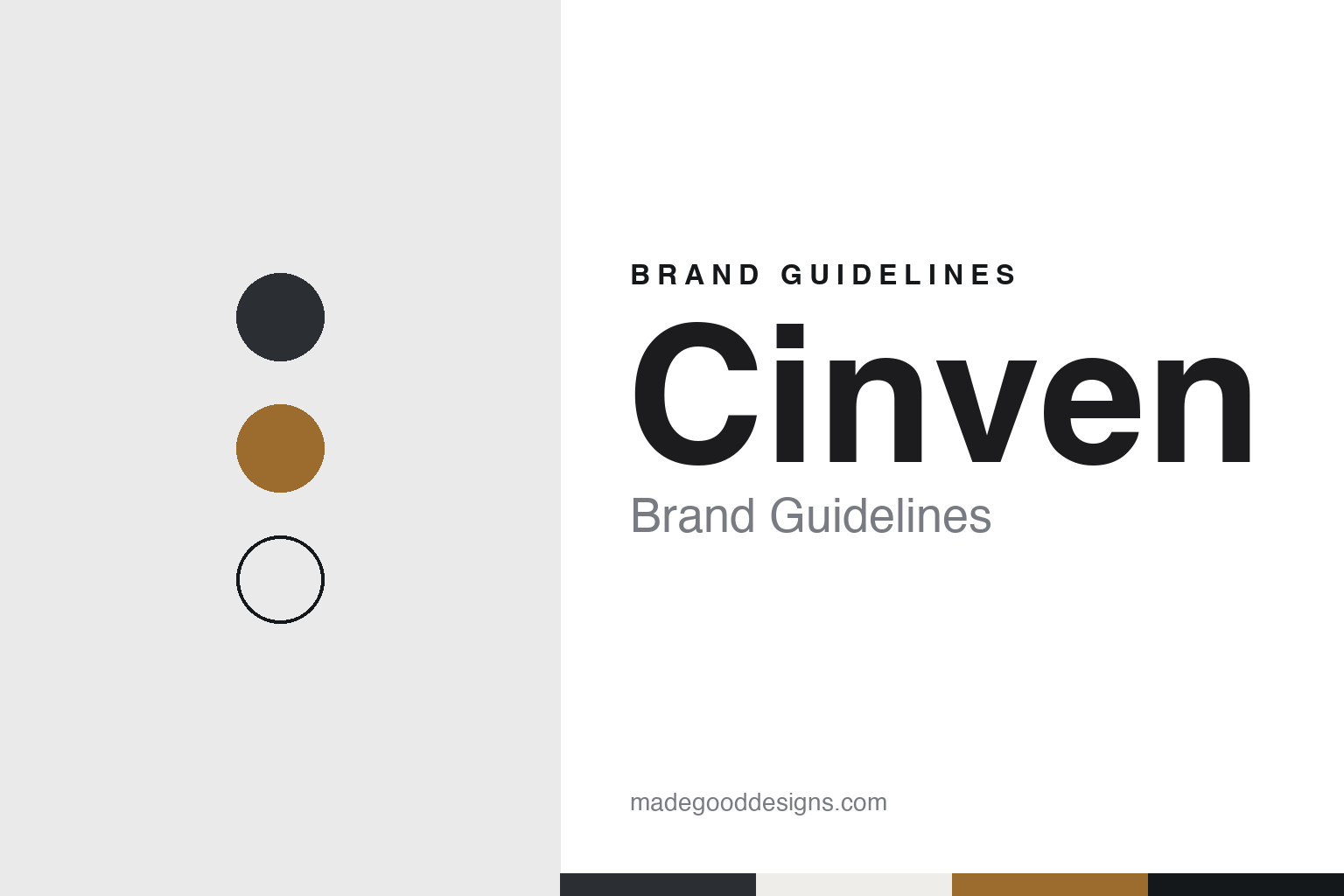
Two constants: a coal slate, chalk and ochre palette and a plain sans register. Abstract homage — not a Cinven asset or mark; no logo or wordmark is reproduced.
Coal Industry Nominees Ventures
A pension scheme’s investment arm.
Cinven began as part of a pension scheme. The company says it was founded in 1977 as part of the British Coal pension scheme, and that its name is an abbreviation of its original one, Coal Industry Nominees Ventures. English Wikipedia adds that its money first came only from three British pension funds — those of British Coal, the railway industry and Barclays Bank — and that they remained important investors. English Wikipedia gives a different expansion, “Coal Investment Nominees for Venture Capital”, as a reported origin of the name.
Its independence came in the mid-1990s. In a written answer to Parliament on 21 November 1995, recorded in Hansard, the government said that the disposal of the British Coal pension fund management company was still being negotiated and that the British Coal pension fund venture capital company was being disposed of as well, both as matters for British Coal. Cinven’s own timeline gives 1995 as the year of a management buyout from its previous owner, and says it has been entirely partner-owned since then.
The firm raised its first fund in 1996, the company says, and opened its first offices in continental Europe, in Paris and Frankfurt, in 1999.
Colour
Partner-owned, sector by sector.
Cinven’s timeline traces steady growth after the buyout. It opened a Milan office in 2006, set up the Cinven Foundation in 2007, became a signatory to the Principles for Responsible Investment in 2009, and opened offices in New York and Madrid in 2015. In 2022 it raised a fund for financial-services investments, and in 2023 its eighth flagship fund, the company says.
Today the company lists seven offices — Frankfurt, London, Luxembourg, Madrid, Milan, New York and Paris — and describes itself as “an international private equity firm with a strong European heritage.” It invests in six sectors: business services, consumer, financial services, healthcare, industrials and technology, media and telecoms, with sector specialists working alongside regional teams.
Its holdings have included familiar names. English Wikipedia records that BUPA agreed in June 2007 to sell its hospitals business to Cinven, which became Spire Healthcare; that Cinven bought Amdipharm and Mercury Pharma in 2012, merged them as AMCo and sold the business to Canada’s Concordia in September 2015; and that it acquired the German drugmaker Stada Arzneimittel in August 2017. The same article lists Gondola Holdings, the owner of the restaurant chains PizzaExpress, ASK and Zizzi, bought in June 2007; CeramTec, in June 2013; Synlab, in June 2015; and the accommodation wholesaler Hotelbeds, bought with the Canada Pension Plan Investment Board in September 2016. Earlier entries include Sebia, acquired in June 2010, and SLV, a supplier of residential and technical lighting products, in April 2011; later ones include the British fashion retailer Kurt Geiger, bought from Sycamore Partners in December 2015, and the Polish company RTB House, in which Cinven invested in January 2019. In September 2021 Cinven agreed to buy a majority stake in the British wealth manager True Potential, and it completed the purchase in February 2022, English Wikipedia says.
The pharmaceutical holdings led to a long competition case. On 29 July 2021 the UK Competition and Markets Authority found that Advanz, the sole UK supplier of liothyronine tablets, had charged excessive and unfair prices to the NHS between 2009 and 2017, and fined Advanz together with two former owners of the businesses, HgCapital and Cinven, for their ownership periods. In August 2023 the Competition Appeal Tribunal upheld the findings but reduced the penalties on HgCapital and Cinven, the CMA said. On 8 May 2025 the Court of Appeal, in a unanimous judgment, confirmed the finding, refused Advanz and Cinven permission to appeal and reinstated the CMA’s original penalty on Cinven, according to the CMA.
Typography
Design and documentation.
Private equity firms sell nothing that sits on a shelf, so their identities have to work without a product. The usual answer is restraint: a short wordmark, often initials or a surname set in a plain sans or a quiet serif, with one dark colour and a lot of white space. The name does most of the work, and the mark is meant to sit comfortably beside the logos of pension funds, banks and the companies a firm owns.
The physical setting carries the same message. Headquarters tend to be in glass-walled towers in financial districts, and the photography on firm websites leans on offices, skylines and people in meetings rather than on objects. When a firm wants to show what it does, it usually shows its portfolio companies: a factory floor, a data centre, a hospital corridor or a shop, each credited to the business rather than to the investor.
Much of the visible design lives in documents. Annual letters to investors, responsible-investment and sustainability reports, investor-day presentations and quarterly results decks are where the typography, charts and colour systems are most fully worked out. Listed firms add the formal layer of a public company, from stock-exchange filings to shareholder reports, and the same restrained palette usually runs through all of them.
Beyond the page, these firms present themselves through institutions. Founders and partners appear as donors to museums, concert halls and universities, and firm names turn up on fellowships, research centres and sponsorships. For a design reader, the category is a study in how far a brand can be carried by a name, a typeface and a tone of voice alone.
Aa
A plain sans — for a name that is an abbreviation. (Specimen set in IBM Plex Sans, a sans STAND-IN; NOT the Cinven logo.)
Cinven
An abbreviation that outlived the coal industry.
The name is the clearest trace of where Cinven came from. Its own account says “Cinven” is an abbreviation of Coal Industry Nominees Ventures, a title from the years when it invested on behalf of the coal industry’s pension scheme. The company kept the short form after the 1995 buyout, and its website notes that Cinven is a registered trademark.
Cinven makes no products of its own; its website presents its sectors, offices and people, and it says it supports not-for-profit causes through the Cinven Foundation, makes direct donations to charities that help young people from disadvantaged backgrounds reach mentoring and training, and matches sponsorship money its staff raise. It describes its investor base as spanning fund types and geographies, and speaks of an “almost-50 year track record”. Cinven Limited, a member of the group, is authorised and regulated by the Financial Conduct Authority and registered as an investment adviser with the US Securities and Exchange Commission, the website says.
For a design guide, Cinven shows how a firm’s name can carry its origin long after the institution behind it has gone. Compare Permira, another London firm that left a parent institution in the 1990s, and CVC, its fellow London-based private equity name. For this guide we use coal slate, chalk and an ochre with a sans, an unofficial interpretation; no product or logo is reproduced.
Explore & save
Keep Cinven’s identity on hand — save it to a board in the Made Good inspiration library.
Cinven identity set
Pin the Cinven coal slate, chalk and ochre palette and the plain sans register to your own board.