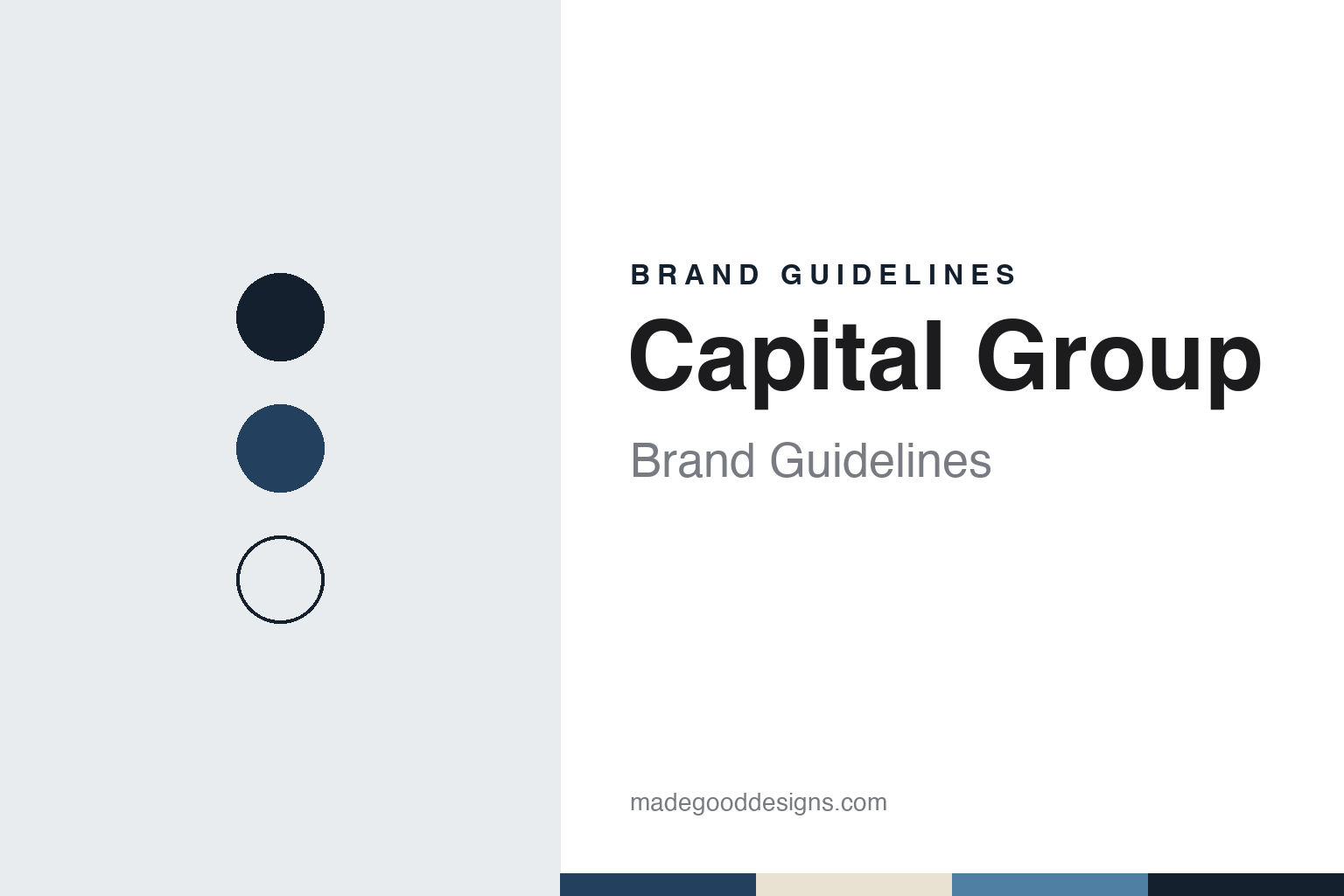
Capital Group Brand Guidelines
The Los Angeles fund house behind American Funds and The Capital System.
Aa
Two constants: a Capital Group navy, blue and sand palette and a Steady serif register. Abstract homage — not a Capital Group product or mark; no logo or fund document is reproduced.
Lovelace, Dennis & Renfrew
A Los Angeles firm founded in 1931.
Capital Group began in Los Angeles in 1931. English Wikipedia says Jonathan Bell Lovelace founded an investment firm called Lovelace, Dennis & Renfrew that year, the business that would become Capital Group. Before that he had been a partner in the stock brokerage E.E. MacCrone, where, Wikipedia says, he explored the idea of an open-end mutual fund and launched The Investment Company of America in 1927. He sold his stake in that firm shortly before the Wall Street Crash of 1929.
The fund followed him. In 1933, Wikipedia says, his new firm took over the management of The Investment Company of America, and the company’s own history says the fund’s success “helped lay Capital Group’s foundation for American Funds,” the name under which its mutual funds are sold in the United States. Wikipedia says those funds are offered through a subsidiary, American Funds Distributors, and that in 2019 the group ran 36 mutual funds under the American Funds banner. The company still describes Lovelace as a founder who “prioritized honesty and integrity.”
Capital Group tells several stories about its early decades that rest on its own account. It says that in the 1930s Lovelace helped Roy and Walt Disney finance Snow White and the Seven Dwarfs and Fantasia; that he gave testimony at the government hearings that led to the Investment Company Act of 1940, the law governing American mutual funds; and that in the late 1940s the firm made “a conscious decision” to sell its funds through brokers and dealers rather than directly to the public. We give those as the company’s claims.
Growth was slow at first. Wikipedia says the firm “enjoyed modest success” for about twenty years, and that its roster of funds grew as mutual funds became popular in the 1950s. The company has remained private: it describes itself as a privately owned global investment manager, and Wikipedia says that in 2019 it was owned by about 450 partners. It is still based in Los Angeles, which PLANADVISER described in January 2023 as the firm’s home.
Colour
The Capital System.
The idea most closely tied to the name is a way of running money. English Wikipedia says that in 1958 the founder’s son, Jon Lovelace Jr., introduced a new system: rather than give each portfolio to a single manager, the firm divided it among several. Each manager shares ideas with colleagues but has full discretion over his or her own section. Known today as The Capital System, it is meant, Wikipedia says, to avoid creating single-manager “stars” whose departure could unsettle a fund. From the mid-1960s research analysts were also given a portion of each portfolio to invest in their own strongest ideas.
The company now presents The Capital System as a trademark and as the core of its approach, “designed to bring together diverse perspectives while reducing reliance on any one individual.” Wikipedia says its funds typically have between three and 13 managers, and that equity investing is split among three independent divisions — Capital World Investors, Capital Research Global Investors and Capital International Investors — with bonds handled by Capital Fixed Income Investors. The company says the three equity groups make investment and proxy-voting decisions independently.
The second thread is international investing. Capital Group says it invested in Royal Dutch Petroleum in 1953 and was an early institutional investor in Japanese stocks. Wikipedia dates its first international fund, the International Resources Fund, to 1954, a year after Lovelace set up an international research staff at his son’s urging. Both sources agree that its first overseas research office opened in Geneva in 1962. The company says it launched its first European fund in 1969, a Luxembourg-based fund in 1970 and the New Perspective strategy in the United States in 1973; that it began managing non-US assets for American institutions in 1978; that it opened in London in 1979; and that it opened its first Asian office in Tokyo in 1982, followed by Hong Kong and Singapore.
One of its claims touches another finance brand. Capital Group says that in the late 1960s, finding little data on markets outside the United States, it created the Europe, Australasia, Far East (EAFE) index, which later became part of the MSCI indices, and that commercial rights to the publication and indexes were sold to Morgan Stanley in 1986. We give that as the company’s account. Wikipedia adds that the firm was criticised in the late 1990s for not offering the technology funds then in fashion, and praised for that caution after the bubble burst.
Typography
Asset managers and their marks.
Asset managers sell something that cannot be photographed: a promise about money over decades. Their visual language tends to borrow calm from elsewhere. Campaigns favour quiet photography of savers, families and retirees, while corporate pages lean on skyline offices, glass lobbies and the street names of financial districts. The tone is reassurance rather than excitement.
Much of the real design work sits in documents. Fund factsheets, prospectuses and annual reports follow tight templates in which a fund name, a ticker and a chart must sit in the same place on every page, across dozens of languages and jurisdictions. Exchange-traded funds have added their own graphic shorthand: three- and four-letter tickers that work almost as logos, and fund-family names such as SPDR, launched by State Street in 1993, and iShares, which BlackRock acquired with Barclays Global Investors in 2009.
The larger firms also publish a steady stream of thought leadership. Stewardship reports explain how they vote shares on behalf of clients, sustainability reports set out policies, and annual letters from chief executives and market-outlook publications are written to be quoted by the financial press. These pieces are designed as editorial products, with covers, charts and data graphics, and they carry much of a firm’s identity.
Visibility beyond the financial pages usually comes through sponsorship of sports and the arts, and occasionally through public stunts: State Street’s Fearless Girl statue, installed facing Wall Street’s Charging Bull in March 2017, began as a promotion for an index fund. This guide sets out what can be checked about each firm — its founding, its owners and its deals — and keeps colours and typefaces to an unofficial interpretation.
Aa
A steady serif — a nearly century-old name. (Specimen set in Source Serif 4, a serif STAND-IN; NOT the Capital Group logo.)
Capital Group
Two names, one firm.
The product range widened over the decades. Capital Group says its first fixed-income fund appeared in 1974, its 529 college savings plan in 2002 and its first target-date series in 2007. English Wikipedia dates the Growth Fund of America to 1973 and says that in 2022 the firm introduced a suite of six exchange-traded funds, five in equities and one in bonds and other fixed income. PLANADVISER described that move in January 2023 as a recent push into actively managed exchange-traded funds.
Leadership changes are rare enough to make news. On 26 January 2023 PLANADVISER reported that The Capital Group Companies, “which runs American Funds,” had announced that chairman and chief executive Tim Armour would step down in October and be succeeded by Mike Gitlin, then head of fixed income, as president and chief executive. Martin Romo was to become chairman and chief investment officer, and Jody Jonsson vice chair. Wikipedia records Gitlin as chief executive from 2023.
The brand works on two levels. Capital Group is the name of the organisation, its offices and its institutional business; American Funds is the name many American investors and retirement-plan savers meet on their statements, and the americanfunds.com address now leads to capitalgroup.com. The company’s trademarks — The Capital System, Capital Ideas, The Investment Company of America — lean on plain, institutional words rather than images, and its history page counts toward a 100th anniversary in 2031. Wikipedia lists offices across the Americas, Europe, Asia and Australia, from Atlanta and Toronto to Geneva, London, Luxembourg, Tokyo and Sydney.
For a design guide, Capital Group shows how a private firm can carry two names for nearly a century and let a method, rather than a star manager, define the brand. Compare Vanguard, another American mutual-fund house with a distinctive ownership story, and Fidelity, a Boston fund house whose story also runs back to the early 1930s. For this guide we use a harbor navy, a Pacific blue and a sand with a serif, an unofficial interpretation; no product or logo is reproduced.
Explore & save
Keep Capital Group’s identity on hand — save it to a board in the Made Good inspiration library.
Capital Group identity set
Pin the Capital Group navy, blue and sand palette and the Steady serif register to your own board.