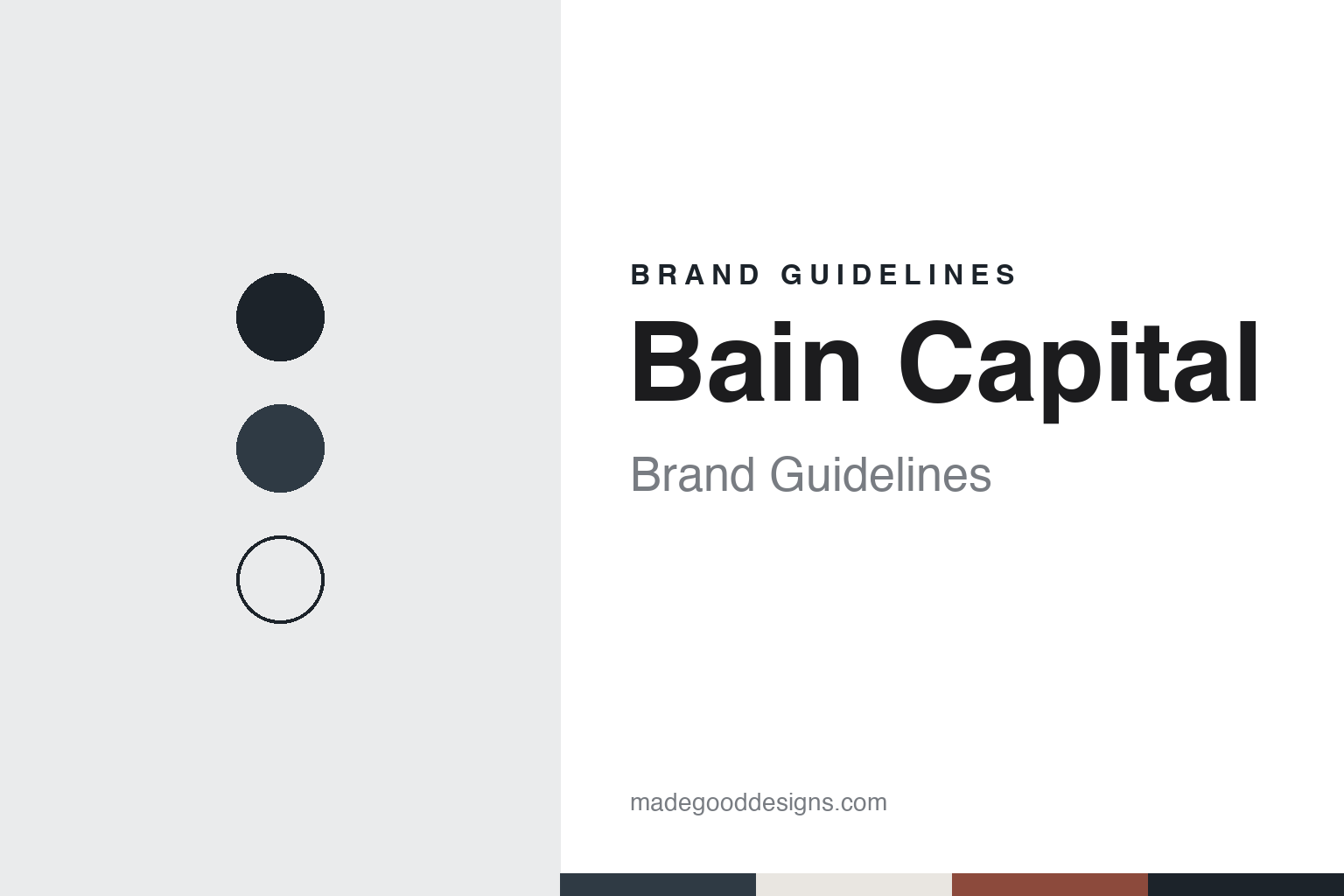
Bain Capital Brand Guidelines
The 1984 Boston firm started by consultants who wanted to invest.
Aa
Two constants: a slate, stone and brick palette and a partnership serif register. Abstract homage — not a Bain Capital asset; no logo or mark is reproduced.
Copley Place
Consultants who set out to invest.
Bain Capital was founded in 1984 in Boston by three partners of the consulting firm Bain & Company: Mitt Romney, T. Coleman Andrews III and Eric Kriss, according to English Wikipedia. Bill Bain, the consultancy’s founder, had offered Romney the chance to lead a new venture that would invest in companies and apply Bain’s consulting methods to how they were run. The firm says on its own website that it was “founded as a private partnership in 1984.”
The shared name causes confusion, so it is worth saying plainly: Bain Capital and Bain & Company are two separate firms. Bain & Company is a management consultancy; Bain Capital is an investment firm. English Wikipedia says Bain Capital was never an affiliate or a division of the consultancy. In the early years the two shared offices in a tower at Copley Place in Boston, with rules in place to stop information passing between them, and Bain Capital at first paid part of its profits to the consultancy, an arrangement that was later dropped.
The start was slow. Wikipedia says the partners spent about a year raising their first fund, and that by 1986 very few deals had been done. The firm began with venture capital. One of its earliest investments, in 1986, backed two supermarket executives opening an office-supply superstore in Brighton, Massachusetts — the business that became Staples, which went public in 1989. From 1989, Wikipedia says, Bain Capital shifted towards leveraged buyouts and growth investments in more mature companies, working with existing managers rather than through hostile takeovers.
Colour
From buyouts to five businesses.
In the 1990s the firm added businesses beyond buyouts: a long-short equity hedge fund, Brookside Capital, in 1996, and a fixed-income affiliate, Sankaty Advisors, two years later, according to English Wikipedia. Its own website now groups the firm into five businesses — Private Equity, Growth & Venture, Capital Solutions, Credit and Real Assets — with teams for life sciences, crypto, insurance and its Double Impact strategy listed beneath them.
Bain Capital has often invested alongside other firms. In 2002 it joined TPG and Goldman Sachs’s private-equity arm in the consortium that bought Burger King from Diageo; in 2005 it was one of seven firms in the buyout of the software and data company SunGard; and in 2006 it joined KKR, Merrill Lynch and the founding Frist family in taking the hospital operator HCA private, Wikipedia records. Consumer names over the years have included Dunkin’ Brands, bought with Carlyle and Thomas H. Lee Partners in 2005, and a majority stake in Canada Goose in 2013.
The firm has also helped start businesses rather than only buy them. In November 2014 Bain Capital and Virgin Group announced a new cruise line, now Virgin Voyages, and in 2020 Bain Capital bought the airline Virgin Australia, Wikipedia says. On 1 October 2024 the education-software company PowerSchool announced that its acquisition by Bain Capital had closed, making it a private standalone company, in a release republished by Vista Equity Partners, which kept a minority stake.
Its largest recent move in Japan was covered by the trade press. On 2 September 2025 CSP Daily News reported that Seven & i Holdings, the parent of 7-Eleven, had completed the sale, announced in March, of its supermarket and specialty-store subsidiary York Holdings to Bain Capital, which it described as a Boston-based private equity firm. York Holdings includes the Ito-Yokado supermarket chain and the company that runs Denny’s restaurants in Japan; Bain holds about 60%, with Seven & i and its founding Ito family reinvesting, the report said.
Typography
Private equity and its presentation.
Private equity firms sell nothing that sits on a shelf, so their identities have to work without a product. The usual answer is restraint: a short wordmark, often initials or a surname set in a plain sans or a quiet serif, with one dark colour and a lot of white space. The name does most of the work, and the mark is meant to sit comfortably beside the logos of pension funds, banks and the companies a firm owns.
The physical setting carries the same message. Headquarters tend to be in glass-walled towers in financial districts, and the photography on firm websites leans on offices, skylines and people in meetings rather than on objects. When a firm wants to show what it does, it usually shows its portfolio companies: a factory floor, a data centre, a hospital corridor or a shop, each credited to the business rather than to the investor.
Much of the visible design lives in documents. Annual letters to investors, responsible-investment and sustainability reports, investor-day presentations and quarterly results decks are where the typography, charts and colour systems are most fully worked out. Listed firms add the formal layer of a public company, from stock-exchange filings to shareholder reports, and the same restrained palette usually runs through all of them.
Beyond the page, these firms present themselves through institutions. Founders and partners appear as donors to museums, concert halls and universities, and firm names turn up on fellowships, research centres and sponsorships. For a design reader, the category is a study in how far a brand can be carried by a name, a typeface and a tone of voice alone.
Aa
A partnership serif for an investment firm. (Specimen set in Source Serif 4, a serif STAND-IN; NOT the Bain Capital logo.)
Bain Capital
A partnership with a borrowed surname.
English Wikipedia describes Bain Capital, LP as a private investment firm with its headquarters in Boston and offices across North America, Europe, Asia and Australia; the firm’s own website counts 24 offices and more than 2,000 team members. Romney, its founding chief executive, finalised his separation from the firm in early 2002, and Wikipedia says it has been run by a management committee since then. In 2016 the firm named Jonathan Lavine and John Connaughton co-managing partners.
The firm presents itself in words rather than products. Its website calls Bain Capital “one of the world’s leading private investment firms” and sets out a purpose — to “drive positive and lasting impact for companies, employees, communities, and the environment” — followed by four values, from “We develop exceptional partnerships” to “We believe character matters.” It also publishes a yearly sustainability and impact report; the 2026 edition is dated 30 June 2026. For anyone working on the name, the key fact is the one above: the investment firm and the consultancy both carry the Bain surname, but they are separate businesses.
For a design guide, Bain Capital shows how an investment firm builds a brand from a founding surname, a partnership story and the companies it backs. Compare TPG, its partner in the Burger King buyout, and KKR, its partner in HCA; for the consultancy that shares its name, see Bain & Company. For this guide we use a deep slate, a stone grey and a muted brick with a serif, an unofficial interpretation; no product or logo is reproduced.
Explore & save
Keep Bain Capital’s identity on hand — save it to a board in the Made Good inspiration library.
Bain Capital identity set
Pin the Bain Capital slate, stone and brick palette and the partnership serif register to your own board.