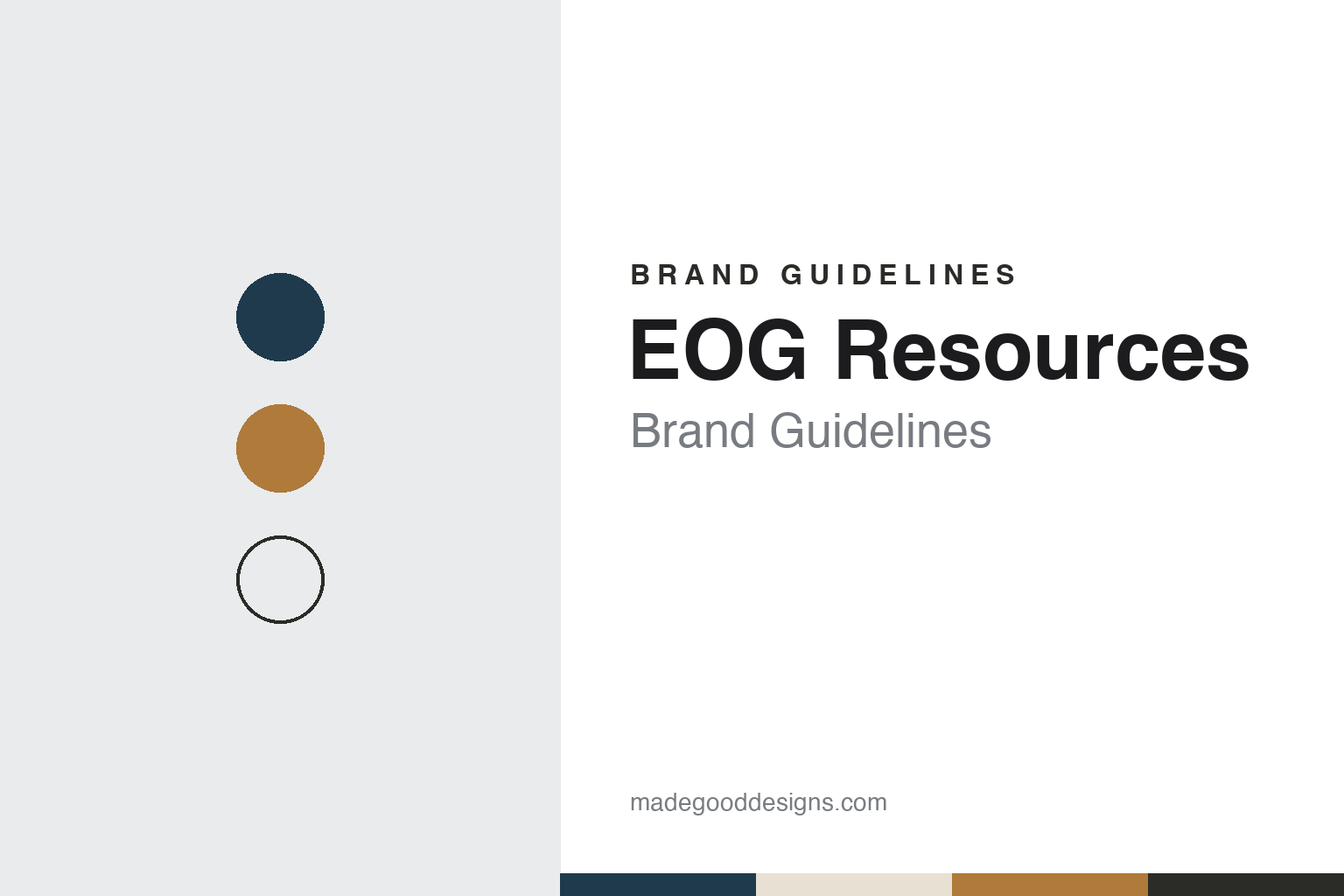
EOG Resources Brand Guidelines
Three letters kept, one name dropped, and a turn from gas to shale oil.
Aa
Two constants: a basin blue, sand and ochre palette and a plain grotesque register. Abstract homage — not an EOG Resources asset; no logo, sign or mark is reproduced.
Enron Oil & Gas
An energy group’s oil and gas arm becomes its own company.
EOG Resources is a Houston oil and gas producer whose initials are older than its name. Until 1999 it was the Enron Oil & Gas Company, part of the Houston energy group Enron, Wikipedia says. In 1999 it separated from Enron Corp. and changed its name to EOG Resources, Inc., keeping the three initials it already used. IndustryWeek, profiling the company in April 2007, put it plainly: Enron Oil & Gas decided to change its name two years before the Enron scandal broke, and in the same year declared its independence from Enron Corp.
The man most closely tied to that period is Mark G. Papa, who led EOG as chairman and chief executive. IndustryWeek dates his election to 1999, the year of the separation; Wikipedia says he was named to both posts in 1998. He stood down from the board in December 2014, according to Wikipedia. The company is organised in Delaware and is based in Houston, where in 2006 it signed a lease for offices in the Heritage Plaza tower, which Wikipedia gives as its headquarters.
The early independent years were spent reshaping the map. In 2000 EOG swapped properties with Occidental Petroleum, taking acreage in East Texas and the Oklahoma Panhandle in return for California and Gulf of Mexico assets, and swapped other properties with Burlington Resources to gain ground in West Texas and New Mexico, in the Permian Basin, Wikipedia says. In 2003 it bought Canadian properties from Husky Energy.
Colour
From a gas producer to a shale-oil producer.
For its first years as an independent company EOG was mainly a natural gas producer. IndustryWeek reported in 2007 that 86% of its 2006 production was natural gas and 14% crude oil and natural gas liquids, with reserves in the United States, Canada, Trinidad and the UK North Sea. The same article noted an early sign of what came next: EOG had completed five horizontal oil wells in the Bakken formation of North Dakota and planned to add rigs there in 2007.
The turn became public in April 2010. The Oil & Gas Journal reported on 19 April 2010 that EOG had gathered acreage across six counties in the Eagle Ford play of South Texas and drilled 16 delineation wells along a 120-mile trend. Papa told the journal he believed the South Texas Eagle Ford horizontal crude oil play would prove to be “one of the most significant United States oil discoveries in the past 40 years.” The journal named the Milton 1H well in Karnes County, which began flowing oil in April 2009, as the discovery well. Over the following years EOG sold its Canadian assets, in 2014, and its offshore assets in the United Kingdom, in 2018, Wikipedia says.
Acquisitions widened the shale footprint. In September 2016 EOG acquired Yates Petroleum, adding acreage in the Delaware Basin of the Permian, the Powder River Basin and New Mexico’s Northwest Shelf, according to Wikipedia; in 2017 it formed a joint venture with The Carlyle Group in Ellis County, Oklahoma. In 2025 it closed its purchase of Encino Acquisition Partners, which, the Oil & Gas Journal reported on 8 August 2025, brought a large position in the Utica shale of Ohio; chairman and chief executive Ezra Yacob called the Utica a “foundational asset.”
Typography
How producers present themselves.
Oil and gas producers sell crude, gas and liquids to refiners, traders and utilities rather than to shoppers, so most of their visual identity lives in places investors, partners, regulators and job seekers look. The pictures are familiar across the sector: drilling pads on open plains photographed from the air, with straight gravel roads running between them; offshore platforms and floating production, storage and offloading vessels, the FPSOs, standing in grey water; and geologists holding core samples cut from the rock they hope to produce.
The second register is the investor presentation. Producers set out their story in investor-day slides and quarterly decks built around acreage maps, with basins shaded in company colours, wells marked as dots and figures for inventory and reserves given in the units the industry uses. Names of basins and plays, such as the Permian, the Eagle Ford or the North Sea, often carry as much weight on these pages as the company’s own mark.
The third is reporting. Annual reports and sustainability reports sit beside each other on company websites, and the sustainability documents return to the same subjects year after year: methane, flaring, water and land use. Community-investment pages show schools, clinics and local programmes in the areas where a company drills, usually with photographs of the people involved rather than of the equipment.
Behind those formats, upstream companies often carry long histories of mergers, spin-offs and renamings, and their names can outlast the businesses that first used them. The guides in this group follow that record company by company, from the origins of each name to its current owner, and treat the colours and type shown here as our own interpretation rather than any company’s official system.
Aa
A plain grotesque for a company known by three initials. (Specimen set in Libre Franklin, a sans STAND-IN; NOT the EOG Resources logo.)
EOG Resources
Three letters, many basins.
Today EOG’s acreage is almost entirely American. Wikipedia lists properties in the Eagle Ford, in the Delaware Basin and other parts of the Permian, in the Williston Basin’s Bakken formation and the Powder River Basin in the Rocky Mountains, and in the Anadarko Basin, the Austin Chalk and the Marcellus, with a small share of reserves in Trinidad and Tobago. In February 2026 it sold its Dean position in the northern Midland Basin, Wikipedia adds. Beyond North America, the Oil & Gas Journal reported in August 2025 that EOG had early-stage development in Bahrain and the United Arab Emirates alongside continued exploration in Trinidad.
The name is the brand’s main design fact. On leaving Enron the company kept the initials it already used and changed only the full name, so “EOG” no longer spells out Enron, oil or gas, and the three letters now stand on their own as the company’s name.
EOG’s own record of itself is told largely through basins and wells: the Milton 1H in Karnes County, the Eagle Ford trend described to the Oil & Gas Journal in 2010, the Delaware Basin added with Yates in 2016 and the Utica added with Encino in 2025. The palette in this guide is our own, chosen to echo the dry country of South and West Texas where much of that story sits.
For a design guide, EOG Resources shows how a company can keep its initials and let them stand on their own after leaving the group that gave them meaning. Compare ConocoPhillips, another Houston producer built from older names, and Devon Energy, an American shale producer. For this guide we use basin blue, ochre and a caliche sand with a sans, an unofficial interpretation; no product or logo is reproduced.
Explore & save
Keep EOG Resources’s identity on hand — save it to a board in the Made Good inspiration library.
EOG Resources identity set
Pin the EOG Resources basin blue, sand and ochre palette and the plain grotesque register to your own board.