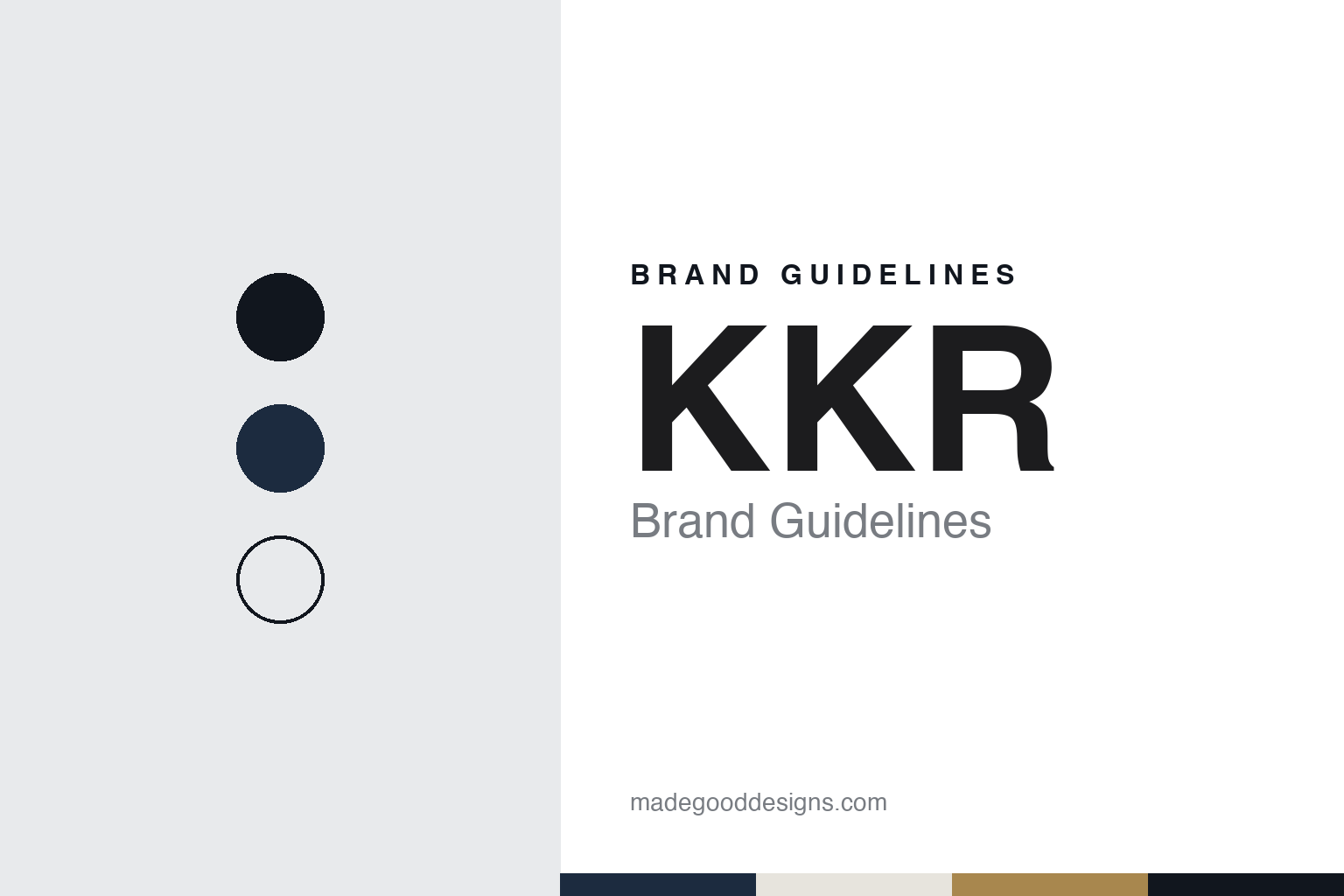
KKR Brand Guidelines
The 1976 New York buyout firm named for its three founders.
Aa
Two constants: a KKR navy, stone and brass palette and a Measured sans register. Abstract homage — not a KKR mark; no logo, document or portfolio-company asset is reproduced.
Kohlberg Kravis Roberts
Three bankers leave Bear Stearns.
KKR began on 1 May 1976 in New York, the date the firm gives on its own history page. Its founders were Jerome Kohlberg Jr. and the cousins Henry Kravis and George R. Roberts, who had worked together in the corporate-finance department of the investment bank Bear Stearns. English Wikipedia says the three had already completed a run of what they called “bootstrap” deals there in the 1960s and 1970s, buying family-owned companies that faced succession problems: businesses too small to float on a stock exchange, whose founders did not want to sell to a competitor.
By 1976, English Wikipedia says, tension with Bear Stearns had built up after the bank’s leadership repeatedly turned down proposals for a dedicated in-house investment fund, and the three left to form Kohlberg Kravis Roberts & Co. The same article says the name was meant to run Kohlberg Roberts Kravis, but public-relations advisers preferred the sound of “KKR,” the three-letter form the firm uses as its name today. KKR’s history page calls Kravis and Roberts “first cousins and the closest of friends” and describes Kohlberg as their mentor; the firm also says its founding launched “what we now know as the alternatives industry,” which is its own description.
The first buyout, of the manufacturer A.J. Industries, followed in 1976, English Wikipedia says, with money from a small group of backers. The firm raised its first institutional fund in 1978, and in 1981 the public pension fund of the Oregon State Treasury invested alongside it in the buyout of the Portland retailer Fred Meyer; the same source says Oregon remains an investor in KKR funds. Its 1979 take-private of Houdaille Industries, a maker of machine tools and car bumpers, is described there as precedent-setting, and as ending in the break-up of the company. In 1987 Kohlberg left to found his own firm, Kohlberg & Co., and Kravis became senior partner; Kravis and Roberts then led KKR together for more than three decades.
Colour
RJR Nabisco and what came after.
KKR’s biggest deal of the 1980s was RJR Nabisco, the food and tobacco group formed in 1985 from Nabisco Brands and R.J. Reynolds. In October 1988 its management proposed a buyout of their own; KKR entered with a rival bid, and after a contest that drew in other bidders, the RJR board accepted KKR’s offer at the end of November 1988 even though management had bid a higher per-share figure, English Wikipedia says, because KKR’s offer was guaranteed. The buyout was completed in April 1989. English Wikipedia calls it the largest buyout in history at that time, a record that stood for 17 years, and the contest was chronicled in the book Barbarians at the Gate, later made into a television film.
The aftermath shaped KKR’s early 1990s. The firm did not complete a single new investment in 1990, English Wikipedia says, and spent those years cutting RJR’s debt through asset sales, fresh equity and an exchange offer that returned RJR stock to public markets in 1991. KKR used its RJR shares as part of its 1994 buyout of the food and chemicals group Borden, and the same source says the last remnants of the 1989 investment were not sold until 2004. In the meantime the firm turned to build-ups and roll-ups, including the publishing platform K-III Communications.
Later decades brought larger funds and a wider reach. English Wikipedia describes the 2007 take-private of the Texas power utility TXU as the largest buyout completed to date, and records deals as different as the publisher Simon & Schuster, acquired in October 2023, where employees received an ownership stake on completion, and the insurer Global Atlantic, majority-owned from 2021 and wholly owned from January 2024. Some deals drew protest. The firm’s 2019 stake, with Alberta Investment Management Corporation, in the Coastal GasLink pipeline in Canada, whose route crosses territory of the Wet’suwet’en Nation, preceded the 2020 Canadian pipeline and railway protests, and its 2024 purchase of the festival group Superstruct Entertainment led performers to sign open letters asking festivals to cut ties with KKR, English Wikipedia says.
Typography
How private equity presents itself.
Private equity firms sell nothing that sits on a shelf, so their identities have to work without a product. The usual answer is restraint: a short wordmark, often initials or a surname set in a plain sans or a quiet serif, with one dark colour and a lot of white space. The name does most of the work, and the mark is meant to sit comfortably beside the logos of pension funds, banks and the companies a firm owns.
The physical setting carries the same message. Headquarters tend to be in glass-walled towers in financial districts, and the photography on firm websites leans on offices, skylines and people in meetings rather than on objects. When a firm wants to show what it does, it usually shows its portfolio companies: a factory floor, a data centre, a hospital corridor or a shop, each credited to the business rather than to the investor.
Much of the visible design lives in documents. Annual letters to investors, responsible-investment and sustainability reports, investor-day presentations and quarterly results decks are where the typography, charts and colour systems are most fully worked out. Listed firms add the formal layer of a public company, from stock-exchange filings to shareholder reports, and the same restrained palette usually runs through all of them.
Beyond the page, these firms present themselves through institutions. Founders and partners appear as donors to museums, concert halls and universities, and firm names turn up on fellowships, research centres and sponsorships. For a design reader, the category is a study in how far a brand can be carried by a name, a typeface and a tone of voice alone.
Aa
A measured sans for a three-letter name. (Specimen set in Inter Tight, a sans STAND-IN; NOT the KKR logo.)
KKR & Co. Inc.
From partnership to listed corporation.
KKR took a long road to the stock market. It listed an investment vehicle, KKR Private Equity Investors, in 2006, and filed in 2007 to sell a stake in the management firm itself, a plan postponed and then called off as credit markets tightened, English Wikipedia says. In October 2009 shares of KKR & Co. were listed on Euronext, which German Wikipedia also records, and on 15 July 2010 trading began on the New York Stock Exchange. On 3 May 2018, Institutional Investor reported, KKR announced that it would convert from a partnership into a corporation, the second listed private-equity firm to make the switch after Ares Management, following the cut in the US corporate tax rate at the end of 2017. The new structure was set to take effect on 1 July 2018, and Kravis and Roberts said it was meant to “broaden our investor base, simplify our structure, and make it easier to invest in our shares.” The listed company is now KKR & Co. Inc., and English Wikipedia says it joined the S&P 500 index on 24 June 2024.
The founders have stepped back from day-to-day leadership. Joseph Bae and Scott Nuttall, co-presidents from July 2017, became co-chief executives in 2021, with Kravis and Roberts as co-executive chairmen, English Wikipedia says. The same source places the headquarters at 30 Hudson Yards in New York, with offices in cities from Abu Dhabi to Tokyo, and describes three business areas: asset management across private equity, credit, infrastructure and real estate; insurance, through Global Atlantic; and a group of strategic holdings. In 2026 the firm marks fifty years since its founding with an anniversary timeline on its website.
For a design guide, KKR shows how a three-letter name, chosen in 1976 for its sound, can carry a firm through buyouts, listings and a change of legal form. Compare Carlyle, the Washington firm founded in 1987, and Goldman Sachs, another New York name in finance. For this guide we use a deep navy, a pale stone and a brass with a sans, an unofficial interpretation; no product or logo is reproduced.
Explore & save
Keep KKR’s identity on hand — save it to a board in the Made Good inspiration library.
KKR identity set
Pin the KKR navy, stone and brass palette and the Measured sans register to your own board.