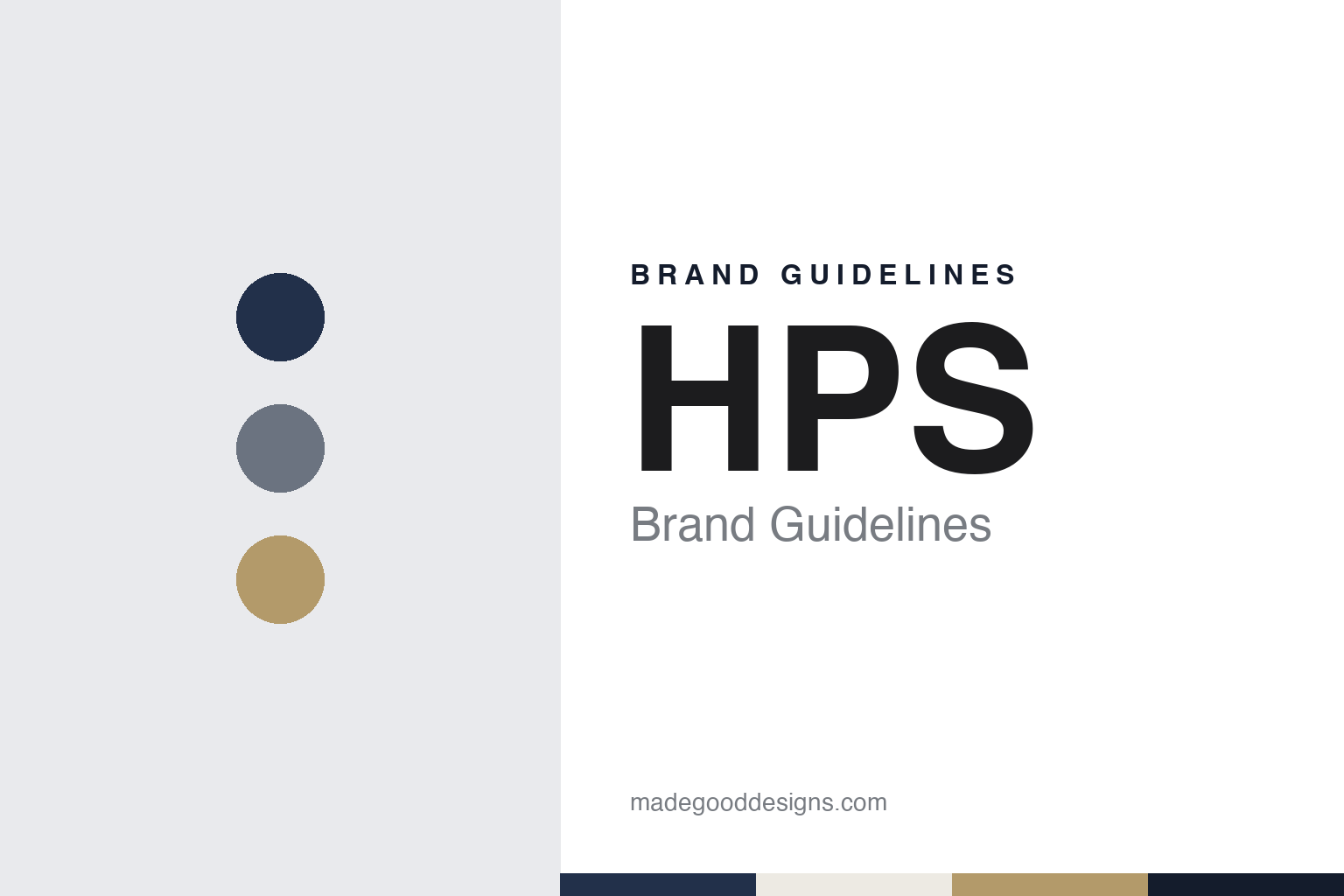
HPS Brand Guidelines
Highbridge’s 2007 credit arm, bought out in 2016, now part of BlackRock.
Aa
Two constants: a navy, slate and brass palette and a ledger serif register. Abstract homage — not an HPS asset or mark; no logo or fund document is reproduced.
Highbridge Principal Strategies
A credit desk inside a bank-owned hedge fund.
HPS began in 2007 inside J.P. Morgan Asset Management. English Wikipedia says Scott Kapnick, Scot French and Michael Patterson founded it as Highbridge Principal Strategies after leaving Goldman Sachs, as the private equity and credit division of the hedge fund Highbridge Capital Management, which J.P. Morgan owned. The firm’s own history page says it was founded “as a part of J.P. Morgan Asset Management” to invest in alternative credit in the US and Europe, and that its first product was a liquid credit strategy.
The early milestones are the firm’s own account. It says it launched its junior private credit strategy, Strategic Investment Partners, and opened a London office in 2008; introduced its first dedicated senior lending strategy, Specialty Direct Lending, in 2010; added Core Senior Lending in 2013 at the request of a large European insurance client; and in 2015 started an asset-based lending strategy and added a private credit team in Sydney. English Wikipedia adds that the business was enlarged in February 2011, after Highbridge bought the Brazilian manager Gávea Investimentos.
The break with the bank followed. In December 2014 Institutional Investor reported talks on a management buyout, and English Wikipedia, summarising that report, says one reason was the Volcker Rule’s limits on how much banks may invest in alternative funds. On 20 October 2015 Private Debt Investor reported that Highbridge Principal Strategies, the private debt business within Highbridge, was close to a deal to spin out from the hedge fund and from JPMorgan Chase, its parent. English Wikipedia says the buyout was completed in March 2016, with JPMorgan keeping the Highbridge hedge funds and a minority stake, and that the spun-out firm took the name HPS Investment Partners. HPS describes the step as its principals buying the firm from J.P. Morgan Asset Management to create an independent, employee-owned firm.
Colour
Outside shareholders, new vehicles and a court case.
Outside shareholders arrived in stages. In 2018 Dyal Capital Partners took what HPS calls a passive minority investment, and the same year, the firm says, a team from Tålamod Asset Management joined to add distressed and special-situations investing. In 2022 Guardian Life Insurance bought a strategic minority stake, according to HPS, which says Guardian widened the partnership in 2024 by placing a large book of assets, mostly high-grade private credit, real estate credit and liquid credit, under its management.
The product range grew around those clients. HPS says it set up an Insurance Solutions Group in 2020, opened offices in Dubai and Singapore in 2021, and in 2022 launched HLEND, its first non-traded business development company, to offer its institutional direct lending strategy to individual investors. In 2021, with the Kapnick Foundation, it established the HPS Center for Financial Excellence at Howard University, with the aim, the firm says, of preparing students for careers in finance. Today its website groups the business into three areas: corporate-focused private credit, asset-based finance and liquid credit.
HPS was also one of the lenders in a closely followed court case. In August 2020 Citigroup sued HPS, Brigade Capital and Symphony Asset Management to recover their share of a payment that Citi said it had sent to Revlon’s lenders by mistake. A federal court ruled for the lenders in February 2021; on 8 September 2022 the US Court of Appeals for the Second Circuit reversed that ruling in Citigroup’s favour, and in October 2022 the lenders’ request for a further review was denied, English Wikipedia reports, citing Bloomberg.
A public listing was also prepared. Bloomberg reported in November 2023, according to English Wikipedia, that HPS had confidentially filed for an initial public offering.
Typography
How private credit firms present themselves.
Private credit firms lend to companies directly rather than through banks or public bond markets, and they present themselves mainly to the investors whose money they manage rather than to consumers. Their websites tend to be restrained: a few corporate colours, plain sans or serif type, photographs of offices and people, and pages organised by investment strategy and by the kinds of client they serve. Blue Owl, for example, sorts its site by audience — asset managers, financial advisors, institutional investors and insurance companies — while Oaktree groups its work into credit, equity and real estate.
Writing carries much of the identity. Managers publish insight pieces, market outlooks and explanatory charts on how direct lending works, where loans sit in a company’s capital structure and how risk is shared. Oaktree’s co-founder Howard Marks has posted his memos publicly on the firm’s website for years, and its pages set out its investment philosophy as a short list of tenets. Team pages, dated timelines and accounts of past deals and portfolio companies do the work that advertising does for a consumer brand.
Listed vehicles add another layer. Many firms run business development companies, American funds that lend to private companies, some traded on a stock exchange and some not. Each needs its own investor-relations pages, with filings, results and shareholder letters; non-traded funds typically offer quarterly tender offers of up to 5% of shares, Reuters explained in July 2026, so their letters on withdrawal requests are public documents in their own right.
Ownership changes often. Many of the firms in this group were formed by merger, spun out of a bank or another manager, or bought by a larger asset manager, and their names, sites and visual identities are adjusted as they move. This guide sets out what can be checked about each firm — who founded it, who owns it and how it describes its business — and marks clearly what rests only on its own word.
Aa
A ledger serif for a firm that kept its initials. (Specimen set in Source Serif 4, a serif STAND-IN; NOT the HPS logo.)
HPS, a part of BlackRock
A name kept inside a larger house.
In December 2024 BlackRock announced that it would acquire HPS, English Wikipedia says, citing The Wall Street Journal, and on 1 July 2025 the two firms announced that the acquisition had been completed, according to BlackRock’s press release of that date. BlackRock created a unit called Private Financing Solutions, combining HPS with its own private credit, CLO and GP–LP businesses, led by Kapnick, French and Patterson; Kapnick became an observer on BlackRock’s board. The release said HPS’s flagship strategies, among them Strategic Investment Partners, the Specialty Loan Fund, the Core Senior Lending Fund and HLEND, would keep HPS branding, and that the business would be known as “HPS, a part of BlackRock.”
HPS is therefore no longer an independent firm: it is a BlackRock business that trades under its own name. Its website, copyrighted in 2026 by HPS Investment Partners, LLC, opens with the line “Powered by ingenuity. Dedicated to performance. Focused on client service.” and describes the firm as “global leaders in alternative credit”, a claim made by the company itself. It speaks to two audiences, institutional investors such as pension funds, insurers and endowments on one side and financial advisers and their clients on the other, and it publishes insights and a podcast, The HPScast. The firm’s history page tells its story as a timeline, from the 2007 founding to the 2025 move into BlackRock.
For a design guide, HPS shows how a firm can carry its initials through a spin-out and an acquisition, from Highbridge Principal Strategies to HPS Investment Partners to HPS, a part of BlackRock. Compare BlackRock, its owner since 2025, and Sixth Street, another credit firm that started inside a larger house and later went its own way. For this guide we use a deep navy, a slate grey and a muted brass with a serif, an unofficial interpretation; no product or logo is reproduced.
Explore & save
Keep HPS’s identity on hand — save it to a board in the Made Good inspiration library.
HPS identity set
Pin the HPS navy, slate and brass palette and the ledger serif register to your own board.