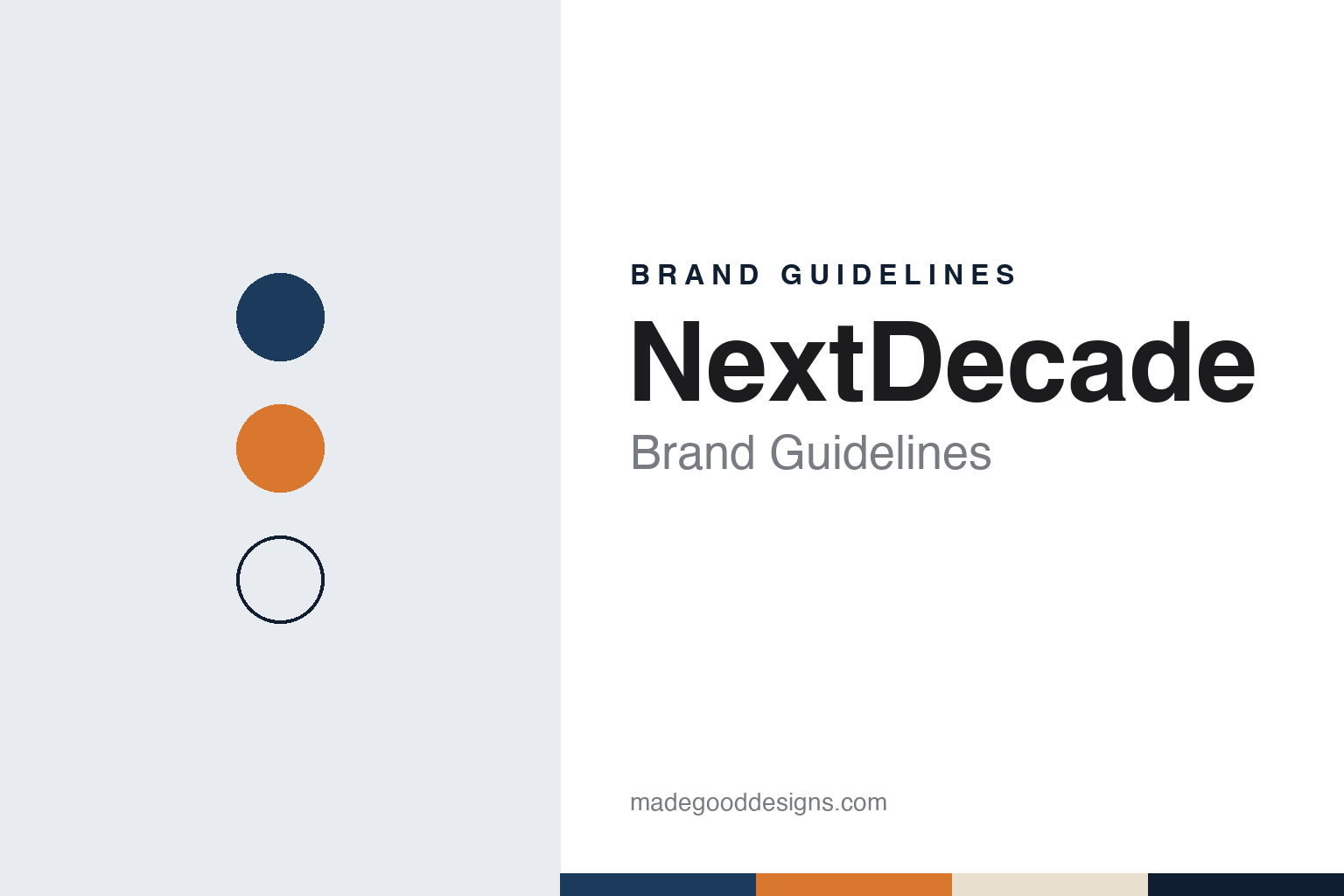
NextDecade Brand Guidelines
A Houston developer building one Texas export site, train by train.
Aa
Two constants: a gulf blue, dusk orange and sand palette and an engineering sans register. Abstract homage — not a NextDecade asset or mark; no plant, logo or nameplate is reproduced.
A bet on Brownsville
An export plan before the US exported LNG.
NextDecade is a Houston company building a single large liquefied natural gas export plant, Rio Grande LNG, at the Port of Brownsville at the southern tip of Texas. Fortune reported in May 2026 that it was founded in 2010 by the industry veteran Kathleen Eisbrenner, at a time when the United States was not yet exporting LNG at all. According to that report, she chose Brownsville for its deepwater access, its light vessel traffic and her view that the Permian Basin of West Texas would one day send large volumes of surplus gas toward the coast, and that pipelines would follow.
The idea was not widely shared. Fortune quoted the company’s later chief executive, Matt Schatzman, then a senior vice president at the gas producer BG Group, admitting that he had been among the sceptics when he first met her. He joined NextDecade in 2017 to lead operations and became chief executive in 2018, when Eisbrenner moved to the role of chair, the magazine reported. By September 2025 the company’s own announcements described him as chairman and chief executive. The name, Schatzman told Fortune, was hers and was meant to evoke the future; he made clear it would not have been his choice.
The site itself is remote from the rest of the industry. Fortune placed it a few miles from SpaceX’s Starbase and about 160 miles south of Corpus Christi, outside the corridor between Corpus Christi and New Orleans where most US LNG capacity sits. The company’s shares trade on Nasdaq under the ticker NEXT, its announcements show. Its website says Rio Grande LNG covers roughly 1,000 acres beside the Brownsville Ship Channel, with about 15,000 feet of waterfront and room for up to ten liquefaction trains, and its tagline is “Delivering energy for what’s NEXT,” the last word set in capitals.
Colour
Permits, courts and final investment decisions.
Permitting took most of a decade. On 21 November 2019, English Wikipedia records, the Federal Energy Regulatory Commission (FERC) approved Rio Grande LNG together with two other Brownsville projects, Texas LNG and Annova LNG; Annova was cancelled in March 2021. The following month the Sierra Club and other environmental groups asked the commission to reconsider.
NextDecade announced its final investment decision on Phase 1 — Trains 1 to 3 — in July 2023, and construction began that month, according to the project timeline on its website. The company gives Phase 1 a capacity of 18 million tonnes per annum (MTPA) and says the engineering, procurement and construction contracts are lump-sum, turnkey agreements with Bechtel.
A year later the project met a legal obstacle. On 6 August 2024, the Oil & Gas Journal reported, the US Court of Appeals for the DC Circuit vacated FERC’s authorisation, finding that the commission should have issued a supplemental environmental impact statement; NextDecade said it disagreed with the decision, and construction of Phase 1 continued. FERC announced a supplemental review in September 2024, and NextDecade petitioned for a rehearing in October. On 18 March 2025, Offshore Energy reported, the court revised its judgment and sent the matter back to FERC without vacating the approval for the first five trains, so construction was not interrupted.
Expansion followed. A Business Wire release of 9 September 2025 announced a final investment decision on Train 4, of about 6 MTPA, with full notice to proceed to Bechtel and twenty-year sale and purchase agreements with ADNOC, TotalEnergies and Aramco; the equity partners named were Global Infrastructure Partners (part of BlackRock), GIC, Mubadala and TotalEnergies. The company’s timeline adds a final investment decision on Train 5 in October 2025 and a formal FERC application in May 2026 for a sixth train and a third berth. In April 2026, Fortune reported, FERC approved a round-the-clock, seven-day construction schedule. On 1 July 2026 the Abu Dhabi investor XRG said it had completed the purchase of a further equity interest in Trains 4 and 5, giving it interests in all five trains under construction.
Typography
How gas companies present themselves.
LNG and natural-gas companies sell something few customers ever see. Gas is cooled to a liquid, carried across oceans and warmed back into gas before it reaches a power station, a factory or a kitchen, so the companies in this guide tend to present themselves through the places and machines that do that work rather than through the product itself.
For exporters, the plant is the picture. Websites and press releases show liquefaction trains, storage tanks and loading docks, often lit at dusk or photographed from the air, and describe each site by its location, acreage and capacity in million tonnes a year. Shipping and floating-terminal companies lean on their vessels instead: membrane tankers, floating storage and regasification units and floating liquefaction ships, each with its own name. Utilities and gas distributors tend to come closer to home, with blue flames, kitchen hobs and heating, and with tariffs and service pages.
The other common thread is time. Projects are told as sequences of milestones: permits, sales agreements, a final investment decision, first cargo and the start of commercial operations, each with a date. Investor presentations add capacity charts, contract tables and maps of buyers in Europe and Asia, while safety, environment and community pages, along with grievance and regulatory notices, sit alongside them, often written for the neighbours of a plant as much as for its customers.
This guide sets out what can be checked about each company: who founded it, who owns it, where its plants and ships operate, and what has happened to them, including outages, disputes and changes of ownership, stated with dates. It marks clearly what rests only on the company’s own word, and the colours and typefaces shown are our own unofficial interpretation, not any company’s brand standard.
Aa
An engineering sans — for a company whose story is a site and a timeline. (Specimen set in Archivo, a sans STAND-IN; NOT the NextDecade logo.)
NextDecade
One site, many trains.
NextDecade’s public face is a construction story told in tonnes and dates. Its website sets out eight trains, or 48 MTPA, under construction and in development, and says it has sold about 85 percent of the output of Trains 1 to 5 under long-term contracts; those are the company’s own figures. It expects first LNG in 2027 and gives guaranteed substantial completion for Train 4 in the second half of 2030 and for Train 5 in the first half of 2031. Fortune reported in May 2026 that the company plans to add roughly one train a year through 2036, and quoted Schatzman saying the project was ahead of schedule. Trains 6 to 8, the company says, would be wholly owned by NextDecade, which filed a Department of Energy export application for Train 6 in June 2026.
The company also presents itself as a local employer. It says Rio Grande LNG will need about 7,500 construction and trade workers at peak and around 700 long-term jobs in the Rio Grande Valley once it operates, and it runs a stakeholder feedback form and a contractor inquiry form from its main menu. Its pages are organised the way an investor would read the project: Phase 1, Train 4, Train 5, Trains 6 to 8, each with a capacity figure, a completion window and a panel of customers and equity partners.
For a design guide, NextDecade shows how a company with one site and no cargo yet shipped builds an identity from a place, a timeline and a name about the future. Compare TotalEnergies, a partner and buyer at Rio Grande LNG, and Venture Global, another US export developer. For this guide we use a gulf blue, a dusk orange and sand neutrals with a sans, an unofficial interpretation; no product or logo is reproduced.
Explore & save
Keep NextDecade’s identity on hand — save it to a board in the Made Good inspiration library.
NextDecade identity set
Pin the NextDecade gulf blue, dusk orange and sand palette and the engineering sans register to your own board.