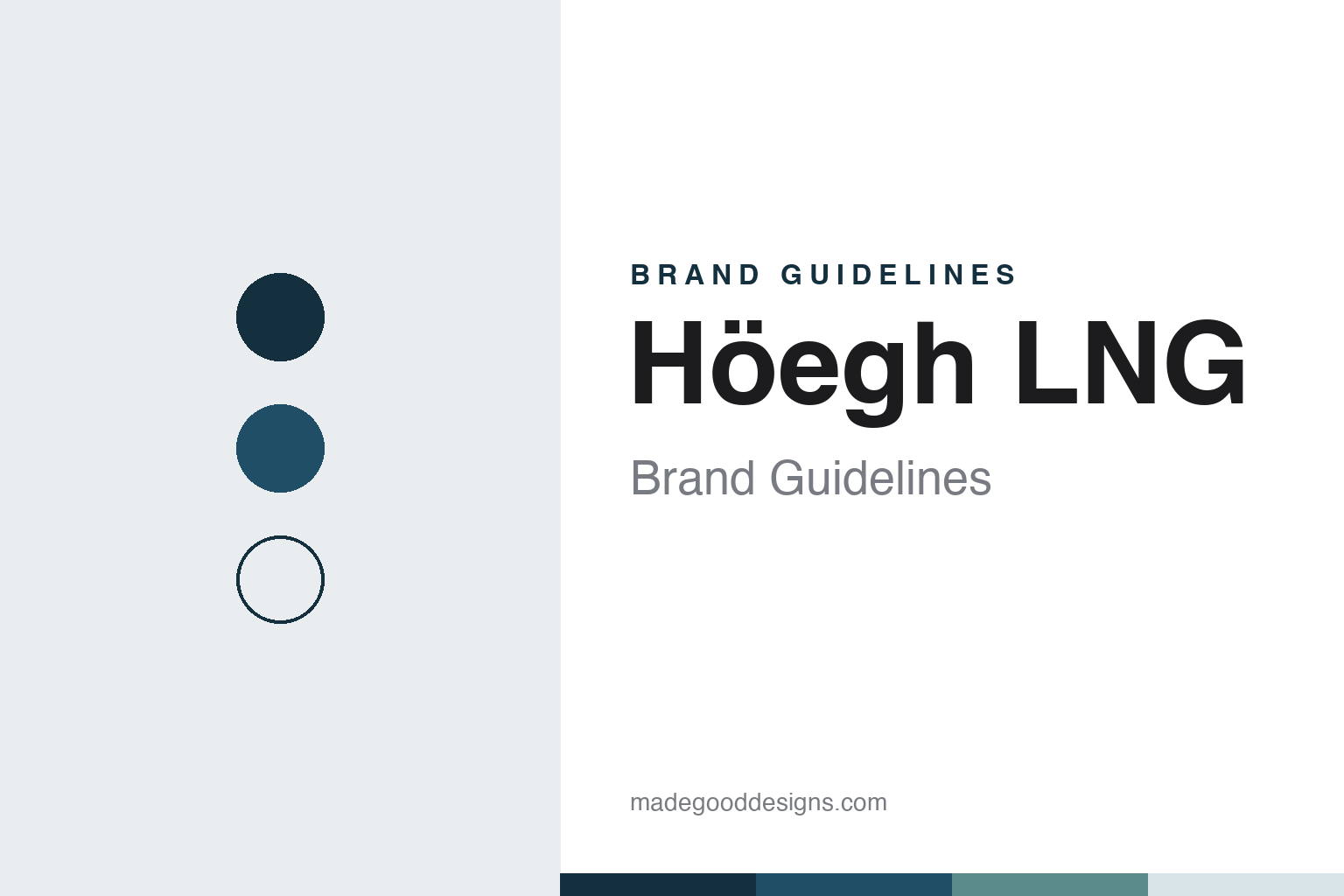
Höegh LNG Brand Guidelines
An Oslo shipowner of 1927 that turned to gas, then took a new name.
Aa
Two constants: a Höegh LNG fjord navy and sea glass palette and a Maritime sans register. Abstract homage — not a Höegh LNG or Höegh Evi product or mark; no vessel, logo or flag is reproduced.
Leif Höegh & Co.
A tanker owner of 1927.
Höegh LNG grew out of one of Norway’s large shipping houses. Store norske leksikon, the Norwegian national encyclopaedia, says Leif Høegh founded the shipowner Leif Höegh & Co. in Oslo in 1927: its first listed company, A/S Atlantica, was registered on the Oslo stock exchange in June 1927, and its first ship, the tanker Varg, was delivered in 1928 from a Danish yard owned by A. P. Møller, who was also among the early shareholders. The family name is spelled Høegh; the company has long used Höegh. In 1933 Høegh bought a Danish motor ship and named it Høegh Trader, the first of the fleet to carry the family name, the encyclopaedia says, and by 1939 the firm was the country’s sixth-largest shipowner.
The occupation years are recorded in the encyclopaedia’s biography of the founder, drawn from Norsk biografisk leksikon. When Germany invaded Norway on 9 April 1940, the whole Höegh fleet was outside German-controlled waters, and the Oslo business almost came to a halt. In spring 1942 the Germans and the occupation-era head of the shipowners’ association demanded that owners order their ships to neutral or German-controlled ports; all refused, and Høegh was among the shipping figures sent to Bredtveit prison, then freed after some months. He left Norway in the last phase of the war, and in 1945–46 he was one of Norway’s representatives on the board of the United Maritime Authority, the Allied body that controlled shipping after the war, sitting in London.
After the war the firm rebuilt with cargo liners, tankers and combination carriers. In 1970 it formed the car-carrier joint venture HUAL with Ugland, the forerunner of today’s Höegh Autoliners, a separate company.
Colour
From Moss tanks to floating terminals.
Gas came next. Store norske leksikon says Leif Höegh & Co. made its first investment in LNG ships in 1967, that it worked on gas projects with the Norwegian engineering group Kværner from 1969, and that in 1973 it took delivery of the first LNG tanker with spherical Moss-design tanks. Höegh Evi’s own history dates the ship to the same year, naming it Norman Lady, built at the Moss Rosenberg yard, and calls 1973 the year “Höegh LNG is born.” The encyclopaedia gives the same founding year for Höegh LNG.
The company’s history then lists a run of vessel types: a shuttle and regasification vessel designed in 2001; two winterised LNG carriers for North Atlantic service, Arctic Princess and Arctic Lady, delivered in 2006; and, in 2009, its first two FSRUs — floating storage and regasification units, ships that act as import terminals — named Neptune and Cape Ann. In 2014 the newly built FSRU Independence went to Klaipėda in Lithuania; in December 2024 the company announced that ownership of the vessel had passed to the Lithuanian terminal operator KN Energies and the Lithuanian state.
Germany followed. Höegh Evi says it delivered three FSRUs to Germany that year, and in January 2023 Höegh LNG announced its second binding ten-year charter with Germany’s Federal Ministry for Economic Affairs and Climate Action, placing Höegh Gannet at the Elbehafen LNG project in Brunsbüttel. The fleet page lists FSRUs in Germany, France, Colombia, Brazil, Jamaica, Australia and Indonesia, among others, and the LNG carrier Hoegh Gandria, which the company bought in February 2023, is being converted into an FSRU under a ten-year charter with Egypt’s state gas holding company EGAS that was signed in May 2025, with deployment planned for the fourth quarter of 2026.
The company describes its FSRU fleet as one of the world’s largest. Since 2023 it has also said it is working on floating terminals for ammonia and hydrogen and on carbon transport and storage.
Typography
Design and documentation.
LNG and natural-gas companies sell something few customers ever see. Gas is cooled to a liquid, carried across oceans and warmed back into gas before it reaches a power station, a factory or a kitchen, so the companies in this guide tend to present themselves through the places and machines that do that work rather than through the product itself.
For exporters, the plant is the picture. Websites and press releases show liquefaction trains, storage tanks and loading docks, often lit at dusk or photographed from the air, and describe each site by its location, acreage and capacity in million tonnes a year. Shipping and floating-terminal companies lean on their vessels instead: membrane tankers, floating storage and regasification units and floating liquefaction ships, each with its own name. Utilities and gas distributors tend to come closer to home, with blue flames, kitchen hobs and heating, and with tariffs and service pages.
The other common thread is time. Projects are told as sequences of milestones: permits, sales agreements, a final investment decision, first cargo and the start of commercial operations, each with a date. Investor presentations add capacity charts, contract tables and maps of buyers in Europe and Asia, while safety, environment and community pages, along with grievance and regulatory notices, sit alongside them, often written for the neighbours of a plant as much as for its customers.
This guide sets out what can be checked about each company: who founded it, who owns it, where its plants and ships operate, and what has happened to them, including outages, disputes and changes of ownership, stated with dates. It marks clearly what rests only on the company’s own word, and the colours and typefaces shown are our own unofficial interpretation, not any company’s brand standard.
Aa
A maritime sans — a name that became Höegh Evi. (Specimen set in IBM Plex Sans, a sans STAND-IN; NOT the Höegh LNG or Höegh Evi logo.)
Höegh LNG
A new name in 2024.
Ownership changed in several steps. Store norske leksikon says Leif Höegh & Co. was listed in Oslo in 1987, that the third generation of the family took the majority in 2003 and took the company off the exchange, and that in 2006 the group was split into two businesses, Höegh Autoliners and Höegh LNG, under a parent with an office in Bermuda. Höegh Evi’s history adds that Höegh LNG listed on the Oslo Stock Exchange in 2011 and partly floated a subsidiary, Höegh LNG Partners, in New York in 2014. In 2021 Höegh LNG was taken private by a joint venture of Larus Holding, indirectly controlled by the third generation of the Høegh family, and funds managed by Morgan Stanley Infrastructure Partners; in 2022 it bought the public units of Höegh LNG Partners, which then left the New York exchange.
On 16 September 2024 the company announced its new name, Höegh Evi. It said Evi stands for “energy vector infrastructure” and reflects a focus that now reaches beyond LNG, and that “along with the new name, the company has adopted a new logo and visual identity.” Offshore Energy reported the change the same day, describing the company as a Bermuda-based shipowner and operator. Two days later the company said the change from Höegh LNG Holdings Ltd. to Höegh Evi Ltd. had been registered in Bermuda, with its ticker unchanged. In December 2024 it announced that funds managed by Igneo Infrastructure Partners had agreed to buy the half of its owner, Larus Holding, held by the Morgan Stanley funds, with the family’s Aequitas keeping the other half; the deal was expected to close in the first half of 2025, and Höegh Evi’s history lists Igneo as an owner from 2025.
For a design guide, Höegh LNG shows how a shipping name with nearly a century behind it can rename its gas business while keeping the family name in front. Compare Excelerate Energy, another owner of floating import terminals, and Flex LNG, an Oslo-run LNG shipowner. For this guide we use a fjord navy, a harbour blue and a sea glass with a sans, an unofficial interpretation; no product or logo is reproduced.
Explore & save
Keep Höegh LNG’s identity on hand — save it to a board in the Made Good inspiration library.
Höegh LNG identity set
Pin the Höegh LNG fjord navy and sea glass palette and the Maritime sans register to your own board.