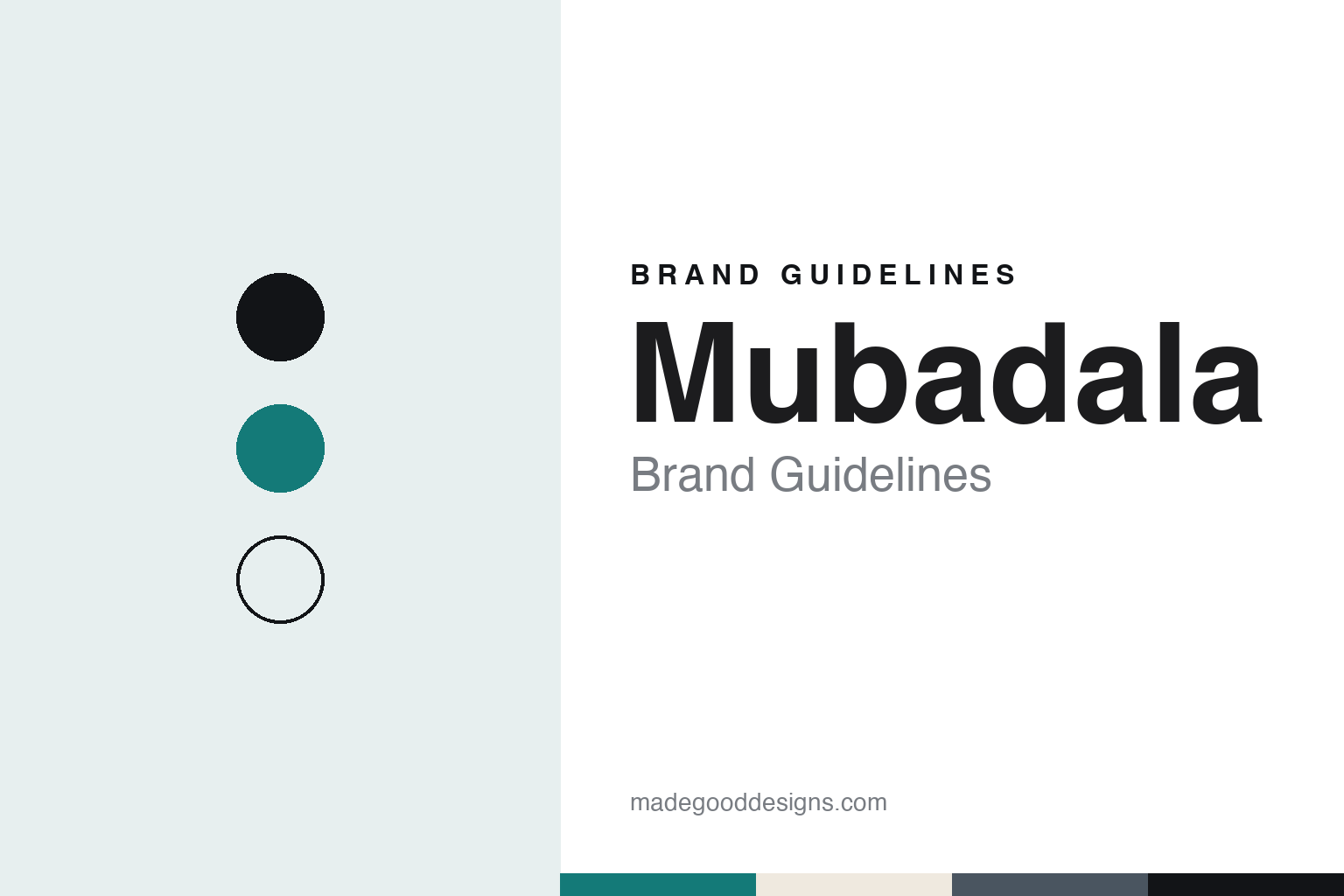
Mubadala Brand Guidelines
The Abu Dhabi state investor built from two funds in 2017.
Aa
Two constants: a Mubadala teal, ink and sand palette and an Institutional sans register. Abstract homage — not a Mubadala asset or mark; no logo or emblem is reproduced.
IPIC and Mubadala Development
Two Abu Dhabi investors, merged in 2017.
Mubadala Investment Company is a state-owned investor based in Abu Dhabi. It describes itself as “a sovereign investor” that manages a portfolio in the United Arab Emirates and abroad “to generate sustainable financial returns for its shareholder, the Government of Abu Dhabi.” English Wikipedia calls it one of the sovereign wealth funds of the government of Abu Dhabi.
The present company is the result of a merger. According to its own history page, the International Petroleum Investment Company (IPIC) was established in 1984 “to advance Abu Dhabi’s natural petroleum wealth for the development of the emirate,” and Mubadala Development Company followed in 2002 to diversify the economy further. English Wikipedia says the plan to merge the two was announced in June 2016; in 2017 ownership of both was transferred to a newly created parent, Mubadala Investment Company. The former Mubadala Development Company is now called Mamoura Diversified Global Holding, English Wikipedia says.
A third body joined a year later. In 2018, the company says, the Abu Dhabi Investment Council became part of Mubadala, which it says doubled the value of the group. Its website now describes business across more than 50 countries and states the size of its portfolio, a figure repeated in the “About Mubadala” text of a company press release dated May 2026; that figure is the company’s own.
The head office is in Abu Dhabi, and the website lists further offices in cities including London, New York and Beijing.
Colour
Chips, energy and an asset manager.
Mubadala organises its business into platforms. Its website currently names four: UAE Investments, which it calls its “national investment vehicle” for sectors including energy, metals, aerospace, technology, healthcare and real estate; Private Equity, which makes buyout and late-stage growth investments, mainly in North America and Europe; Credit and Special Situations; and Real Assets, which covers real estate and infrastructure.
Its longest-running technology holding is the chip foundry GlobalFoundries. English Wikipedia records that it was created in March 2009 from the manufacturing arm of AMD and was privately owned by Mubadala until its stock-market listing in October 2021. The stake was first held through the Advanced Technology Investment Company, or ATIC, set up in 2008, which English Wikipedia says became Mubadala Technology in 2014. In May 2026 Mubadala announced that it had sold 22 million GlobalFoundries shares and still held about 73 per cent of the company, down from about 77 per cent. Earlier, in September 2009, ATIC announced that it would buy Chartered Semiconductor of Singapore, which English Wikipedia says was later merged into GlobalFoundries.
Energy is another strand. In September 2022 Mubadala Petroleum relaunched itself as Mubadala Energy, the Indonesian news agency Antara reported; the company, headquartered in Abu Dhabi, said then that it worked in eleven countries and employed more than 500 people, and that the new name marked a shift towards gas and newer areas such as carbon capture.
Within the Credit and Special Situations platform sits Mubadala Capital, the group’s alternative asset manager, whose businesses the company’s structure page lists as private equity, Brazil, venture capital and solutions. It was founded in 2011, according to an announcement carried by Markets Media in October 2026. That announcement said the American investment firm Apollo had agreed to take a minority stake in Mubadala Capital, with Mubadala remaining the majority shareholder and Mubadala Capital keeping its own governance and management. The deal was announced in late October 2026 and was expected to close in the fourth quarter of 2026, subject to regulatory and legal approvals; it had not completed at the time of writing.
Typography
Design and documentation.
Sovereign wealth funds and large public pension investors rarely advertise. They manage money for governments or for pension members rather than for retail customers, and their public identity is built mostly from documents: annual reports, responsible-investment reports, governance pages and press releases about individual deals. Norway’s oil fund publishes a year-by-year timeline of its own growth; Singapore’s GIC publishes a report each July with its 20-year returns, while explaining on its website why it does not disclose the size of its assets.
Their websites tend to be restrained. They lead with a mandate — preserving national wealth, paying pensions, investing for future generations — and support it with portfolio overviews, lists of holdings, leadership pages and statements of values. Several also publish stewardship material: how they vote at company meetings, how they engage with boards, and which companies they have excluded or placed under observation, and why. NBIM’s exclusion list, which gives a criterion and a date for each company, is one example.
Their physical presence is usually a handful of offices in financial districts rather than shops or products. NBIM lists offices in Oslo, London, New York and Singapore; English Wikipedia describes GIC’s network of 11 offices in financial capitals. What the public sees of them is mostly a name or a set of initials, a limited palette, and pages of text and charts.
This guide sets out what can be checked about each institution — when it was founded, who owns it, what it is mandated to do and how it presents itself — using dated sources and the institutions’ own words, attributed as such. Occasionally one steps outside that register, as GIC did in October 2026 with The Secret Vault, a public exhibition marking its 45th anniversary.
Aa
An institutional sans — a bilingual website set in Interstate and an Arabic face. (Specimen set in Overpass, a sans STAND-IN; NOT the Mubadala logo.)
Mubadala
A teal mark and a tennis title.
Mubadala’s visual identity, as its own website shows it, is restrained. The logo appears in light and dark versions that pair a teal tone with black, and the site’s stylesheet calls for Interstate, a sans-serif, for Latin text, alongside an Arabic typeface named DinarOne. Every page links to an Arabic version of the site, and the “Who We Are” section adds pages on the board, the investment committee, Abu Dhabi itself and the company’s awards. Its press releases describe a business that draws on sector expertise and long-standing partnerships to support the diversification and global integration of the UAE economy.
The name reaches a wider public through sport. The WTA, the women’s tennis tour, lists the Washington tournament as the Mubadala DC Open, a WTA 500 event played on outdoor hard courts at the William H.G. FitzGerald Tennis Center; it says the women’s tournament was established in 2011 and became a WTA 500 event in 2023, and gives the 2027 dates as 26 July to 1 August. Its tournament description also uses the longer name Mubadala Citi DC Open.
The company sets out four values on its website — accountability, inspiration, integrity and partnership — and publishes a group code of ethics and a separate business partner code of conduct. Its investor pages cover a bond programme, a sukuk programme, a commercial paper programme and a revolving credit facility.
For a design guide, Mubadala shows how a state investor can carry one name across chip-making, energy, asset management and sport. Compare ADIA, another Abu Dhabi state investor, and QIA, Qatar’s sovereign wealth fund. For this guide we use a deep teal, ink and sand with a sans, an unofficial interpretation; no product or logo is reproduced.
Explore & save
Keep Mubadala’s identity on hand — save it to a board in the Made Good inspiration library.
Mubadala identity set
Pin the Mubadala teal, ink and sand palette and the Institutional sans register to your own board.