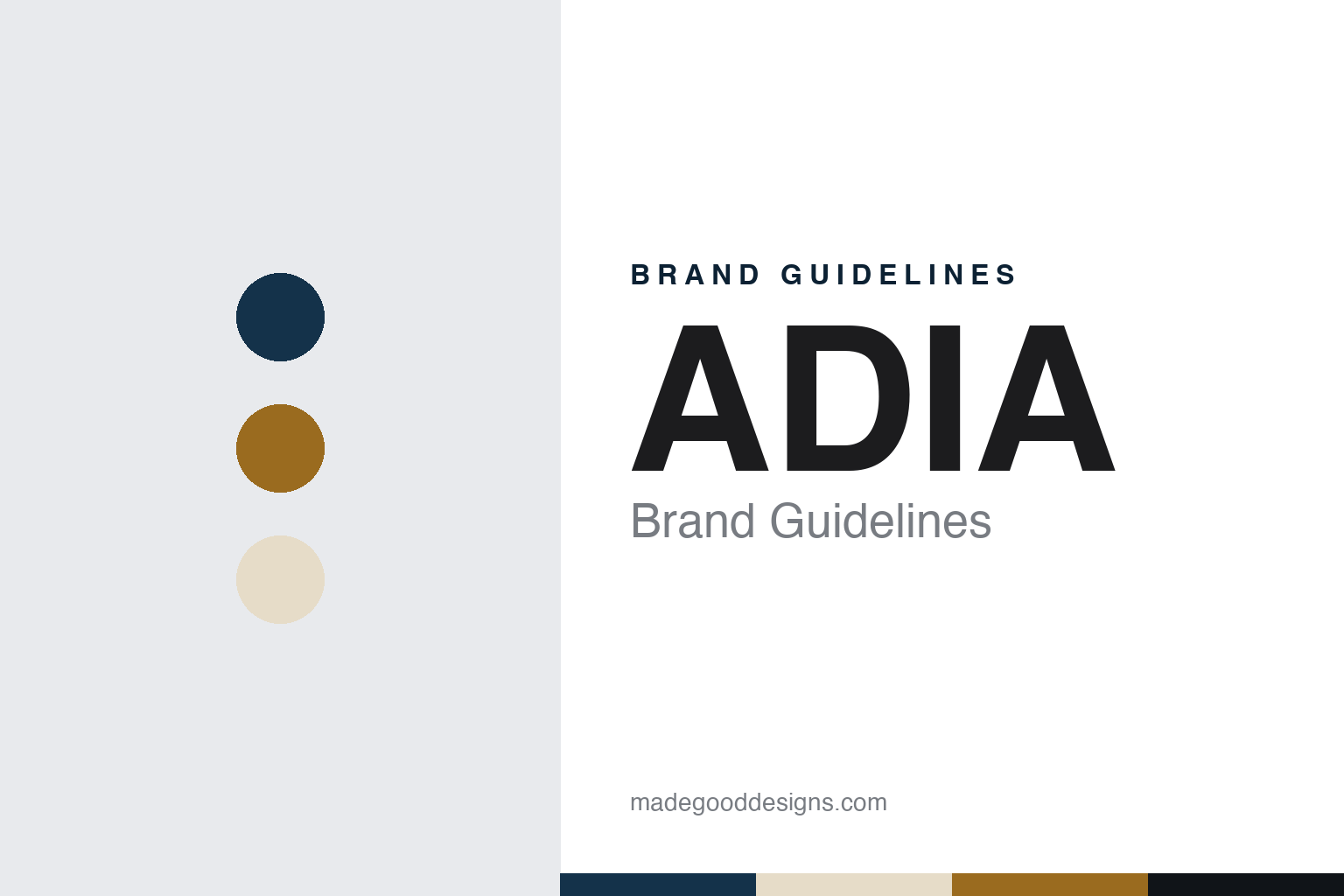
ADIA Brand Guidelines
Abu Dhabi’s 1976 investment authority, set in Plantin and Prelo.
Aa
Two constants: a navy, sand and gold palette and an old-style serif register. Abstract homage — not an ADIA asset; no logo, report or mark is reproduced.
From a finance board
An investment office that became an independent authority.
The Abu Dhabi Investment Authority, which signs itself ADIA, grew out of an office inside the emirate’s government. In 1967 Abu Dhabi created a Financial Investments Board within its Department of Finance to manage surplus oil revenue, English Wikipedia says, citing ADIA’s 2009 Review; in 1976 that board was turned into the Abu Dhabi Investment Authority. Wikipedia adds that it was then novel for a government to invest its reserves in anything other than gold or short-term credit.
ADIA’s own account sets the founding in context. It says it was founded in 1976, just over a decade after Abu Dhabi first shipped oil to overseas buyers and five years after the United Arab Emirates was created in 1971 with Abu Dhabi as its capital. Its founders, led by Sheikh Zayed bin Sultan Al Nahyan and his son Sheikh Khalifa bin Zayed Al Nahyan, made three decisions it still describes as foundations: a long-term mission, which it says has been enshrined in law since 1976; investing globally from a headquarters in Abu Dhabi, which it calls unusual at a time when investors typically based themselves in London and New York; and independence, so that it could focus on financial returns.
The authority says it was an early investor in newer asset classes, moving into private equity and hedge funds in the 1980s. It describes itself today as a global investment institution with a multicultural workforce investing in more than two dozen asset classes and sub-categories, and gives its head office as a building on the Corniche, Abu Dhabi’s waterfront.
Colour
An independent institution with a fixed portfolio frame.
ADIA sets out its relationship with the government plainly on its website. It says it was established by the Government of the Emirate of Abu Dhabi in 1976 as an independent investment institution; that it invests without reference to the government and has no visibility of the government’s spending needs or of the activities of other Abu Dhabi-owned investment entities; and that its assets are not classified as international reserves. The government gives it funds that are surplus to its fiscal requirements, and ADIA returns funds as needed.
Its board, the authority says, consists of a chairman, a managing director and members appointed by a decision of the Chairman of the Supreme Council for Financial and Economic Affairs. The board sets strategy and risk-return parameters; the managing director runs the investment and operational work and chairs the Investment Committee, which includes the executive directors of all investment departments.
The portfolio is framed by published ranges rather than a published total. ADIA’s 2025 Review gives geographic ranges of 45 to 60 per cent for North America, 15 to 30 per cent for Europe, 10 to 20 per cent for emerging markets and 5 to 10 per cent for developed Asia, and notes that, as a matter of practice, ADIA does not invest in the UAE. In 2025 it widened the range for private equity to 15–20 per cent from 12–17 per cent and for financial alternatives to 7–12 per cent from 5–10 per cent, and cut real estate to 2–7 per cent from 5–10 per cent, Reuters reported on 10 September 2026. The same report gave ADIA’s 20-year and 30-year annualised returns at the end of 2025 as 6.6 and 7.2 per cent, against 6.3 and 7.1 per cent a year earlier, and described ADIA as the oldest of Abu Dhabi’s three major government-controlled funds.
ADIA also points to its part in setting standards for its peers. It says it co-chaired, with the International Monetary Fund, the 2008 work that produced the Santiago Principles, 24 generally accepted principles and practices for sovereign wealth funds; that it is a member of the International Forum of Sovereign Wealth Funds; and that, as a founding member of the One Planet Sovereign Wealth Fund Working Group, it helped develop a 2018 framework for bringing climate-change analysis into the management of large, long-term asset pools.
Typography
How state investors present themselves.
Sovereign wealth funds and large public pension investors rarely advertise. They manage money for governments or for pension members rather than for retail customers, and their public identity is built mostly from documents: annual reports, responsible-investment reports, governance pages and press releases about individual deals. Norway’s oil fund publishes a year-by-year timeline of its own growth; Singapore’s GIC publishes a report each July with its 20-year returns, while explaining on its website why it does not disclose the size of its assets.
Their websites tend to be restrained. They lead with a mandate — preserving national wealth, paying pensions, investing for future generations — and support it with portfolio overviews, lists of holdings, leadership pages and statements of values. Several also publish stewardship material: how they vote at company meetings, how they engage with boards, and which companies they have excluded or placed under observation, and why. NBIM’s exclusion list, which gives a criterion and a date for each company, is one example.
Their physical presence is usually a handful of offices in financial districts rather than shops or products. NBIM lists offices in Oslo, London, New York and Singapore; English Wikipedia describes GIC’s network of 11 offices in financial capitals. What the public sees of them is mostly a name or a set of initials, a limited palette, and pages of text and charts.
This guide sets out what can be checked about each institution — when it was founded, who owns it, what it is mandated to do and how it presents itself — using dated sources and the institutions’ own words, attributed as such. Occasionally one steps outside that register, as GIC did in October 2026 with The Secret Vault, a public exhibition marking its 45th anniversary.
Aa
An old-style serif — after the Plantin that ADIA’s own website and Review use. (Specimen set in Crimson Pro, a serif STAND-IN; NOT the ADIA logo.)
ADIA
A serif, a sans and an Arabic face.
ADIA’s public face is its yearly ADIA Review, published as web pages and a downloadable PDF. The 2025 edition opens with the authority’s mission, “to sustain the long-term prosperity of Abu Dhabi by prudently growing capital through a disciplined investment process and committed people who reflect ADIA’s cultural values,” followed by a letter from the managing director, the asset-class reviews and a governance section. It counts 1,350 employees from 61 countries; the website, quoting the managing director, speaks of more than 65 nationalities at headquarters.
The typography is consistent across both. The website, in English and Arabic, loads Plantin MT Pro and Prelo for Latin text and Almarai for Arabic, and the 2025 Review PDF is set in Plantin with Prelo. The same pairing runs from the home page to the governance pages.
The Review also covers ADIA Lab, which it describes as an independent data and computational sciences research institution supported by ADIA. In 2025, it says, the Lab ran its first summer internship programme, hosted summer schools in Granada and Shanghai, and held a three-day symposium attended by more than 800 people in person and 600 online.
For a design guide, ADIA shows how a sovereign investor can carry its identity through type and structure alone: one serif, one sans, one Arabic face and a report built around a mission statement. Compare Mubadala, another Abu Dhabi state investor, and NBIM, Norway’s state fund manager. For this guide we use a deep navy, dune sand and a muted gold with a serif, an unofficial interpretation; no product or logo is reproduced.
Explore & save
Keep ADIA’s identity on hand — save it to a board in the Made Good inspiration library.
ADIA identity set
Pin the ADIA navy, sand and gold palette and the old-style serif register to your own board.