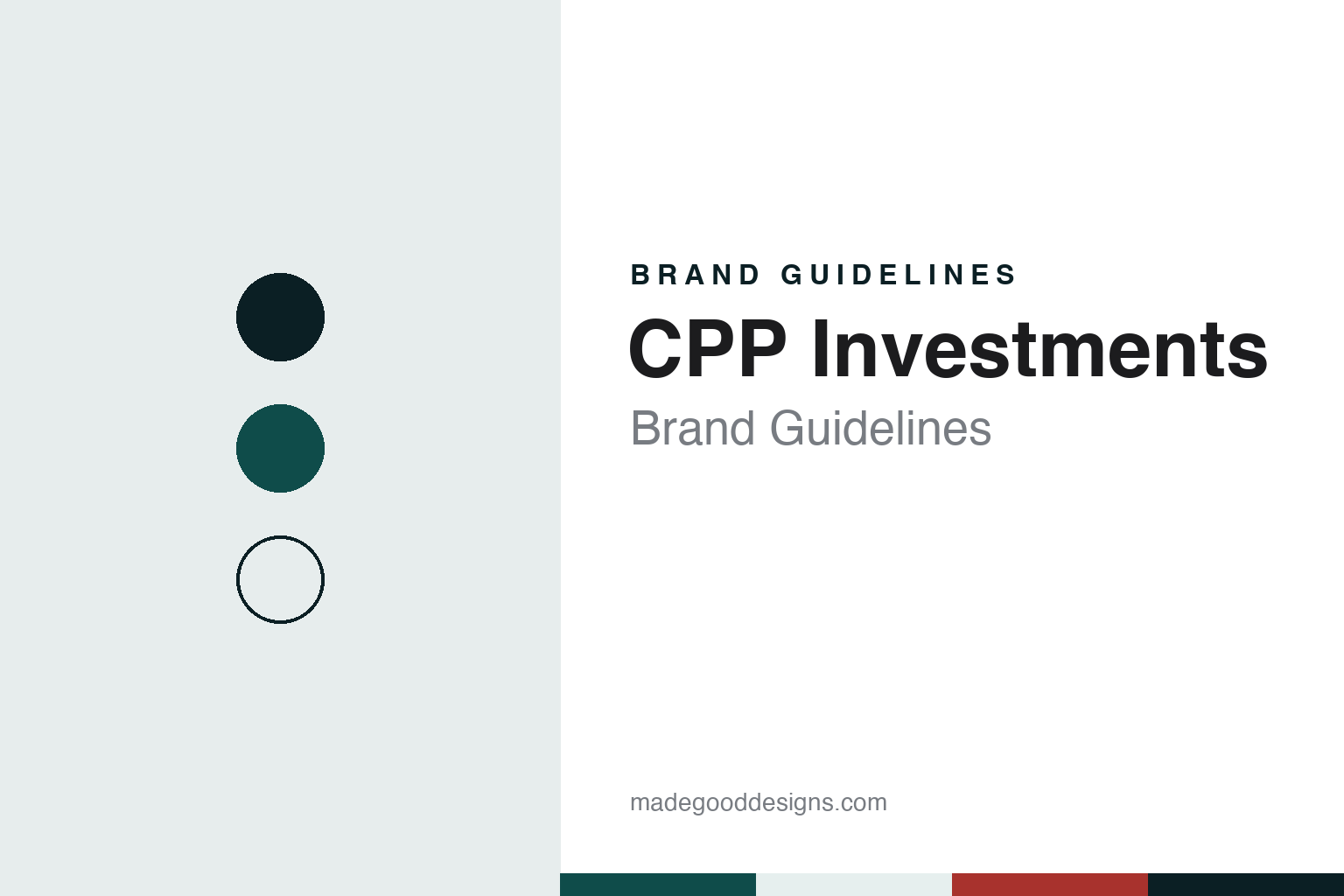
CPP Investments Brand Guidelines
The 1997 Toronto board behind the Canada Pension Plan.
Aa
Two constants: a deep teal and maple red palette and an Institutional sans register. Abstract homage — not a CPP Investments asset or mark; no logo or wordmark is reproduced.
An Act of 1997
A board created by statute.
CPP Investments is the operating name of the Canada Pension Plan Investment Board, long known by its initials, CPPIB, and in French as Investissements RPC. It was created by the Canada Pension Plan Investment Board Act of 1997, which establishes “a corporation to be known as the Canada Pension Plan Investment Board,” and it is based in Toronto. English Wikipedia describes it as a Crown corporation; the Act itself says that the Board is not an agent of the Crown and that its directors, officers and employees are not part of the federal public administration.
The pension plan it invests for is older. English Wikipedia says the Canada Pension Plan was established in 1966 and for much of its history relied on current contributions to pay benefits. By 1996, the federal government had concluded that the plan as then constituted was unsustainable. Reforms raised the contribution rate in steps and created the investment board, under the then finance minister Paul Martin, as an independent but accountable body. The board began its investment programme in 1999, Wikipedia says, building up the CPP Reserve Fund from contributions not needed to pay current pensions.
Its formal structure is spare. The Act divides the Board’s capital into ten shares, issued to the Minister of Finance to be held on behalf of the Crown. The Board reports to the public every quarter and to Parliament every year through the Minister of Finance, according to English Wikipedia, and is overseen by a professional board of directors rather than by government departments. Its staff, Wikipedia adds, are not part of the Public Service of Canada.
Colour
Return, without undue risk.
The mandate is written into law. Section 5 of the Act tells the Board to invest its assets “with a view to achieving a maximum rate of return, without undue risk of loss,” having regard to the factors that affect the funding of the Canada Pension Plan and its ability to meet its obligations on any given business day. English Wikipedia notes that, although it is a Crown corporation, CPP Investments is not usually counted as a sovereign wealth fund, because it works at arm’s length from the government and manages contributions paid by workers and employers rather than public funds. It is one of the large Canadian pension investors nicknamed the “Maple 8.”
Its approach changed in stages. In 1997, English Wikipedia says, the fund was invested entirely in government bonds; it then moved to passive index strategies and, in 2006, to active investment. Its Policy on Responsible Investing, which treats environmental, social and governance factors as matters of risk and return, was first adopted in 2005. The 2013 annual report put about 63 percent of assets outside Canada, and by 2023, Wikipedia says, the share abroad had reached 86 percent, with the United States the largest single market and Asia second.
Its holdings, as English Wikipedia lists them, have included the American pet retailer Petco, bought with CVC Capital Partners in 2015; a stake in the International Towers Sydney office development; and a majority stake in Ontario’s Highway 407 toll road. It made its first direct office investment in Seattle in 2016, and its first direct investment in Canadian rental housing, a Toronto apartment property, in 2015. In 2021 it began a partnership with the developer Greystar on rental housing in the United States. In December 2025 it agreed to take an indirect stake in the lubricants maker Castrol in a transaction led by Stonepeak; Wikipedia says that deal was subject to regulatory approvals, with completion expected by the end of 2026. Stonepeak announced on 2 November 2026 that the Castrol purchase had been completed; the sources used for this guide do not confirm CPP Investments’ part in that closing.
Typography
Design and documentation.
Sovereign wealth funds and large public pension investors rarely advertise. They manage money for governments or for pension members rather than for retail customers, and their public identity is built mostly from documents: annual reports, responsible-investment reports, governance pages and press releases about individual deals. Norway’s oil fund publishes a year-by-year timeline of its own growth; Singapore’s GIC publishes a report each July with its 20-year returns, while explaining on its website why it does not disclose the size of its assets.
Their websites tend to be restrained. They lead with a mandate — preserving national wealth, paying pensions, investing for future generations — and support it with portfolio overviews, lists of holdings, leadership pages and statements of values. Several also publish stewardship material: how they vote at company meetings, how they engage with boards, and which companies they have excluded or placed under observation, and why. NBIM’s exclusion list, which gives a criterion and a date for each company, is one example.
Their physical presence is usually a handful of offices in financial districts rather than shops or products. NBIM lists offices in Oslo, London, New York and Singapore; English Wikipedia describes GIC’s network of 11 offices in financial capitals. What the public sees of them is mostly a name or a set of initials, a limited palette, and pages of text and charts.
This guide sets out what can be checked about each institution — when it was founded, who owns it, what it is mandated to do and how it presents itself — using dated sources and the institutions’ own words, attributed as such. Occasionally one steps outside that register, as GIC did in October 2026 with The Secret Vault, a public exhibition marking its 45th anniversary.
Aa
An institutional sans — a statutory board with a short public name. (Specimen set in Inter Tight, a sans STAND-IN; NOT the CPP Investments logo.)
CPP Investments
A statutory name and a short one.
As a design subject, CPP Investments sits between a public body and an asset manager. Its public face is the short operating name rather than the statutory one: the Act still speaks only of the Canada Pension Plan Investment Board, while English Wikipedia gives “CPP Investments” and the French “Investissements RPC” as the names it operates under, and its website address is cppinvestments.com. English Wikipedia’s infobox gives its founding date as 31 December 1997 and its headquarters as Toronto.
Its leadership is documented in the same way. John Graham has been chief executive since February 2021, English Wikipedia says, succeeding Mark Machin, and the board of directors is chaired by Heather Munroe-Blum. Governance has drawn scrutiny at times. In 2009, Wikipedia records, executives took a 31.4 percent cut in their bonuses after questions were raised about pay at the Crown corporation. The fund has also been criticised by climate campaigners for not divesting from fossil fuels. In fiscal 2025 it adopted a new set of benchmark portfolios, which it said better reflected its strategies; according to Wikipedia, it missed those benchmarks in fiscal 2025 and 2026, and critics raised governance concerns because the change, combined with an updated pay plan, lifted bonuses.
For a design guide, CPP Investments shows how an institution created by statute can build a public identity on a short, plain name and a steady rhythm of reporting. Compare Ontario Teachers’, another of Toronto’s large pension investors, and Brookfield Asset Management, the Canadian investor that appears alongside it in several of its transactions. For this guide we use a deep teal and a maple red with a sans, an unofficial interpretation; no product or logo is reproduced.
Explore & save
Keep CPP Investments’s identity on hand — save it to a board in the Made Good inspiration library.
CPP Investments identity set
Pin the CPP Investments deep teal and maple red palette and the Institutional sans register to your own board.