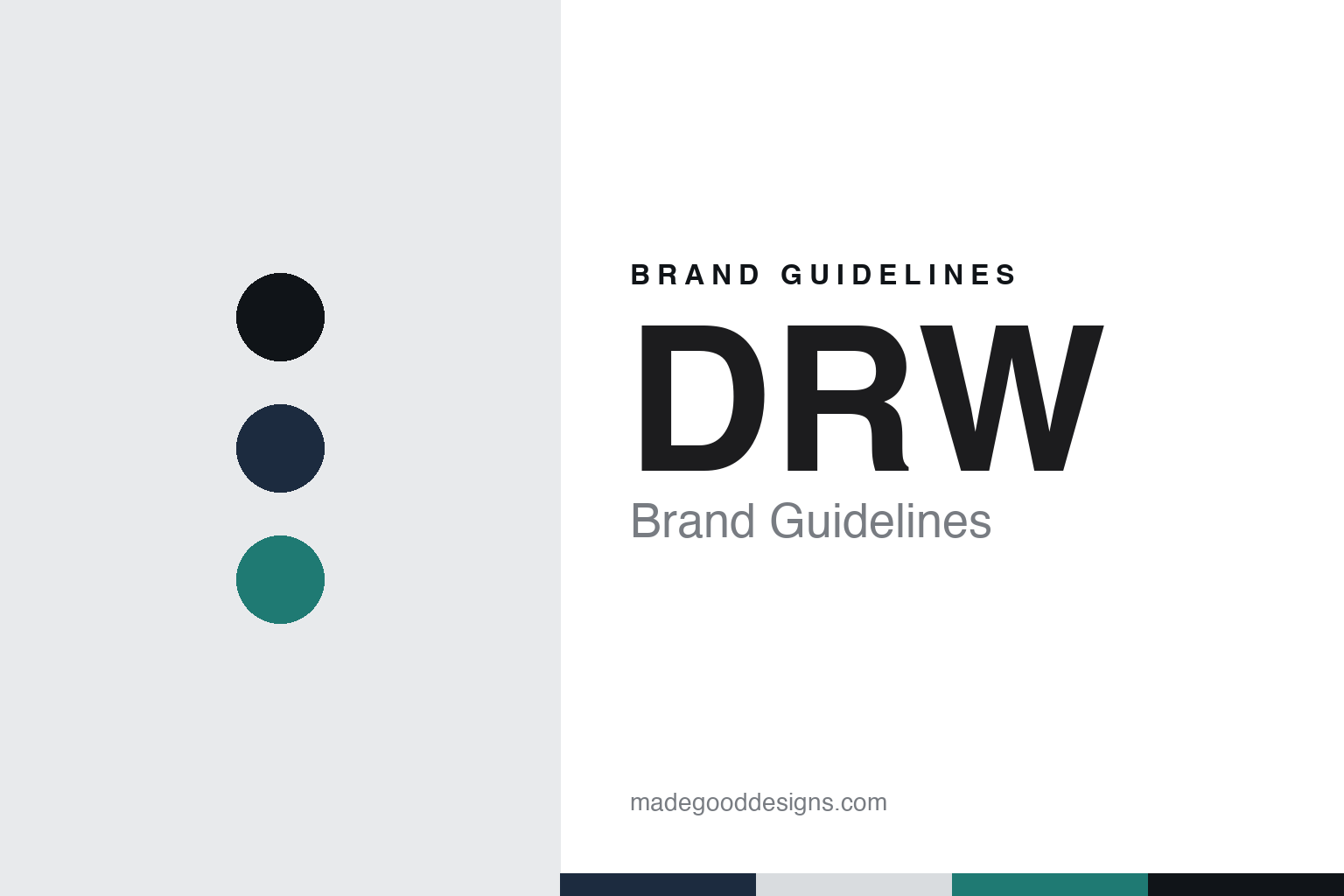
DRW Brand Guidelines
A Chicago trader’s initials on a firm that trades its own capital.
Aa
Two constants: a navy, teal and grey palette and a plain technical sans register. Abstract homage — not a DRW asset or mark; no logo or screen is reproduced.
Three initials
An options trader’s own firm in Chicago.
DRW is a proprietary trading firm based in Chicago. It was founded in 1992 by Don Wilson, then an options trader at the Chicago Mercantile Exchange, and English Wikipedia says the firm is named after his initials. The company’s own history describes a founder who “saw an opportunity to start a new type of trading firm,” one that would apply modelling, technology and quantitative research to the global markets. Its formal name today is DRW Holdings, LLC.
The firm trades its own money. DRW says it still trades “for our own account” and that the absence of outside investors lets it move quickly, which sets it apart from a hedge fund that manages other people’s capital. It says it is active on exchanges on five continents, in a wide range of products and asset classes, and describes itself as a liquidity provider, a risk taker and a latency-sensitive trader, sometimes all at once, depending on the market. English Wikipedia lists fixed income, derivatives, energy, agriculture and digital assets among the markets it trades.
Its growth came partly through purchases. The company’s timeline dates its move into energy markets to 2002, the acquisition of Vigilant, a low-latency trading firm in Montreal, to 2013, Chopper Trading of Chicago to 2015 and RGM Advisors of Austin, Texas, to 2017. English Wikipedia, citing Reuters, gives August 2017 for the RGM deal, and adds that DRW bought Lehman Brothers’ foreign-exchange, interest-rate and agricultural derivatives portfolios at auction in 2008, during the bank’s collapse. In November 2017 it set up an energy trading group in Houston from Martin Energy Trading, Wikipedia says, citing a Business Wire release.
The firm was also among those described in Michael Lewis’s 2014 book Flash Boys, about the race among trading firms to build faster links between markets, English Wikipedia says.
Colour
Cumberland, ventures, property and carbon.
DRW’s largest offshoot is Cumberland. The company says it made its first bitcoin trade in 2010 and launched Cumberland DRW in 2014 to act as a counterparty for institutional investors in crypto-assets; English Wikipedia describes Cumberland as a liquidity provider in cryptocurrency markets. DRW’s timeline credits Cumberland with executing Goldman Sachs’ first block trade in crypto in 2021, which is the company’s own account, and dates the launch of Cumberland Labs, a blockchain incubator backed by DRW’s founders, to 2022. English Wikipedia adds that Digital Asset Holdings, a blockchain-database company, was spun out of a bitcoin trading operation at DRW, and that in 2018 DRW backed a cryptocurrency market set up by Eris Exchange.
Other arms reach beyond trading. DRW Venture Capital, launched in 2011, invests in financial and enterprise technology, and the company names BitGo and TradingView among its investments. Convexity Properties invests in buildings and projects, the company says, where it can “give under appreciated properties a new lease on life.” The DRW Foundation, set up in 2004, supports organisations working on education, career readiness and opportunity in underserved communities. In 2024 the firm launched Artemeter DRW, which combines its trading in compliance and voluntary carbon markets with structuring, origination and advisory services, according to the company.
The newest field is computing power. In October 2026 Crypto Briefing reported that DRW had incubated Compute Exchange, a marketplace for GPU capacity, and Silicon Data, which publishes pricing benchmarks and indices for GPU compute, and that in August 2026 DRW had signed an agreement with QumulusAI for a dedicated cluster of Nvidia Blackwell B300 processors. The same report said DRW was recruiting researchers who focus on compute markets.
Typography
Trading firms in public.
Proprietary trading firms and electronic market makers sell little to the public, so their identities are built for a narrow audience: the students, engineers and researchers they hope to hire, and the institutions they trade with. Their websites read less like consumer marketing and more like careers sites, with pages on departments, open roles, interviewing and benefits placed as prominently as any description of the business.
Recruiting shapes the tone. Jane Street, for example, keeps a Puzzles page that posts a new problem every month or two, and its events include meet-ups built around puzzles and technical talks. Coding challenges, internship programmes and scholarships do similar work, signalling that the firm values problem solving before it values a finance background.
The trading floor is the other recurring image. Firms describe offices in several financial centres and present their floors as places of shared work rather than private desks, while technology pages talk about low-latency networks, compilers and research. Blogs and podcasts carry much of the explanation, letting engineers and researchers speak for the firm instead of an advertising campaign.
The marks themselves tend to be modest: a plain name, a simple geometric symbol or a word set in capitals, used consistently across careers pages, legal notices and the regulated subsidiaries that carry the brand in each market. For designers, the category is a study in restraint, where credibility comes from clarity, consistency and a careful choice of tone rather than from colour or spectacle. The palettes in these guides are our own unofficial interpretations.
Aa
A plain technical sans for a three-letter name. (Specimen set in IBM Plex Sans, a sans STAND-IN; NOT the DRW logo.)
DRW
Two regulatory cases, both closed.
DRW has been through two regulatory cases, both now closed. In 2013 the US Commodity Futures Trading Commission brought a civil case against the firm over its trading in an interest-rate swap futures contract listed on the IDEX exchange, covering 2010 and 2011. After a bench trial, a federal court in New York ruled on 30 November 2018 that the CFTC had not proved that DRW created an artificial price or intended to manipulate the market, according to a December 2018 client alert from the law firm WilmerHale.
In October 2024 the US Securities and Exchange Commission sued Cumberland DRW, alleging that it had operated as an unregistered dealer in crypto assets. On 5 March 2025 Ledger Insights reported that Cumberland said it had agreed with SEC staff that the case would be dismissed, subject to the commissioners’ approval; English Wikipedia, citing SEC records, says the case was dismissed with prejudice in March 2025.
Today DRW lists offices in thirteen cities, among them Chicago, London, Singapore and Tel Aviv, and dates the opening of its Hong Kong office to 2023. Its company page says it has more than 2,000 employees. Its website speaks mainly to recruits and trading counterparties, with pages on working at DRW, access to its liquidity, community investment and a news-and-insights feed.
For a design guide, DRW shows how a plain three-letter name taken from a founder’s initials can stretch across trading, crypto, ventures, property and carbon. Compare CME Group, the parent of the Chicago exchange where its founder once traded options, and Jump Trading, another Chicago trading firm. For this guide we use a deep navy, a teal and a cool grey with a sans, an unofficial interpretation; no product or logo is reproduced.
Explore & save
Keep DRW’s identity on hand — save it to a board in the Made Good inspiration library.
DRW identity set
Pin the DRW navy, teal and grey palette and the plain technical sans register to your own board.


