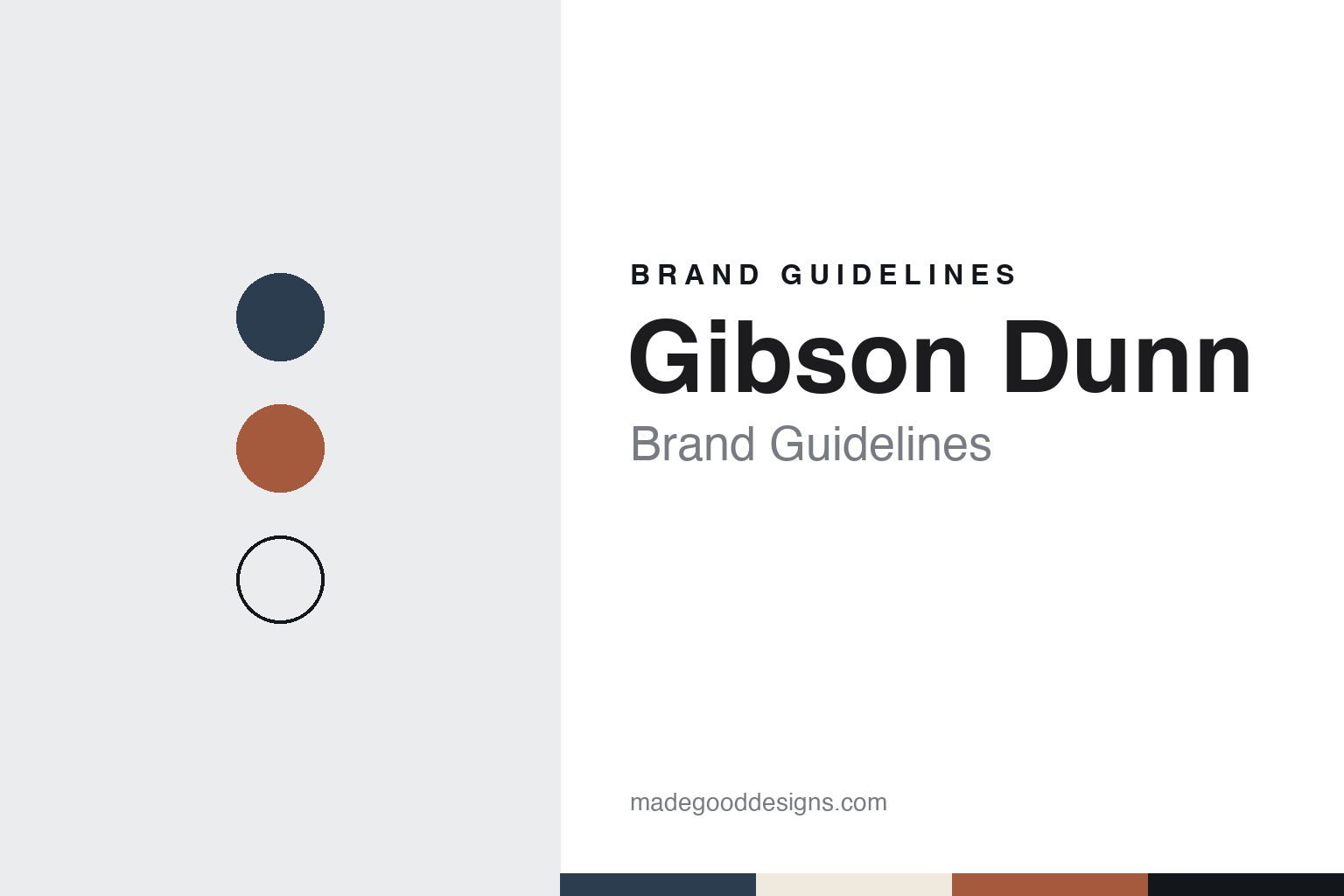
Gibson Dunn Brand Guidelines
The Los Angeles firm of 1890 that took its name in 1911.
Aa
Two constants: a slate, sand and terracotta palette and a civic sans register. Abstract homage — not a Gibson Dunn asset; no logo, wordmark or document is reproduced.
Bicknell & Trask
A Los Angeles practice that gathered its names.
Gibson Dunn was not founded by Gibson, Dunn or Crutcher. English Wikipedia says the firm began in Los Angeles in May 1890, founded by John D. Bicknell and Walter Trask. The firm counts from that year: its About page today speaks of 136 years of partnership.
The names arrived over two decades. Wikipedia says Judge James Gibson joined in 1897. Six years later, at the suggestion of a client the two practices shared, Henry E. Huntington, the firm merged with the practice of William Ellsworth Dunn, a former Los Angeles city attorney, and Albert Crutcher, an assistant city attorney. The combined firm, Bicknell, Gibson, Trask, Dunn & Crutcher, was then the largest law firm in Los Angeles, Wikipedia says. In 1911 it was renamed Gibson, Dunn & Crutcher, the name the partnership still carries. On its website and in its press releases the firm uses the short form “Gibson Dunn,” keeping the full name with its comma and ampersand for the legal entity, Gibson, Dunn & Crutcher LLP.
Its early clients were the companies building Southern California. Wikipedia lists the Los Angeles Gas & Electric Company, several oil companies, and Huntington and his Pacific Light & Power Company among them. In 1914, it says, the firm recruited its first lawyer from Harvard Law School, a step it describes as a turn towards the methods of the eastern law schools.
Colour
From 25 lawyers to an international network.
Growth was slow for half a century and then fast. English Wikipedia says New Deal legislation in the 1930s brought labour work to the firm, and gives a headcount of 25 lawyers in 1943, 39 in 1954 and 63 a decade later. By 1980 it had about 200 lawyers, and by 1991 about 700.
The move beyond California came in the late 1970s. Wikipedia says Gibson Dunn opened offices in Washington, D.C. and Paris in 1977 and in London in 1980, and that in 1989 it became associated with the Brussels firm Van Bael & Bellis. In 1984 it started one of the first appellate practices at a large law firm, Wikipedia says; the firm has since argued more than 160 cases before the US Supreme Court. In 1991 the historian Jane Wilson completed a history for the firm, Gibson, Dunn & Crutcher, Lawyers: An Early History, which received a Donald H. Pflueger Local History Award in 1993 for its account of economic growth in Southern California. A second book followed in 2011, when the University of Arizona Press published F. Daniel Frost and the Rise of the Modern American Law Firm by the law professor Toni M. Massaro, a study of the partner who joined the firm in 1950 and became its managing partner in 1979.
The record also includes court findings against the firm. English Wikipedia records that in 2007 the Montana Supreme Court upheld a punitive-damages award in a dispute over the attribution of a painting, finding that the firm had acted with actual malice; and that in 2023 a federal court in San Francisco sanctioned the firm, together with its client Facebook, over its conduct of discovery in a consumer-privacy case, finding bad faith. In October 2025, Wikipedia says, the Anti-Defamation League announced a partnership with the firm on a nationwide pro bono legal-service network.
Typography
Design and documentation.
Large American law firms tend to present themselves with restraint. Many are named after founding or senior partners, and their names are often set as sober wordmarks: a serif with a long institutional pedigree, or a plain grotesque sans, usually in a single colour. Navy, near-black and white are common choices, with an occasional accent kept for links and headings rather than for decoration. Long partnership titles are frequently cut down over the decades to two surnames joined by an ampersand, or to a single surname used in conversation.
Their websites are built around how clients and recruits search. Practice-area and industry pages sit near the top, alongside a directory of lawyer biographies, each with a headshot, admissions, education and representative work. Latham & Watkins, for example, organises its main menu under People, Capabilities, Achievements, Insights and Global Citizenship, and lists every office by city on its About Us page.
Publishing is a large part of the presentation. Firms issue client alerts on new laws and rulings, along with articles, podcasts and webcasts grouped under headings such as insights or thought leadership. Many also publish pro bono reports, figures on community service and reports on diversity and inclusion, and some set out environmental commitments for their offices.
Recruiting pages form a separate register, written for law students and junior lawyers: summer associate programmes, training, office life and alumni networks. Across all of these pages the visual system usually stays quiet, so that the firm’s name, its people and its record of work carry the identity. The guides in this series look at how individual firms use those conventions, and where their histories and names differ.
Aa
A civic sans — two surnames, set short. (Specimen set in Libre Franklin, a sans STAND-IN; NOT the Gibson Dunn logo.)
Gibson Dunn
Twenty-three offices and a short name.
Today Gibson Dunn describes itself as a global firm advising on significant transactions and disputes. Its About page gives more than 2,200 lawyers, over 600 partners, more than 70 practices and industries and 23 offices; English Wikipedia adds about 1,000 staff and lists offices across North America, Europe, Asia and the Middle East. The firm also gives figures for its pro bono work, saying its lawyers spent more than 240,000 hours on pro bono matters in 2025 and took on more than 750 new pro bono cases.
Independent reporting shows how one practice grew inside that network. In August 2026 Commercial Observer reported that the firm’s real estate department had grown by 30 percent over two years to more than 200 lawyers in 17 of the firm’s 23 offices, with its London real estate team growing from six lawyers in 2021 to 21; the firm told the magazine it had completed more than 225 data-centre transactions in 2025.
The website is organized in a way common to large US partnerships: pages for people, capabilities and insights, a firm-news stream, an annual report, and separate sections for pro bono, diversity and inclusion, alumni and careers. Its About page opens with a quotation from the directory Chambers USA and lists its lawyers’ government experience among its headline numbers: more than 80 lawyers with prior government service, more than 450 former US judicial law clerks and 40 former US Supreme Court clerks, the firm says.
For a design guide, Gibson Dunn shows how a firm founded under other names can make two later partners’ surnames its brand. Compare Latham & Watkins, another Los Angeles firm turned global, and Kirkland & Ellis. For this guide we use a slate blue, sand and a terracotta with a sans, an unofficial interpretation; no product or logo is reproduced.
Explore & save
Keep Gibson Dunn’s identity on hand — save it to a board in the Made Good inspiration library.
Gibson Dunn identity set
Pin the Gibson Dunn slate, sand and terracotta palette and the civic sans register to your own board.


