SEA Milan Airports Brand Guidelines
The Milan operator born on an old military runway at Malpensa.
Aa
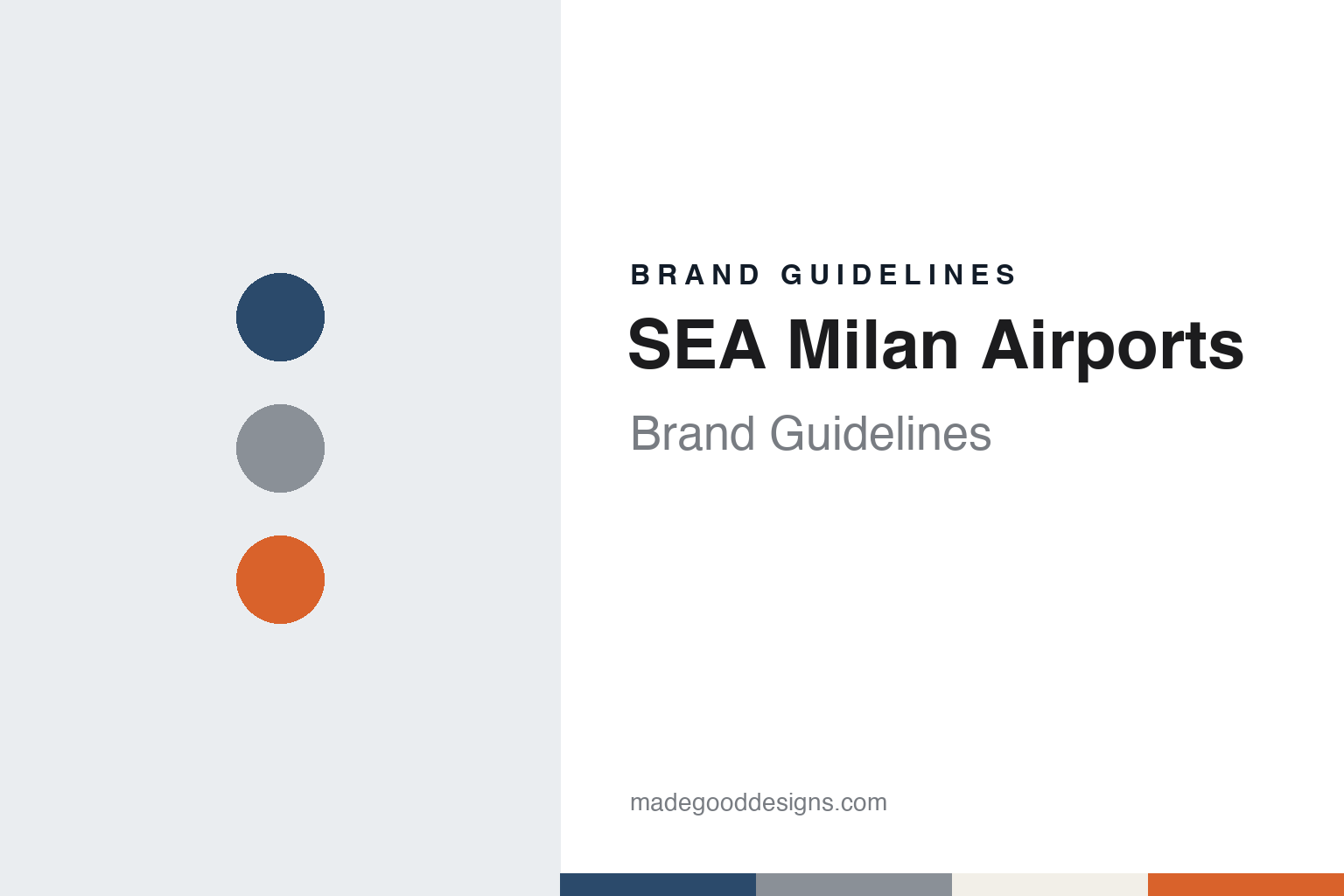
Two constants: a slate blue, grey and white palette and a modern grotesque register. Abstract homage — not a SEA asset; no logo, sign or mark is reproduced.
Società Aeroporto di Busto
An old military runway and a group of Lombard backers.
SEA did not begin in Milan. The company was set up in Busto Arsizio, north-west of the city, on 22 May 1948 as the Società Aeroporto di Busto, to put back to use what remained of the old military runway at Malpensa and to connect Lombardy to the international air routes that were reopening after the Second World War, Italian Wikipedia says, citing a history published by the Varese Chamber of Commerce. Its first president was Giovanni Rossini, and its backers included local industrialists and politicians. The first aircraft, a four-engined BZ.308, landed on 21 November 1948; the runway, with 1,800 metres of new paving, was fully reopened in 1949 with a wooden building as the terminal, the company says. On 2 February 1950 TWA flew the first direct service to New York.
The City of Milan became a shareholder in 1951, SEA says, and the Province of Milan also took a growing stake. On 12 May 1955 the shareholders renamed the business Società Esercizi Aeroportuali – S.E.A. and moved its registered office to Milan. In 1957 SEA applied to the government to build and run a second airport at Linate, about eight kilometres from the city; the first scheduled flight landed there on 26 June 1960, and in 1966 SEA moved its head offices to Linate, where they remain.
The decades that followed were about capacity. The “Malpensa 2000” master plan went to the Ministry of Transport in 1985 and was approved in 1987; in 1989 SEA bought a fifth of SACBO, the company that runs Bergamo’s airport; and on 25 October 1998 the new Malpensa Terminal 1 opened, the company says. In 2001 SEA signed a forty-year agreement with ENAC, Italy’s civil aviation authority, under which it manages the Milan airport system, Italian Wikipedia says.
Colour
Two airports, a public majority and a private fund.
Today SEA runs Milano Malpensa, with two passenger terminals and a cargo terminal about 48 kilometres from Milan, and Milano Linate, the city airport, which Italian Wikipedia describes as serving frequent flyers on domestic and European routes. The group also produces electricity and heat, for its airports and for sale, and holds about 30 per cent of SACBO at Bergamo. In 1997, SEA says, it formed an international consortium that won the contract to manage Argentina’s airport system. At its shareholders’ meeting in April 2026 SEA reported 42.3 million passengers for 2025, up 8 per cent, and about 759,000 tonnes of cargo, Affaritaliani reported on 28 April 2026.
Ownership is part public and part private. Until 2011 the City and Province of Milan held almost all the shares. In December 2011 the City sold 29.75 per cent to the infrastructure fund F2i, Italian Wikipedia says. In October 2026 Il Sole 24 Ore’s Radiocor agency gave the split as 54.81 per cent for the City of Milan and 45.01 per cent for F2i, most of it held through 2i Aeroporti, a vehicle 51 per cent controlled by F2i with Asterion Industrial Partners holding the rest, according to an ANSA report carried by RaiNews in August 2026.
SEA’s record also includes a major court case. After the runway collision at Linate on 8 October 2001, Italy’s Court of Cassation in February 2008 upheld the convictions of several defendants, including two SEA managers and executives of the air-navigation provider ENAV, Il Sole 24 Ore reported on 21 February 2008. In 2019 SEA closed Linate from 27 July to 27 October to rebuild its runway, moving the flights to Malpensa, Italian Wikipedia says.
Typography
How airport operators present themselves.
An airport operator has an unusual design problem: most of the people who meet its brand never think about the company at all. They read its signs. Wayfinding is the core of the identity, and operators typically commission a sign typeface, a pictogram set and a colour code for departures, arrivals, gates and exits, then apply them to everything from motorway approach signs to the backs of check-in desks. The corporate logo often sits quietly in a corner while the directions do the work.
Architecture carries the rest of the image. Operators’ own photography tends to favour terminals at dusk, when glazed façades glow against a darkening sky, long roofs read as clean lines and an apron full of parked aircraft becomes a pattern of lights. Interiors are shown as wide, calm halls rather than queues, and new piers or façades are announced with renderings long before they open.
The numbers come next. Route maps radiating from a single hub, new long-haul destinations and passenger milestones are standard material for press pages and annual reports, because traffic is what airlines, investors and local governments want to see. Alongside them sit pages on sustainability and noise: carbon programmes, noise contour maps, insulation schemes for nearby homes and community funds, often written for neighbours rather than travellers.
Finally, an airport is also a shopping centre and a lounge network. Retail, food and lounge promotions follow a lighter, more commercial register, with seasonal campaigns and partner brands, while investor reports return to a sober corporate grid of charts and tables. The operators in this series show how one company can speak in all of these voices at once: public utility, landlord, retailer and listed or state-owned business.
Aa
A modern grotesque — the register of a corporate operator rather than a single terminal. (Specimen set in Manrope, a sans STAND-IN; NOT the SEA logo.)
SEA Milan Airports
Aldo Rossi, a Magic Gateway and a Cerri façade.
The Milan airports have long used architects to shape their image. In 1991 SEA commissioned Aldo Rossi to upgrade the Linate terminal, the company says. In 2011 it opened the Porta Magica, or Magic Gateway, at Malpensa, a structure that SEA describes as celebrating a “threshold” with a blade of light that appears only through clouds of mist. In 2017 it began a renewal of Linate with a new façade by Pierluigi Cerri’s studio, Cerri & Associati, clad in dry-fixed Corian panels under a glazed metal canopy over departures, Living, the Corriere della Sera design magazine, reported in July 2017; Italian Wikipedia dates the façade’s inauguration to May 2018.
The corporate name has moved online too. The old seamilano.eu address now forwards to milanairports.com, where the group signs itself SEA Milano Airports and issues releases as SEA Milan Airports; in August 2026 it announced a cooperation agreement with Chongqing Airport Group. A larger change may lie ahead. In August 2026 SEA began studying a possible integration with SAGAT, the company that runs Turin airport and is wholly owned by F2i, ANSA reported; on 23 October 2026 Radiocor reported that a Milan city council committee meeting on the planned SEA–SAGAT merger had been postponed to November. The project was under study and not completed at the time of writing.
For a design guide, SEA Milan Airports shows how one operator gives two very different airports, a hub on the heath and a city airfield, a shared corporate voice. Compare Aeroporti di Roma, the operator of Rome’s airports, and Aena, which runs Spain’s airports. For this guide we use a slate blue, a runway grey, a warm white and a signal orange with a sans, an unofficial interpretation; no product or logo is reproduced.
Explore & save
Keep SEA Milan Airports’s identity on hand — save it to a board in the Made Good inspiration library.
SEA Milan Airports identity set
Save the SEA Milan Airports slate blue, grey and white palette and the modern grotesque register to your own board.