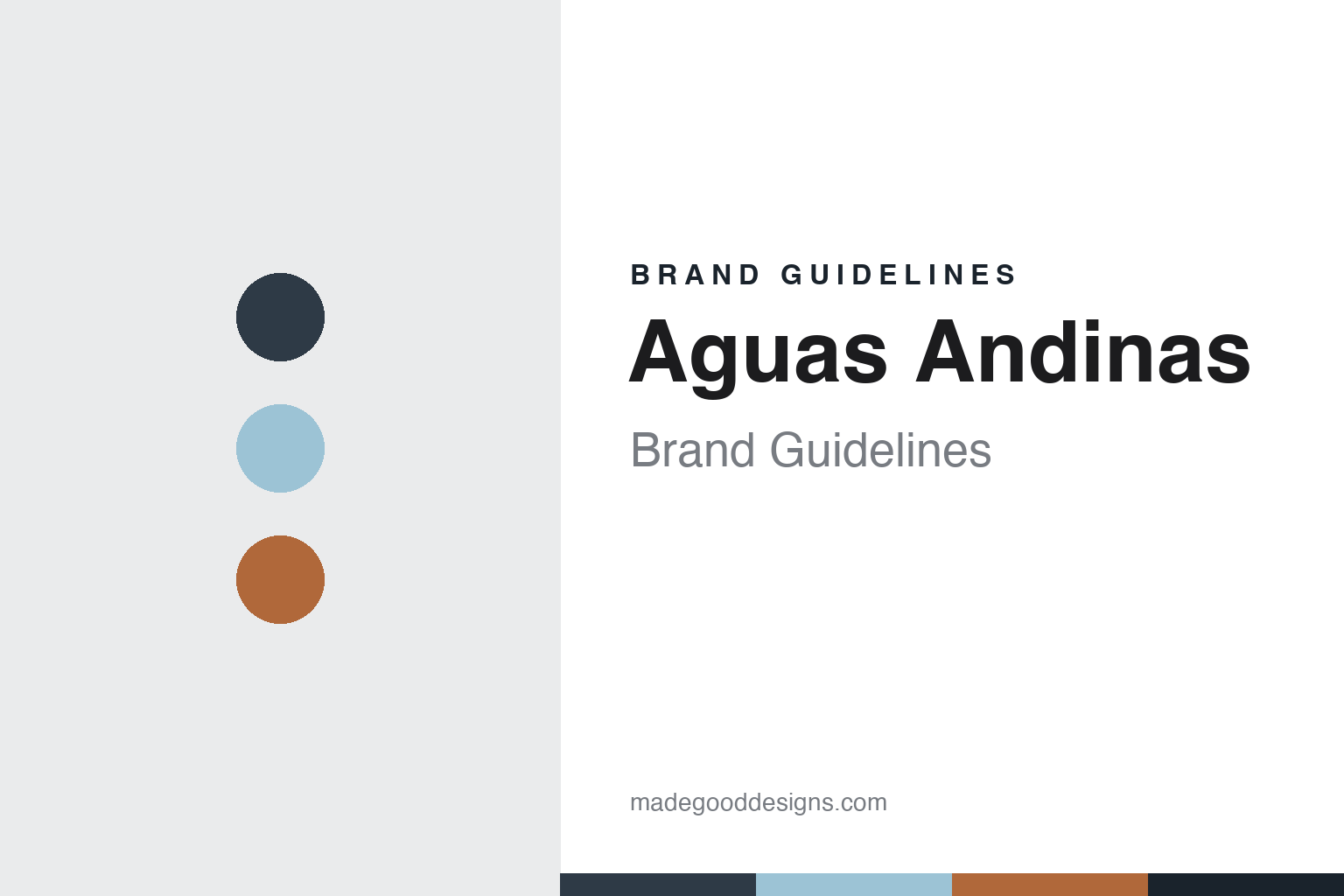
Aguas Andinas Brand Guidelines
Santiago’s 1861 water company, renamed for the Andes.
Aa
Two constants: a cordillera slate, glacier blue and copper palette and a Civic serif register. Abstract homage — not an Aguas Andinas asset or mark; no logo is reproduced.
Agua Potable de Santiago
A concession, an aqueduct and 88 homes.
Aguas Andinas traces its history to the Empresa de Agua Potable de Santiago. Its investor-relations history says the engineer Manuel Valdés Vigil agreed with the Municipality of Santiago in 1859 to organise the company, and that a municipal decree of 1861 granted it the right, for thirty years, to use the water that belonged to it for drinking, washing, cleaning and other domestic uses. He could not raise the money, the company says, so in 1864 the municipality, then led by Federico Errázuriz Zañartu, later President of Chile, became a limited partner and agreed to fund the works.
Service began in 1866. A covered aqueduct from the Ramón creek and two clarifying reservoirs, later known as the La Reina reservoirs, were finished in 1865, and the first customers, the company says, were 88 private homes and 21 industrial establishments in central Santiago. In 1872, at the request of the mayor Benjamín Vicuña Mackenna, the municipality bought out Valdés Vigil’s rights and the company became municipally owned; in 1898 a law turned it into an autonomous state enterprise.
The twentieth century brought the large works. The company lists a sewer system built under the direction of the French firm Battignolles-Fould and handed over between 1907 and 1910; the 87-kilometre Laguna Negra aqueduct, inaugurated in 1917 to bring water from the Negra and Encañado lagoons; the Las Vizcachas filter plant on the Maipo River at Puente Alto, at full capacity in 1952; and the El Yeso reservoir, inaugurated in 1967.
Colour
From EMOS to Andean waters.
The name changed with the reorganisation of state sanitation services. In 1977, the company says, the Empresa de Agua Potable de Santiago became the Empresa Metropolitana de Obras Sanitarias, or EMOS, and took on sewerage and sanitation services that other public agencies had run in Santiago. Sanitation and tariff laws of 1988 reorganised the sector, and in mid-1989 EMOS became a public limited company, EMOS S.A.
Private capital came in 1999. According to the company, Inversiones Aguas Metropolitanas (IAM), owned in equal parts by the Spanish water company Agbar and Suez Lyonnaise des Eaux, took control by acquiring 51.202% of EMOS. English Wikipedia says Agbar has controlled the company since 2008.
In 2001 the corporate identity was redefined. The company took the name Aguas Andinas — “Andean waters” — for the Andean origin of the water that supplies the inhabitants of the Santiago basin and is returned, treated, to its western valleys, and adopted a new logo as the symbol of that identity, its history page says.
The current chain of control runs through Spain to France. The company says Veolia Environnement became its controller in 2022, after Veolia and Suez formalised their combination agreement in January that year. Veolia indirectly controls Agbar, which owns 50.1% of IAM, which in turn holds 50.1% of Aguas Andinas.
Treatment works became its main projects after privatisation. The El Trebal plant opened in 2001 and La Farfana in 2003, which the company says became the largest plant of its kind in Latin America; the Mapocho Urbano Limpio interceptor, opened in 2010, ended 21 wastewater discharges into the city’s main river, and with the Mapocho plant of 2013 the company says it reached treatment of all the urban sewage of Greater Santiago. Since 2017 it has described La Farfana and Mapocho-Trebal as “biofactories.”
Typography
How water utilities present themselves.
Water utilities sell something nobody sees being made. Their identities therefore lean on a small set of images: blue and green palettes, droplet and wave marks, and reservoirs, treatment works and pipelines photographed from the air. The look is meant to read as calm and dependable, closer to a public service than to a consumer brand, even when the company is investor-owned and listed on a stock exchange.
Much of a utility’s visible design work is practical. Bill explainers, tariff tables, payment-help schemes and outage maps make up a large share of its website, and the tone is plain and procedural. Many companies run several regional or state brands under one parent, so a naming system and a shared set of colours often matter more than any single logo.
Messaging changes with the weather and the regulator. Leak-repair campaigns, drought appeals and hosepipe or watering restrictions appear in dry years; investment programmes, pipe-replacement work and rate cases appear in filings and press releases. Environmental performance reports and sustainability reports set out targets and results in charts and tables, usually in the same restrained palette as the rest of the brand.
The last strand is education. Utilities run school visits, careers programmes, treatment-plant tours and community grants, and they publish material on how water is treated and why pipes need replacing. This guide sets out what can be checked about each company — when it began, who owns it and how it describes itself — and marks clearly what rests only on the company’s own word.
Aa
A civic serif — the voice of a long-lived public company. (Specimen set in Source Serif 4, a serif STAND-IN; NOT the Aguas Andinas logo.)
Aguas Andinas
A capital’s water, from the cordillera.
The group has also changed shape. In September 2020 Aguas Andinas agreed to sell its 53.5% direct and indirect stake in Essal, the Empresa de Servicios Sanitarios de Los Lagos, to the Canadian group Algonquin Power & Utilities, BioBioChile reported; La Tercera reported on 13 October 2020 that the sale had closed and Aguas Andinas was no longer Essal’s controller. BioBioChile noted that the deal was announced a month after Essal received the maximum fine allowed by law over a 2019 contamination incident, caused by a chemical spill, that left much of Osorno without drinking water for about ten days.
Today the company says it supplies around seven million people, with its sanitation subsidiaries, across a 71,000-hectare concession area in the Metropolitan Region, and it describes itself as the largest water utility in Chile. Its planned works are public events. A shutdown for works on the Paralelo aqueduct, planned to last 36 hours from the night of 22 May 2026, affected more than 143,000 customers in parts of eight southern communes; restoration was delayed by what the company called hydraulic incidents, and on 24 May it announced full restoration, having run 72 alternative supply points and more than 20 tanker trucks, CNN Chile reported.
Its upland land carries a conservation story too. Ladera Sur reported in October 2026 that camera traps in Parque Aguas de Ramón, in a project run by Parque Cordillera with Aguas Andinas’ support, had recorded an Andean cat, with no earlier record of the species in that protected area since its creation in 2002. In July 2024 the company and Ediciones UC launched a book, Historia del agua potable en Santiago.
For a design guide, Aguas Andinas shows how a utility can rename itself after the landscape its water comes from. Compare Veolia, its controlling group, and Suez, whose predecessor co-owned the company from 1999. For this guide we use a cordillera slate, a glacier blue and a copper with a serif, an unofficial interpretation; no product or logo is reproduced.
Explore & save
Keep Aguas Andinas’s identity on hand — save it to a board in the Made Good inspiration library.
Aguas Andinas identity set
Pin the Aguas Andinas cordillera slate, glacier blue and copper palette and the Civic serif register to your own board.