UltraTech Cement Brand Guidelines
Grasim plants, L&T’s cement arm and a brand pressed onto every bag.
Aa
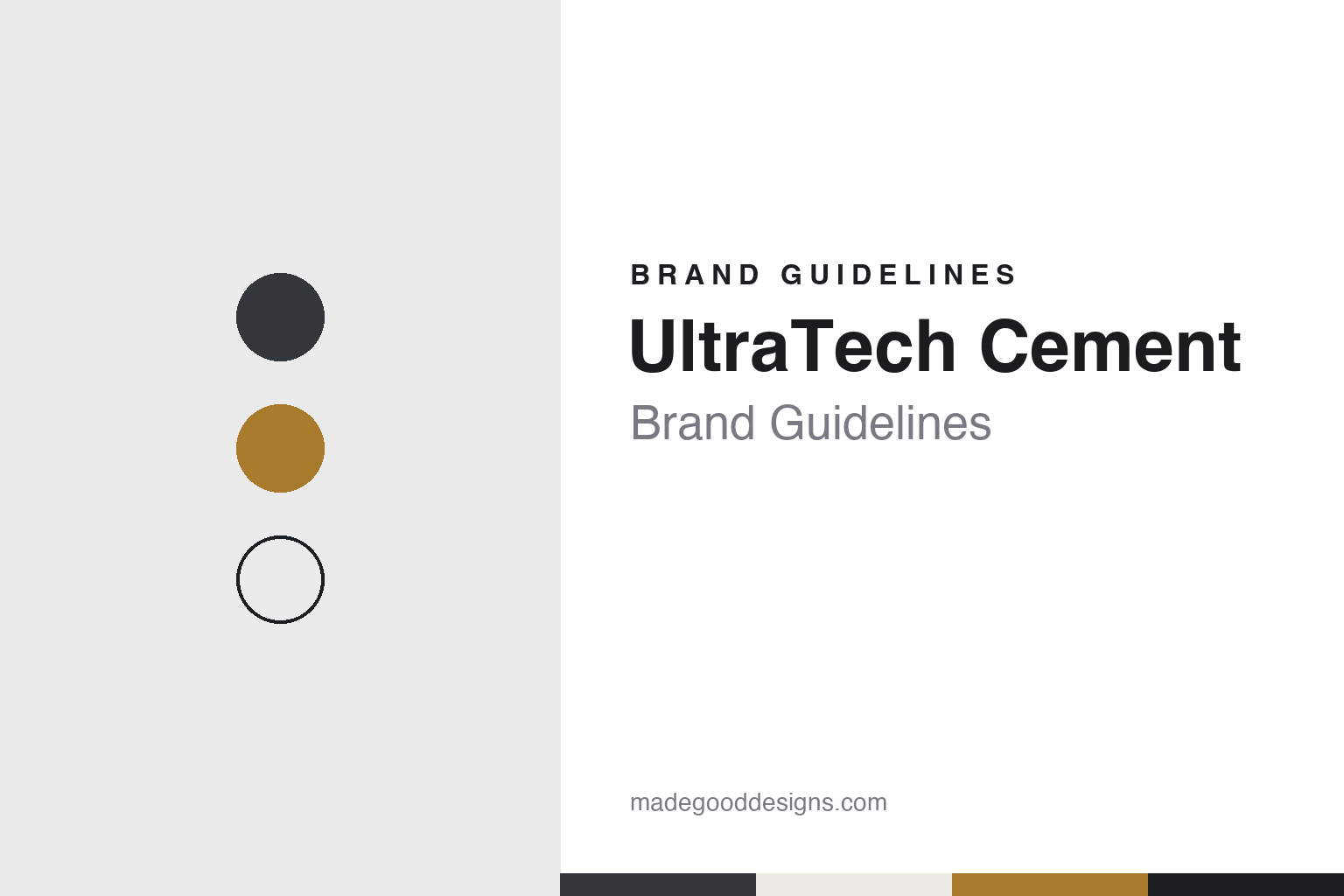
Two constants: an UltraTech grey, ink and ochre palette and an industrial sans register. Abstract homage — not an UltraTech product or mark; no bag, logo or nameplate is reproduced.
Grasim and L&T
Two group plants and an engineering firm’s cement arm.
UltraTech Cement is the cement flagship of the Aditya Birla Group, the company says, and English Wikipedia describes it as an Indian multinational cement company based in Mumbai. Its own history starts before the UltraTech name existed. The company’s timeline begins in the mid-1980s with two plants: Vikram Cement, set up for Grasim, and Rajashree Cement, set up for Indian Rayon, both Aditya Birla Group companies. In mid-1998 the cement businesses of Indian Rayon and Grasim were merged, with a capacity the company puts at 8.5 million tonnes a year.
The UltraTech name came from outside the group. In 2004, the company’s timeline says, the Birla side acquired the cement business of Larsen & Toubro (L&T), the Mumbai engineering group, and that business became UltraTech Cement Ltd. The company puts combined capacity after the deal at a little over 30 million tonnes a year, plus about one million tonnes in a separate unit it calls SDCCL, which it says was divested in 2008.
From there the timeline reads as a list of acquisitions. In 2010 UltraTech bought Star Cement in the Middle East, and in 2013 and 2014 it took over a plant at Sewagram and a grinding unit at Wanakbori, in Gujarat, from Jaypee Cement. In June 2017 it completed the purchase of six integrated plants and five grinding units from Jaiprakash Associates, with 21.2 million tonnes of capacity. The Press Trust of India, in a report carried by India.com on 29 June 2017, said the deal took UltraTech’s grey-cement capacity to 93 million tonnes a year, reported the company’s statement that it had become the fourth-largest cement player globally outside China, and quoted chairman Kumar Mangalam Birla describing the move as geographic expansion into high-growth markets.
Colour
Weather Plus, Birla White and a long dealer network.
UltraTech speaks to two audiences: home builders and their engineers on one side, infrastructure and corporate buyers on the other. Its website is organised that way, with separate sections “For Home Builders,” “For Infrastructure” and “For Corporate,” and its pages can be read in English, Hindi and eight other Indian languages. The site’s page title carries the line “The Engineer’s Choice,” and it calls the product “India’s No. 1 Cement.”
The product names are plain and descriptive. Alongside UltraTech Cement itself, the site lists UltraTech Weather Plus, ready-mix concrete, Birla Shakti and a building-products range that includes waterproofing systems, a tile and marble fitting system and a plaster called Readiplast Pro. White cement goes to market under a separate name, Birla White; the company says it has two white-cement units and four wall-care putty units. It also says it runs 485 ready-mix concrete plants in 179 cities, and describes itself as India’s largest maker of ready-mix concrete and of white cement.
The company points to a wide sales network. UltraTech says it has more than 1.5 lakh — 150,000 — channel partners and reaches more than 80% of Indian cities and towns. Its website hosts home-building guides, how-to videos and expert articles, as well as tools such as a cost calculator, a product predictor and a store locator, and it lists UltraTech Building Solutions among its offers to individual home builders. In February 2025 the company announced plans to enter wires and cables through its building-products division, according to its overview.
Typography
How cement makers present themselves.
Cement is sold in bags by the million, so the makers in this guide mostly present themselves through plain, solid wordmarks that have to read on a sack, a lorry, a silo and a dealer’s signboard. Their palettes tend towards greys, reds and greens, often with one strong colour that can be spotted across a building site. Imagery leans on the industry itself: quarries, kilns, grinding units, bulk terminals and finished buildings, more than people or lifestyle scenes.
Their websites are usually split by audience. Pages for individual home builders sit beside pages for engineers, contractors and infrastructure buyers, and products are often listed by cement type — ordinary Portland, Portland pozzolana, slag and composite cements — and by strength class or intended use, alongside ready-mix concrete and building products such as plasters, waterproofing and tile adhesives. Several makers add home-building guides, how-to videos, store locators and calculators for estimating materials.
Sustainability has become a standard section. Many cement groups publish sustainability reports and pages on lower-carbon or blended cements, alternative fuels, waste-heat recovery and water use; this guide reports such material only as the companies or dated sources state it, and makes no claims of its own about emissions or performance. Investor pages, annual reports and capacity figures in million tonnes a year sit close by, because many of these makers are listed companies that grew through acquisitions.
Community and safety programmes complete the picture, from local schools and water projects near plants to training for masons and contractors. For a design reader, the interest lies in how heavy, commodity products are given a recognisable face: a name on a bag, a colour on a truck, and a tone of voice that speaks both to a family building one house and to a highway contractor.
Aa
An industrial sans for a bag-and-truck brand. (Specimen set in Archivo, a sans STAND-IN; NOT the UltraTech logo.)
UltraTech
One product leaving many factories.
Growth by acquisition has meant absorbing other brands. In 2018 UltraTech commissioned an integrated plant at Dhar and bought the cement business of Binani Cement; in 2019 it merged in the cement business of Century Textiles & Industries, and says it became the first cement company with more than 100 million tonnes of capacity in a single country outside China. In 2024, the company says, The India Cements Limited became its subsidiary, and in 2025 it completed the purchase of the cement business of Kesoram Industries. Its timeline puts total cement capacity at 205.5 million tonnes a year in 2026, while its overview gives 210.1 million tonnes of grey cement from 35 integrated plants, 36 grinding units, one clinkerisation unit and ten bulk packaging terminals, with operations in India, the United Arab Emirates, Bahrain and Sri Lanka. The company describes itself as the largest cement maker outside China by sales volume and capacity.
India Cements shows how the brand travels. In May 2026 The Hindu BusinessLine reported that UltraTech had completed a full brand migration at India Cements by the end of March 2026, so that one product now leaves all nine of its factories where several brands had gone out before; industry insiders told the paper that India Cements’ older names, Sankar and Coromandel, were no longer being bagged. The same report said UltraTech was leaning towards Portland pozzolana cement rather than the ordinary Portland cement India Cements had used.
The company has also faced scrutiny. The Competition Commission of India opened an investigation into alleged cartelisation by grey-cement makers after complaints in 2019, and searched the premises of five makers, including UltraTech, in December 2020, Mint reported in September 2026. That month the Delhi High Court dismissed an UltraTech appeal against the commission’s decision to let the Builders Association of India join the proceedings; Mint described the case as an investigation into alleged conduct.
For a design guide, UltraTech Cement shows how a group brand can be assembled from acquired plants and then pressed onto every bag. Compare Shree Cement, which moved its cements under one master brand in 2024, and Ambuja Cements, another large Indian maker. For this guide we use a kiln grey, an ink and an ochre with a sans, an unofficial interpretation; no product or logo is reproduced.
Explore & save
Keep UltraTech Cement’s identity on hand — save it to a board in the Made Good inspiration library.
UltraTech Cement identity set
Pin the UltraTech grey, ink and ochre palette and the industrial sans register to your own board.