Aena Brand Guidelines
The Spanish airport operator that traded sky blue for green.
Aa
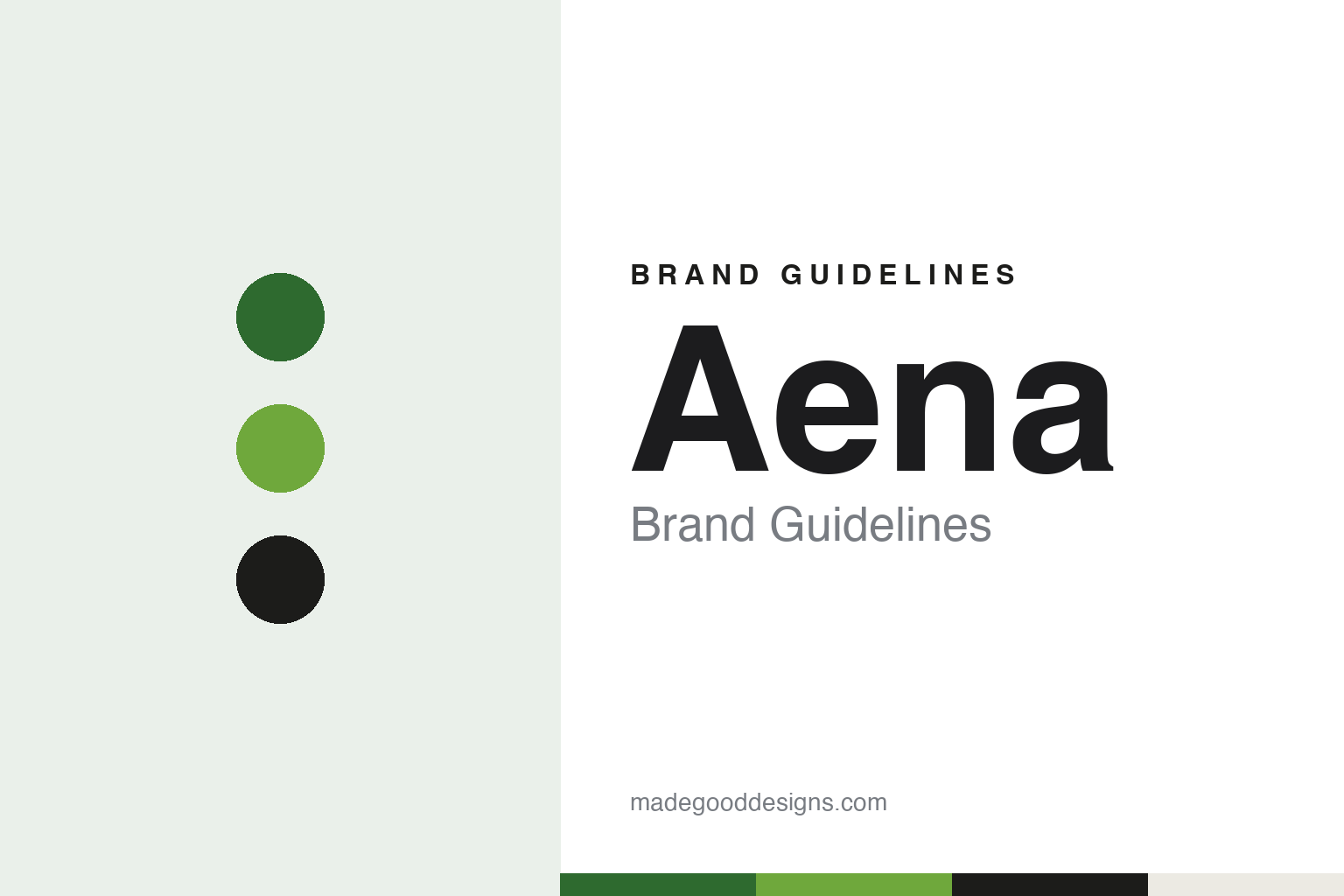
Two constants: a green and black palette and a geometric sans register. Abstract homage — not an Aena asset; no logo, sign or mark is reproduced.
From public body to listed company
A 1991 decree, a 2011 split and a 2015 flotation.
Aena began as a public body. Spain’s budget law for 1990 provided for an entity called Aeropuertos Españoles y Navegación Aérea, and its statute was approved by Royal Decree 905/1991 of 14 June, published in the Boletín Oficial del Estado on 18 June 1991 under the Ministry of Public Works and Transport. Aena says the entity was effectively constituted on 19 June 1991 and began providing airport services on 2 November 1991; Spanish Wikipedia, citing ABC, adds that it took on air navigation services a year later. The acronym AENA therefore joined two jobs under one name: running Spain’s airports and managing the air traffic between them.
Aena dates its first venture abroad to 1997, a concession at Barranquilla in Colombia, and the creation of its international arm, Aena Internacional, to 1998. In the decade from 2000 it carried out three large expansion plans, for Madrid-Barajas, Barcelona and Málaga, and opened airports at Logroño, Albacete, Burgos and Huesca-Pirineos as well as heliports at Ceuta and Algeciras, the company says.
The split came next. A royal decree-law of 3 December 2010 created a state company, Aena Aeropuertos S.A., which took over airport management on 7 June 2011, Spanish Wikipedia says, citing the BOE. In July 2014 a further decree-law renamed the old public body ENAIRE, leaving it with air navigation, and the airport company took back the short historic name Aena. ENAIRE kept 51 per cent. On 11 February 2015 the other 49 per cent was floated on the Madrid stock exchange and Aena joined the IBEX 35 index, Spanish Wikipedia says, citing a same-day report in Expansión.
Colour
Forty-six Spanish airports, then Luton, Brazil and Yorkshire.
At home Aena runs 46 airports and two heliports, from Madrid-Barajas and Barcelona-El Prat to small fields such as El Hierro and Huesca-Pirineos, the company says. Its reach abroad was built in stages. In August 2013 it agreed to buy London Luton, then the fifth-busiest airport in the United Kingdom, with AXA Private Equity’s infrastructure fund as its partner, DFNI reported on 1 August 2013; the airport itself is owned by Luton Borough Council, with the operating concession in private hands. Aena called the purchase a first step towards holding airports it controls rather than minority stakes. Today it holds 51 per cent of the Luton concession, the company says.
Brazil followed. Aena Brasil was born in 2019, the company says, when Aena won a 30-year concession for a group of airports in the north-east, operating from 2020; in 2022 it won eleven more in four states, including Congonhas in São Paulo, which it began running in 2023. In March 2026 its subsidiary Aena Desarrollo Internacional won an auction at the B3 exchange in São Paulo for the concessionaire of Rio de Janeiro-Galeão, subject to approvals, Le Journal de l’Aviation reported on 2 April 2026. Aena took over the concession in early October 2026, with a contract running to 2039, Agência Brasil reported on 13 October 2026. Aena says its Brazilian airports trade under one name, Aena Brasil.
In the United Kingdom, Aena signed a contract in December 2025 to buy 51 per cent of a new holding company, Augusta, covering Leeds Bradford Airport and a stake in Newcastle International Airport; the deal completed on 7 May 2026, The Northern Echo reported on 11 August 2026. Aena also holds stakes in airport companies in Mexico and Colombia, Spanish Wikipedia says. The company says no airport group handles more passengers, a claim Le Journal de l’Aviation repeated in April 2026; for 2019 Aena reported a then-record 275.2 million passengers across its Spanish network.
Typography
How airport operators present themselves.
An airport operator has an unusual design problem: most of the people who meet its brand never think about the company at all. They read its signs. Wayfinding is the core of the identity, and operators typically commission a sign typeface, a pictogram set and a colour code for departures, arrivals, gates and exits, then apply them to everything from motorway approach signs to the backs of check-in desks. The corporate logo often sits quietly in a corner while the directions do the work.
Architecture carries the rest of the image. Operators’ own photography tends to favour terminals at dusk, when glazed façades glow against a darkening sky, long roofs read as clean lines and an apron full of parked aircraft becomes a pattern of lights. Interiors are shown as wide, calm halls rather than queues, and new piers or façades are announced with renderings long before they open.
The numbers come next. Route maps radiating from a single hub, new long-haul destinations and passenger milestones are standard material for press pages and annual reports, because traffic is what airlines, investors and local governments want to see. Alongside them sit pages on sustainability and noise: carbon programmes, noise contour maps, insulation schemes for nearby homes and community funds, often written for neighbours rather than travellers.
Finally, an airport is also a shopping centre and a lounge network. Retail, food and lounge promotions follow a lighter, more commercial register, with seasonal campaigns and partner brands, while investor reports return to a sober corporate grid of charts and tables. The operators in this series show how one company can speak in all of these voices at once: public utility, landlord, retailer and listed or state-owned business.
Aa
A geometric sans — the register of a green wordmark with black lettering. (Specimen set in Outfit, a sans STAND-IN; NOT the Aena logo.)
Aena
From Zimmermann’s 1991 symbol to Mariscal’s green.
The mark has its own history. The original Aena symbol, an “aerodyne” figure, was created by the designer Yves Zimmermann in 1991, when the public body was founded, Europa Press reported on 5 August 2014. That summer, after the split from ENAIRE, the studio of Javier Mariscal, the designer of Cobi, the mascot of the 1992 Barcelona Olympics, redesigned it. The new logo moved from the sky blue of the old mark to a green that Aena sources described as very identifiable with the company, close to the earth and with a clear environmental connotation, with black added for the lettering. The roll-out was to be gradual, from press releases to the SIPA passenger-information screens. ENAIRE, for its part, took a new blue logo by the studio Biográfica, with a simple symbol suggesting an aircraft’s trail.
Gradual proved slow. In June 2023 El Español reported that old “Aena Aeropuertos” marks had still not been fully removed from seven of the busiest airports, among them Madrid-Barajas, Barcelona-El Prat, Palma and Málaga, and that Aena had put out to tender an audit of every remnant: exterior monoliths, bus-lane signs, car parks and building lettering outside; directories, direction signs and furniture inside the terminals. Aena told the paper that in large airports the old marks were often made in materials that are complex to remove.
For a design guide, Aena shows how a state-controlled operator carries one green mark from small island airfields to London Luton and Rio de Janeiro. Compare Heathrow, the London hub, and Aeroporti di Roma, which runs Rome’s airports. For this guide we use a deep green, a leaf green, black and a pale stone with a sans, an unofficial interpretation; no product or logo is reproduced.
Explore & save
Keep Aena’s identity on hand — save it to a board in the Made Good inspiration library.
Aena identity set
Save the Aena green, black and stone palette and the geometric sans register to your own board.