Qafco Brand Guidelines
Qatar’s first large industrial venture, built on gas at Mesaieed.
Aa
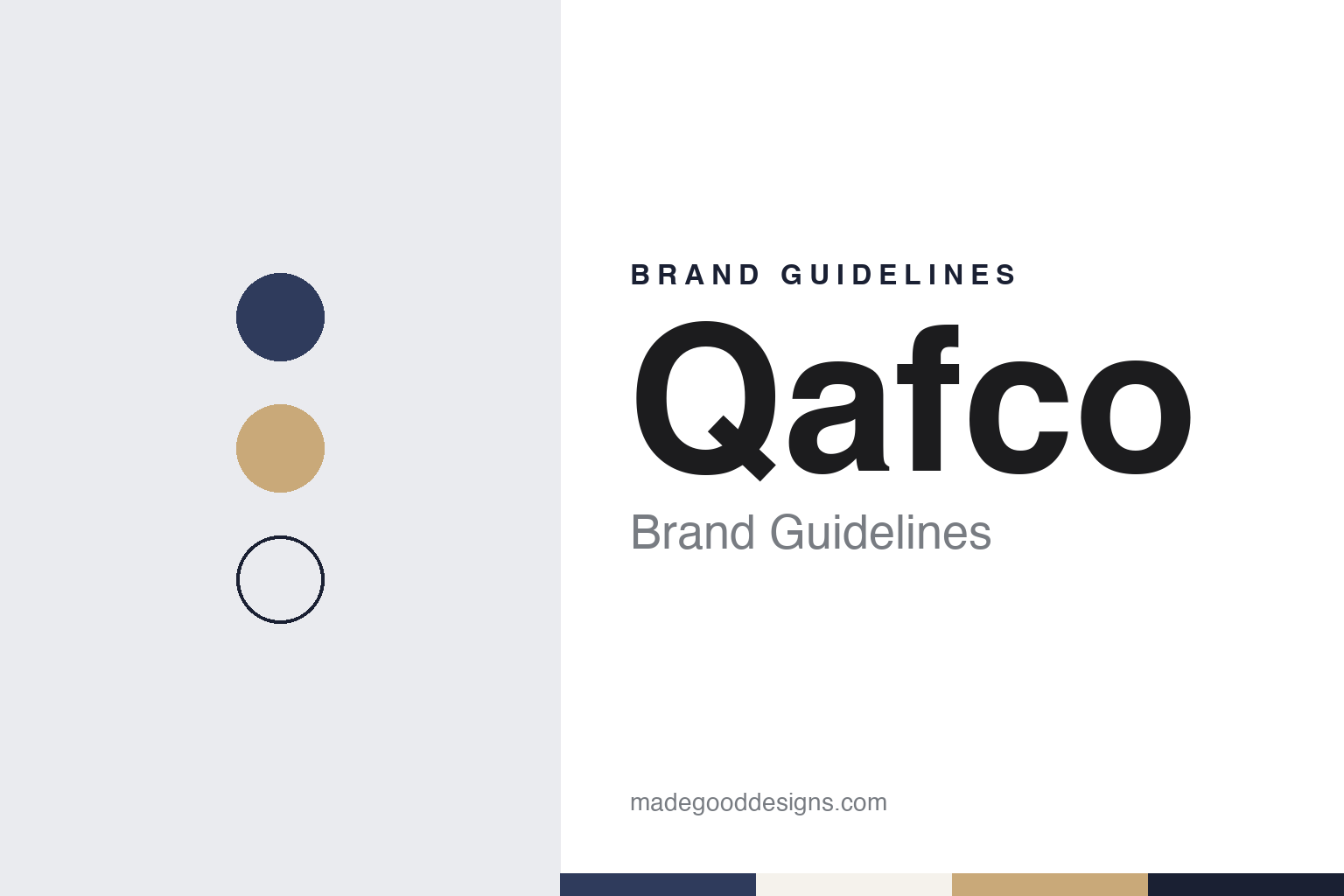
Two constants: a dusk, prill white and sand palette and a geometric sans register. Abstract homage — not a Qafco product or mark; no logo, plant or ship is reproduced.
Qatar Fertiliser Company
A government, a Norwegian partner and two British firms.
Qatar Fertiliser Company — Qafco — was founded in 1969. English Wikipedia’s article on QatarEnergy gives the founders as the Qatari government, Norsk Hydro of Norway, Davy Power and Hambros Bank, joined to make ammonia and urea from the country’s natural gas. The company’s website describes the venture in similar terms, as a joint venture of the Government of Qatar and a number of foreign shareholders, and calls it the country’s first large-scale venture in the petrochemical sector, set up to diversify the economy and use the nation’s gas reserves.
Industries Qatar, the group that owns Qafco today, calls it the oldest member of its group, and says its founding marked the first significant step in Qatar’s programme of industrial diversification. Its first plant was inaugurated in 1973; English Wikipedia gives that plant’s design capacity as 900 tons of ammonia and 1,000 tons of urea a day.
Everything was built in one place: Mesaieed, the industrial city on Qatar’s east coast south of Doha. English Wikipedia describes the complex as a set of integrated trains, each pairing an ammonia unit with a urea unit, alongside a urea formaldehyde unit. The company lists its address at Mesaieed, with an office in Doha’s West Bay.
Colour
Six trains, then a seventh.
The complex grew in stages, each numbered. Industries Qatar says Qafco completed Qafco IV in 2004. Qafco 5 followed, built by a consortium led by Saipem and Hyundai Engineering & Construction, and the same group built Qafco 6, a single urea plant of about 1.35 million tonnes a year that was inaugurated at Mesaieed on 11 December 2012, Gulf Times reported. The paper said Saipem licensed the urea process and Uhde Fertiliser Technology the granulation, a technology also used in Qafco 3 and 4, and that the plant lifted the company’s urea output to 5.6 million tonnes a year. It reported that the opening made Qafco the biggest exporter of urea, with about 15% of globally traded urea.
Qafco’s website today speaks of seven plants, an annual capacity of 3.8 million tonnes of ammonia and 5.8 million tonnes of urea, around 14% of global supply and exports to more than 45 countries; those are the company’s own figures. Its products are ammonia, urea in prilled and granular form, melamine, urea formaldehyde and diesel exhaust fluid. Industries Qatar says Qafco has two subsidiaries, Gulf Formaldehyde Company and Qatar Melamine Company, and that much of the ammonia it makes is used inside the complex as feedstock for urea. The company’s specification sheets give its urea a minimum of 46% nitrogen, as prills of 1 to 2.8 millimetres or granules of 2 to 4 millimetres. Melamine goes mainly into construction, in high-pressure laminates, and also into kitchen utensils and plates, according to Industries Qatar. The urea formaldehyde condensate, UFC-85, is added to urea to strengthen the granules and is used mostly in Qafco’s own urea plants, Industries Qatar says.
A further project was signed on 31 August 2022. QatarEnergy Renewable Solutions and Qafco agreed to build Ammonia-7, a blue-ammonia plant of 1.2 million tonnes a year at Mesaieed, to be operated by Qafco as part of its complex, The Peninsula reported the next day; the engineering contract went to a consortium of thyssenkrupp and Consolidated Contractors Company, and the targeted start-up was the first quarter of 2026.
Typography
Fertiliser makers and their records.
Fertiliser makers sell to two very different audiences at once: farmers and dealers on one side, and industrial buyers, investors and governments on the other. Their public material tends to reflect that split. Green fields, ripening crops and harvest scenes sit beside photographs of mines, process plants, storage domes and port terminals, so that the farm and the factory appear under the same name.
Much of what these companies publish is practical. Crop-nutrition guides, product-grade explainers and nutrient ratios printed as plain numbers, such as an NPK grade written out in full, do a good deal of the identity work. Many makers add agronomy tools, soil-testing services, call centres or field demonstrations for growers, and present them as part of the brand rather than as an extra.
The investor side has its own documents. Annual reports, quarterly statements, sustainability and emissions reports and filings to stock exchanges give these companies a steady, formal voice, often with maps of plants and shipping routes. Capacity figures, new plant projects and joint ventures appear there first, usually dated and attributed, and they are the most reliable record of how a maker has grown.
Distribution is the last layer. Fertiliser reaches farms through dealer networks, cooperatives, regional offices and state channels, and the bag, the dealer sign and the product name are often what a grower actually sees. The guides that follow look at each company through what can be checked: who founded it, who owns it, where it makes its products, how it presents itself and, where it matters, how its name and ownership have changed over the decades.
Aa
A geometric sans — clean, wide and open. (Specimen set in Manrope, a sans STAND-IN; NOT the Qafco logo.)
Qafco
From joint venture to a wholly owned subsidiary.
Qafco’s ownership has been reorganised more than once. Before 2003, Industries Qatar says, the national oil company — then Qatar Petroleum, now QatarEnergy — held interests in Qafco and its sister companies. In April 2003 a reorganisation transferred those interests to Industries Qatar, which was listed on the Qatar Exchange after a public offering later that year. English Wikipedia describes Industries Qatar as a 51% subsidiary of QatarEnergy, with petrochemicals, fertiliser and steel businesses; its other holdings include the polyethylene maker Qapco and Qatar Steel.
For years the Norwegian side kept a share: English Wikipedia’s QatarEnergy and Industries Qatar articles still describe Qafco as a 75:25 venture with Yara, the fertiliser company spun out of Norsk Hydro. More recent sources give a different picture. The Peninsula described Qafco in September 2022 as owned 100 percent by Industries Qatar, and Industries Qatar’s own website says the company, incorporated in 1969 as a joint venture, is currently owned by Industries Qatar alone.
The company states its vision as becoming a leading urea producer by 2030, and it presents itself with stewardship and quality pages alongside its products, naming the International Fertilizer Association’s product stewardship programme. Its name is an acronym of Qatar Fertiliser Company: the company sets it in capitals, QAFCO, as does The Peninsula, while Gulf Times writes Qafco.
For a design guide, Qafco shows how a single industrial site can carry a national name, with each expansion given a number rather than a new brand. Compare Yara, whose predecessor Norsk Hydro helped found it, and Fertiglobe, another Gulf nitrogen exporter. For this guide we use a deep dusk blue, a prill white and a warm sand with a sans, an unofficial interpretation; no product or logo is reproduced.
Explore & save
Keep Qafco’s identity on hand — save it to a board in the Made Good inspiration library.
Qafco identity set
Pin the Qafco dusk, prill white and sand palette and the geometric sans register to your own board.