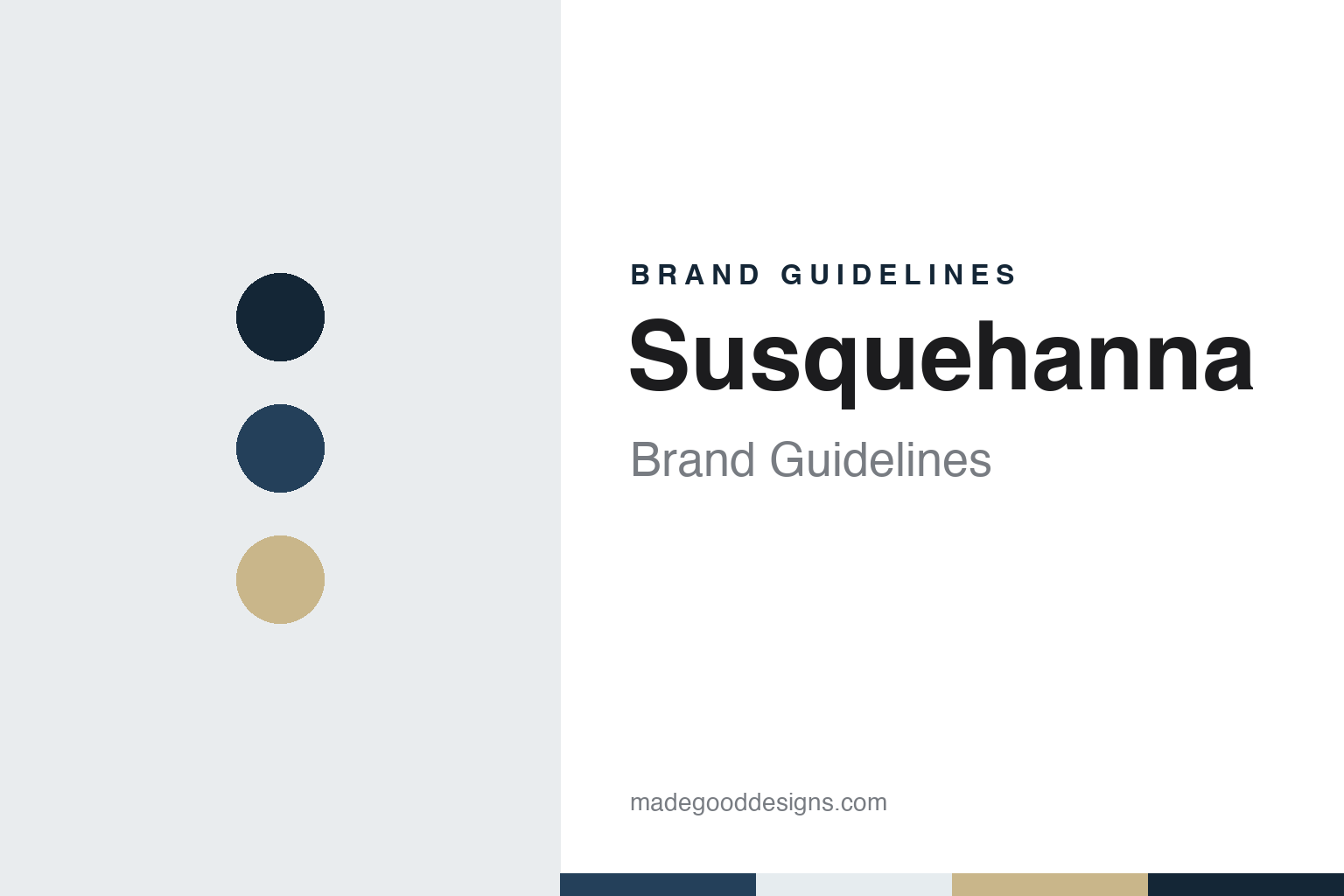
Susquehanna Brand Guidelines
Six card-playing friends, a river name and a trading floor in Philadelphia.
Aa
Two constants: a Susquehanna river slate and sandbar palette and a Bookish serif register. Abstract homage — not a Susquehanna asset or mark; no logo or wordmark is reproduced.
A river name
Six friends, a card table and a trading floor.
Susquehanna was founded in May 1987 by six entrepreneurs, among them Jeff Yass and Arthur Dantchik, according to English Wikipedia. The founders had met in the late 1970s at the State University of New York at Binghamton, where they gathered to play cards, and they named the firm after the Susquehanna River, which flows near their old university. The group is formally Susquehanna International Group, often shortened to SIG, and its headquarters are in Bala Cynwyd, Pennsylvania, just outside Philadelphia.
The company tells the same origin in its own words. In the early 1980s, it says, a group of college friends began trading independently on the floor of the Philadelphia Stock Exchange, using their quantitative skills and their “poker experience” to build strategies, and joined together in 1987 to start what is now Susquehanna. English Wikipedia adds that by October 1988 the firm had 100 employees and was located above the Philadelphia Stock Exchange.
Its business has always centred on options. English Wikipedia describes Susquehanna as a specialist or designated primary market maker in about 600 equity options and 45 index options across several American exchanges, including the Cboe, and says that by the late 1990s it was also trading convertible bonds, commodity options and index options and had become a major market maker in exchange-traded funds. As of 2018, the same article says, it traded about 7% of US ETF volume.
The firm has grown from that Philadelphia floor into an international network. English Wikipedia lists offices in New York, Chicago, San Francisco, Philadelphia, Boston and Stamford in North America, Dublin and London in Europe, Sydney, and Shanghai, Beijing, Hong Kong and Tokyo in Asia. Its institutional broker-dealer, Susquehanna Financial Group, handles order execution and publishes equity research on nearly 200 companies, the same article says.
Colour
Poker, chess and a culture of games.
Susquehanna’s public identity is built around games. Its website says strategy games and decision science are used to teach many new employees, and that this approach “has been fundamental to our success since day one.” It names poker as the game it uses to teach new traders about decision making under uncertainty, comparing the expected value of a hand with the pricing of a trade, and lists chess, esports, the trick-taking card game Wizard and Magic: The Gathering among its favourites. Board-game nights and puzzles around the office, it says, are part of daily life.
The values the company publishes follow the same line: good decision making, teamwork, belonging, a growth mindset, expertise and integrity. Its homepage now calls Susquehanna “a global quantitative trading firm” that applies machine learning and quantitative research to large datasets, and says it has more than 3,500 employees in more than 16 offices. The site speaks mainly to recruits: its menus lead to careers in trading, technology and quantitative research, a blog called Waves and a separate games-and-puzzles site, Raise Your Game.
The group has spread well beyond trading. English Wikipedia records the founding of Heights Capital Management in San Francisco in 1996, the venture-capital arm SIG China in 2005, Susquehanna Growth Equity in 2006, the purchase of the broker G1 Execution Services from E-Trade in 2013, Susquehanna Private Capital in 2017 and Nellie Analytics, a Dublin sports-betting business, in the same year. SIG China had invested in more than 350 companies by 2022, and the venture business expanded to Japan in 2014. The article also records Susquehanna’s early investment in ByteDance, the owner of TikTok, when that company was founded in 2012.
Its newest unit is Susquehanna Predictions. English Wikipedia says the firm announced Wall Street’s first dedicated trading desk for prediction markets in 2024, and the company now describes the unit as bringing market making, research and capital to regulated prediction markets. On 21 January 2026 Miami International Holdings announced it had completed the sale of 90% of MIAXdx, a futures exchange and clearinghouse regulated by the US Commodity Futures Trading Commission, to a joint venture set up by Robinhood in partnership with Susquehanna International Group, keeping 10% itself.
Typography
Design and documentation.
Proprietary trading firms and electronic market makers sell little to the public, so their identities are built for a narrow audience: the students, engineers and researchers they hope to hire, and the institutions they trade with. Their websites read less like consumer marketing and more like careers sites, with pages on departments, open roles, interviewing and benefits placed as prominently as any description of the business.
Recruiting shapes the tone. Jane Street, for example, keeps a Puzzles page that posts a new problem every month or two, and its events include meet-ups built around puzzles and technical talks. Coding challenges, internship programmes and scholarships do similar work, signalling that the firm values problem solving before it values a finance background.
The trading floor is the other recurring image. Firms describe offices in several financial centres and present their floors as places of shared work rather than private desks, while technology pages talk about low-latency networks, compilers and research. Blogs and podcasts carry much of the explanation, letting engineers and researchers speak for the firm instead of an advertising campaign.
The marks themselves tend to be modest: a plain name, a simple geometric symbol or a word set in capitals, used consistently across careers pages, legal notices and the regulated subsidiaries that carry the brand in each market. For designers, the category is a study in restraint, where credibility comes from clarity, consistency and a careful choice of tone rather than from colour or spectacle. The palettes in these guides are our own unofficial interpretations.
Aa
A bookish serif — a firm that teaches through card games. (Specimen set in Source Serif 4, a serif STAND-IN; NOT the Susquehanna logo.)
Susquehanna
A name taken from a river.
The name itself comes from geography. Rather than a founder’s surname or an invented word, the firm took the name of the river near the university where its founders met, according to English Wikipedia, and it still trades as plain “Susquehanna” on its website and in its copyright line. The palette in this guide is our own interpretation.
English Wikipedia also records two court cases. It says a class action led by the California Public Employees’ Retirement System in 2009, against Susquehanna and several other broker-dealers over the handling of client orders, was settled in 2012, and that a spoofing suit filed against Susquehanna and other market makers by Northwest Biotherapeutics in 2022 was dismissed in 2024.
For a design guide, Susquehanna shows how a trading firm can build an identity from a place name and a teaching culture rather than from consumer marketing. Compare Optiver, another options market maker, and Cboe, one of the exchanges where it makes markets. For this guide we use a river slate, a pale mist and a sandbar tone with a serif, an unofficial interpretation; no product or logo is reproduced.
Explore & save
Keep Susquehanna’s identity on hand — save it to a board in the Made Good inspiration library.
Susquehanna identity set
Pin the Susquehanna river slate and sandbar palette and the Bookish serif register to your own board.