Mercuria Brand Guidelines
The Geneva trader founded in 2004 that bought a JPMorgan commodities unit.
Aa
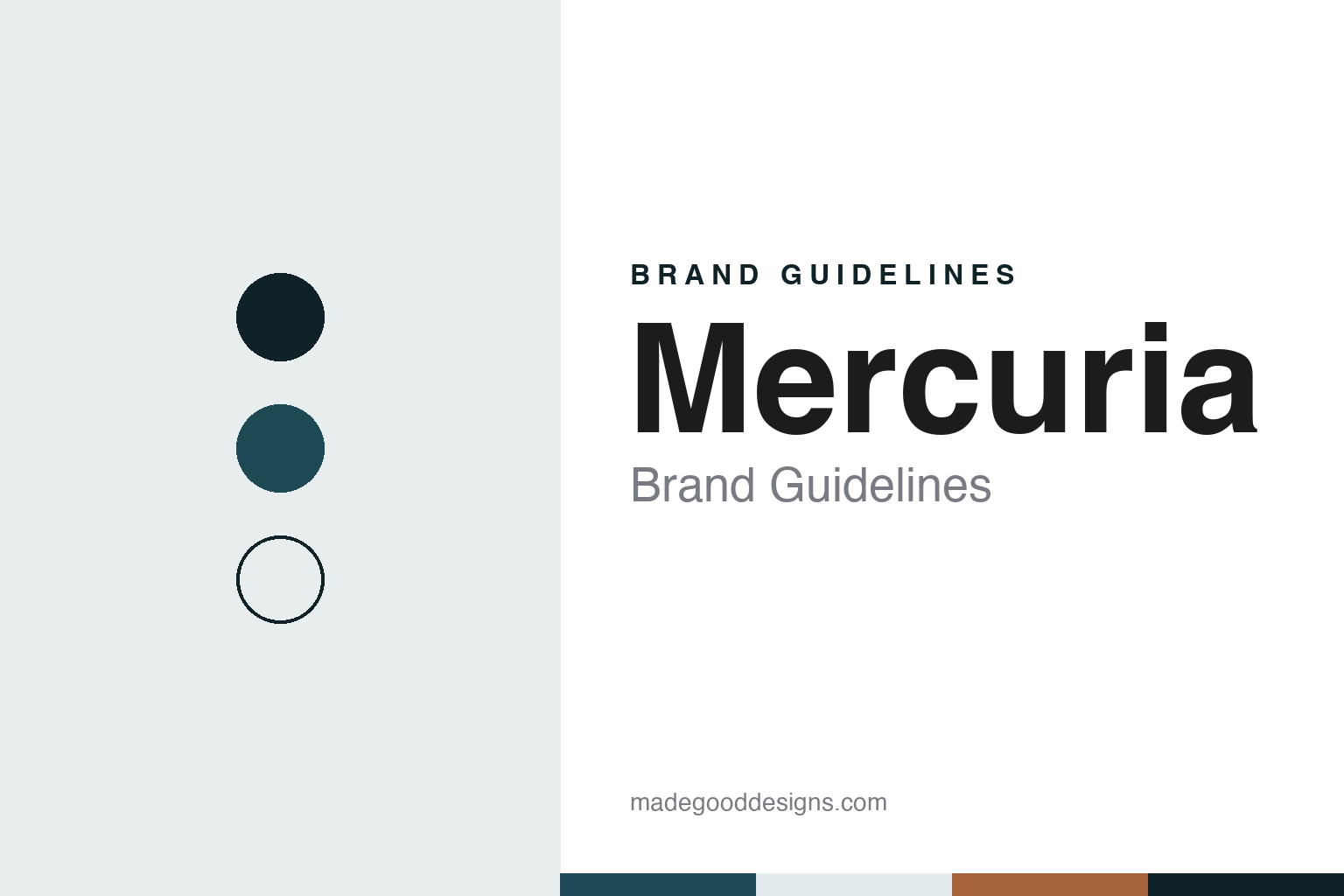
Two constants: a Mercuria petrol blue and copper palette and a Rounded grotesque register. Abstract homage — not a Mercuria product or mark; no logo or globe is reproduced.
Geneva, 2004
Two Swiss traders start their own house.
Mercuria was founded in Geneva in 2004 by two Swiss traders, Marco Dunand and Daniel Jaeggi, the company says. By its account the two have worked together for nearly 40 years, beginning their careers at Cargill International and then moving to trading roles at Goldman Sachs’s J. Aron unit, Salomon Brothers and Sempra Energy before starting Mercuria. English Wikipedia describes them as executives of Phibro, the commodities trading firm later sold by Citigroup to Occidental Petroleum, at the time they founded it.
English Wikipedia also ties the company’s start to an older business: it says Mercuria took control of the J&S Group, an oil trading company named after two Polish businessmen who joined Mercuria as founding shareholders and, it says, remain shareholders. The company’s own history page names only the two Swiss founders.
For its first years Mercuria was an oil trader. English Wikipedia says it concentrated on oil until 2007, then widened into natural gas and LNG, power, biodiesel, base metals and agricultural products. Geneva has been its main hub since the company was founded, it says, and it now gives its reach as more than 50 countries on five continents, with more than 1,400 employees of more than 65 nationalities in over 30 locations. It describes itself as “independent and privately owned by our founders, employees and a group of strategic investors.” As it grew, English Wikipedia says, it hired traders and investment staff from Morgan Stanley, Goldman Sachs, the Louis Dreyfus group and Electrabel. By 2017 it was moving about 1.5 million barrels a day of crude oil and oil products, the same source says, and in April 2024 Bloomberg reported that it was preparing to trade in Japan’s physical power market, according to English Wikipedia.
Colour
Buying a bank’s commodities desk.
Growth came partly through purchases. In November 2010, English Wikipedia says, Mercuria bought MGM International Group from Morgan Stanley. The larger step came in 2014, when it bought part of JPMorgan Chase’s physical commodities trading business, according to English Wikipedia; German Wikipedia places the purchase in 2013. The company lists the JPMorgan trading unit among its main acquisitions, alongside Noble Group’s US gas and power business and the Aegean Marine Petroleum Network.
The Aegean purchase gave it a fuel-supply arm. After Aegean Marine’s reorganisation, English Wikipedia says, Mercuria acquired the business in 2019 and restructured it as Minerva Bunkering, a physical supplier of marine fuels; the company describes Minerva as its wholly owned bunkering and maritime subsidiary. English Wikipedia also records that the Chinese chemicals group ChemChina took a 12 per cent stake in Mercuria in January 2016.
Storage is the other strand. English Wikipedia names Vesta Terminal Services, which runs port logistics, storage and processing facilities in the Netherlands, Estonia, Belgium and Germany, and says Mercuria sold half of its terminals to Sinopec in a joint venture in 2013. It lists upstream interests in Argentina, Canada and the United States, oil terminals in Europe and China, and biofuel plants in Germany and the Netherlands. In Canada its subsidiaries include Navitas Energy.
The company now presents its strategy around the energy transition. It says it has committed half of its investments to the transition, in projects ranging from renewables and biofuels to technology metals and electric-vehicle infrastructure, and that it supports an ocean data programme with the foundation HUB Ocean.
Typography
Design and documentation.
Commodity trading houses sit between the producers of oil, gas, metals and grain and the refineries, smelters, utilities and food makers that use them. Many are privately held, some by their own staff, and few sell anything under their own name to the public. Their brands are written for a narrow audience: lenders, state oil companies, mining partners, regulators and the people they hope to hire.
That audience shapes how they look. Their websites tend to be sober and spare, with short statements of purpose, a handful of photographs and plain navigation by commodity: crude oil and products, gas and power, metals and minerals, agricultural goods. The pictures that do appear are usually of the physical chain rather than of people at screens: tankers at sea, storage terminals and tank farms, ports, rail lines, smelters and grain silos. Trading floors, the image most people associate with the business, appear only rarely.
Much of the identity work is done in documents. Annual reviews and volume statements explain what a physical trader does and how much it moved in a year; responsibility, sustainability and transparency reports set out policies on emissions, human rights and payments to governments; and ethics and compliance pages sit prominently in the main menu. For several of these companies, those pages also have to address court cases, regulatory penalties and settlements that form part of their public record.
This guide looks at each house in turn: where and when it was founded, who owns it, what it trades and which assets it holds, and what independent, dated sources record about it. Where a fact rests only on a company’s own statement, it is marked as such. The palettes and typefaces here are our own unofficial interpretations, not the companies’ brand assets.
Aa
A rounded grotesque for a trader that describes itself in plain words. (Specimen set in Manrope, a sans STAND-IN; NOT the Mercuria logo.)
Mercuria
Beyond the trading floor.
Two recent moves take Mercuria further into owning and operating businesses. In October 2026 the company announced that the Shell-brand fuels business in Argentina, previously run by the Brazilian group Raízen, now operates as Sígnar Energy, a Mercuria company. By the company’s account Sígnar runs the Dock Sud refinery near Buenos Aires, a lubricants plant in the city, aviation fuel facilities at Ezeiza and Aeroparque airports, logistics terminals and a network of 892 Shell service stations, under a licence to use the Shell brand. Mercuria said it expected two Argentine partners to join shortly as minority shareholders in the holding company.
The second move is still pending. On 1 July 2026 Mercuria and the Italian energy group Eni announced an agreement to set up a 50-50 joint venture for global energy trading, covering oil, gas, LNG, biofuels and related logistics, run independently through a holding structure with global trading hubs, Zawya reported the next day. Completion was subject to regulatory approvals and customary conditions, and the Russian business agency AK&M still described it that way on 9 November 2026; the venture had not been completed at the time of writing.
Mercuria’s public face is plain. Its website leads with the line “Connecting markets. Advancing the energy transition,” sets out regional hubs in Europe, Asia Pacific and the Americas, and publishes daily and monthly price information alongside a corporate social responsibility report.
For a design guide, Mercuria shows how a privately owned trader can describe itself through its founders, its acquisitions and its stated commitments rather than through products. Compare Gunvor, another Geneva trading house, and Glencore. For this guide we use a deep petrol blue, a copper and a pale mist with a sans, an unofficial interpretation; no product or logo is reproduced.
Explore & save
Keep Mercuria’s identity on hand — save it to a board in the Made Good inspiration library.
Mercuria identity set
Pin the Mercuria petrol blue and copper palette and the Rounded grotesque register to your own board.