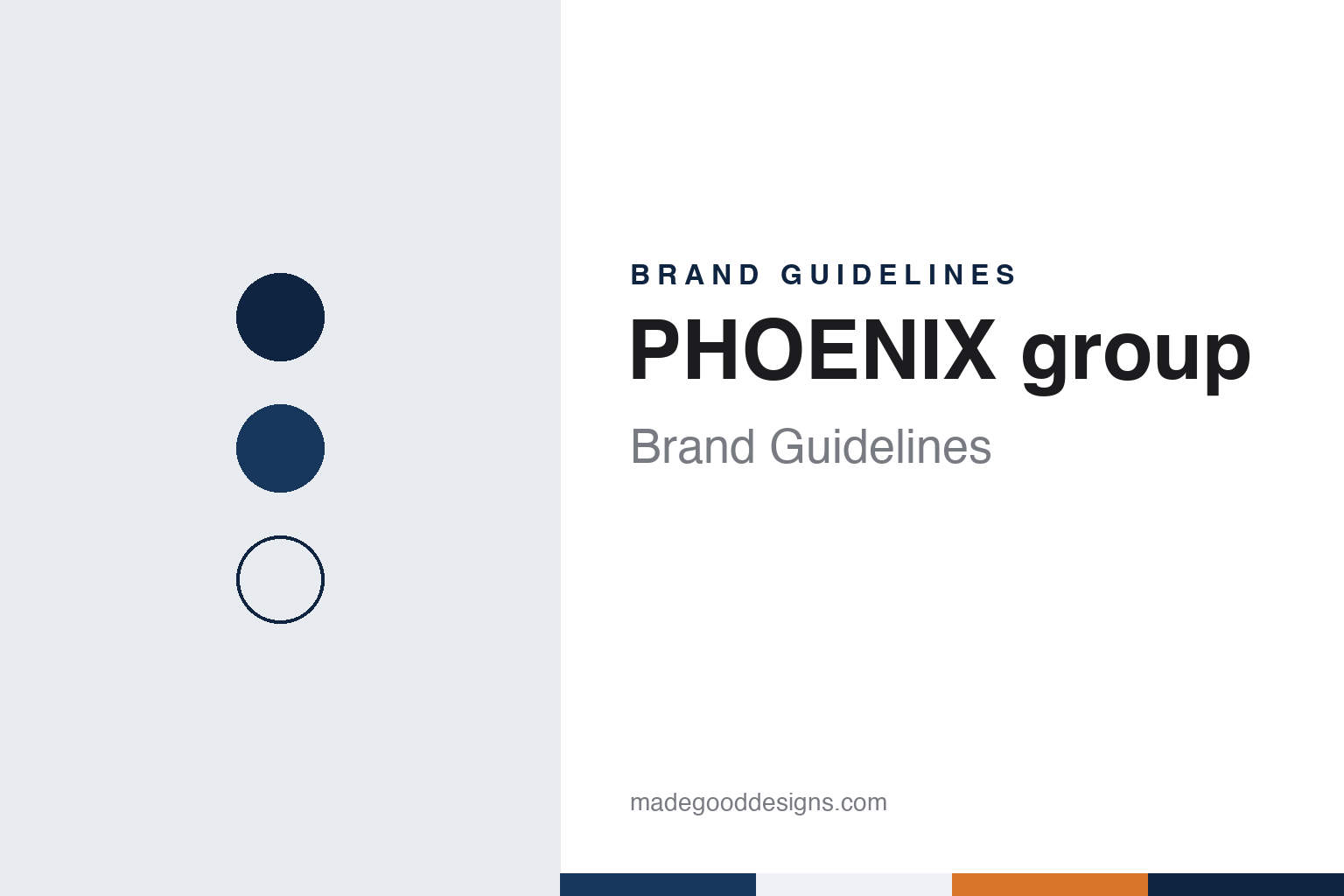
PHOENIX group Brand Guidelines
The Mannheim wholesaler built from five regional houses.
Aa
Two constants: a navy, grey and orange palette and a grotesque sans register. Abstract homage — not a PHOENIX group asset; no logo, pack or pharmacy sign is reproduced.
Five houses, one name
A merger worked out at weekend meetings.
PHOENIX group is a pharmaceutical wholesaler and pharmacy operator based in Mannheim, in south-west Germany. Its parent company is PHOENIX Pharma SE, and the group belongs to the Merckle family’s group of companies, German Wikipedia says. The company writes its own name in capitals, and this guide follows that spelling.
The group dates from 1994. In the early 1990s the entrepreneur Adolf Merckle bought into a series of regional pharmaceutical wholesalers. According to German Wikipedia and the company’s own history, he then brought five of them together: F. Reichelt AG of Hamburg, Otto Stumpf GmbH of Berlin, Ferd. Schulze GmbH of Mannheim, Otto Stumpf AG of Nuremberg and Hageda AG of Cologne. The new business was called PHOENIX Pharmahandel Aktiengesellschaft & Co.
The structure was unusual. The pharmacy trade paper Apotheke Adhoc, writing for the company’s 25th anniversary in April 2019, explained that the operating-lease contracts were signed on 18 January 1994: the Mannheim wholesaler Ferd. Schulze, wholly owned by Merckle, was turned into PHOENIX, while the other wholesalers leased their branches and customers to it and kept stakes in the new company. Several of the old firms, some of them listed on the stock exchange, carried on as property and holding companies for years afterwards.
The same paper described how the plan was worked out at weekend meetings with Merckle, and how the lawyer Bernd Scheifele, then an adviser, became the first chief executive. Scheifele later chaired the company’s supervisory board, a role the company still gave him in October 2025. Reimund Pohl, who came from Hageda, took over as chief executive in 2005, Apotheke Adhoc reported.
In April 2017 the holding company PHOENIX Pharma SE was founded in Mannheim, and Reichelt, Stumpf and Hageda contributed their stakes in PHOENIX to it, Apotheke Adhoc reported; the company said at the time that the step set the course for its future as a family business.
Colour
From German wholesale to a European network.
PHOENIX began expanding abroad almost at once. In 1995, the company says, it took a majority in the northern Italian wholesaler Comifar, a 60 per cent holding in the Dutch wholesaler ACF and a majority in a Hungarian wholesaler. In 1997 it took over the Austrian company Hestag, and its French business, Schulze Pharma France, was renamed PHOENIX Pharma.
Britain followed in 1998, when PHOENIX bought the regional wholesalers L. Rowland & Co. and Philip Harris Medical; the Rowlands estate then had about 70 pharmacies, the company says. In 2000 it took over the Dutch company Brocacef and entered Switzerland through a joint venture with Amedis. In 2004 it gained all the shares in the Finnish group Tamro, which was then delisted from the Helsinki stock exchange; the company calls it the largest acquisition in its history at that point. Croatia, Slovakia, Bulgaria, the Czech Republic, Serbia and Romania were added over the following years, Romania in 2018 through the wholesaler Farmexim and the Help Net pharmacy chain.
In 2009, during a refinancing, the company became PHOENIX Pharmahandel GmbH & Co KG, it says, and in 2010 it issued its first bond. In 2016 Brocacef took over about 500 Mediq pharmacies in the Netherlands, the German pharmacists’ paper DAZ.online reported in June 2016.
The largest step came in 2022. In November that year PHOENIX completed its purchase of several country businesses of McKesson Europe, DAZ.online reported, bringing it into Belgium, Ireland, Portugal and Slovenia and adding to its businesses in France and Italy. The company calls this the largest acquisition in its history. In 2023, it says, the 32 McCabes Pharmacy shops in Ireland joined its 82 LloydsPharmacy branches there under the McCabes name.
In October 2025 the company described itself as having 210 logistics sites across 29 countries and almost 3,300 pharmacies of its own. Its chief executive was Sven Seidel; two new members, Joachim Sowada and Wolfgang Wallisch, joined the executive board on 1 February 2026, the company announced.
Typography
Design and documentation.
Pharmaceutical wholesalers sit between the companies that make medicines and the pharmacies, hospitals and clinics that hand them out, so their public image is mostly an image of movement. The pictures these companies tend to show are long automated warehouse aisles, conveyor lines carrying plastic totes, and high racks of shelving, with staff in high-visibility vests picking orders between them. The aim of that imagery is to show scale and order rather than any single product.
The second recurring scene is the road. Fleets of liveried vans and temperature-controlled trucks carry the company name through towns and onto motorways and are often the most visible sign of a wholesaler on the street. Close-ups of insulated cold-chain boxes, data loggers and handheld barcode scanners carry the same message at a smaller size: goods are tracked from shelf to doorstep.
The third scene is the pharmacy counter. Because many wholesalers also run pharmacy networks, franchise banners or buying groups, their brochures often show a pharmacist behind a counter talking with a customer, which gives a logistics business a human face. These banners usually carry their own names and colours, separate from the parent company, so one wholesaler can stand behind several identities on the high street.
Beyond that, the visual record is corporate: trade-fair stands, investor presentations and annual reports with supply-chain diagrams of arrows linking factories, distribution centres and pharmacies. For a design study, the useful question is how one identity can work on a lorry side, a carton label, a pharmacy sign and a screen at the same time.
Aa
A plain grotesque sans for a company that writes its name in capitals. (Specimen set in Archivo, a sans STAND-IN; NOT the PHOENIX group logo.)
PHOENIX group
A wholesaler that also became a pharmacy brand.
PHOENIX is a wholesaler first, but much of its public face is retail. In 2011 it announced BENU, a pharmacy brand for several European countries, starting in the Netherlands, and in 2012 it described a new store concept with its own shop fittings and ways of presenting goods, the company says. In 2019 the company opened its 2,500th BENU pharmacy, in Prague, and in 2023 BENU was launched in Italy, with concept stores in Milan and Bologna. German Wikipedia lists the group’s pharmacy names as BENU, Apotek 1, Rowlands Pharmacy, HelpNet and Lloyds.
The company has also added brands for the pharmacies it supplies. In 2017 it introduced LIVSANE, which it calls its first Europe-wide category brand for pharmacies, sold through independent pharmacies in its partnership programmes and through BENU. In Germany it launched the app “deine Apotheke” with its subsidiary ADG in 2018 and, with partners, the health platform gesund.de in 2020, the company says. Since 1996 it has awarded a pharmaceutical science prize for university research in German-speaking countries, German Wikipedia says. In 2025, the company says, it opened a clinical trials hub in the Netherlands.
The company’s signature line is “We deliver health.” Its anniversaries are kept at the Mannheim headquarters, where the 25th was marked in April 2019, Apotheke Adhoc reported. The group’s colours and typeface are not described in the sources used here, so the palette below is our own.
For a design guide, PHOENIX group shows how a wholesaler assembled from regional houses can build a single name and then a pharmacy brand on top of it. Compare Boots, a pharmacy name with long roots in Britain, and McKesson, whose European businesses PHOENIX partly took over. For this guide we use navy, grey and an orange with a sans, an unofficial interpretation; no product or logo is reproduced.
Explore & save
Keep PHOENIX group’s identity on hand — save it to a board in the Made Good inspiration library.
PHOENIX group identity set
Pin the PHOENIX group navy, grey and orange palette and the grotesque sans register to your own board.